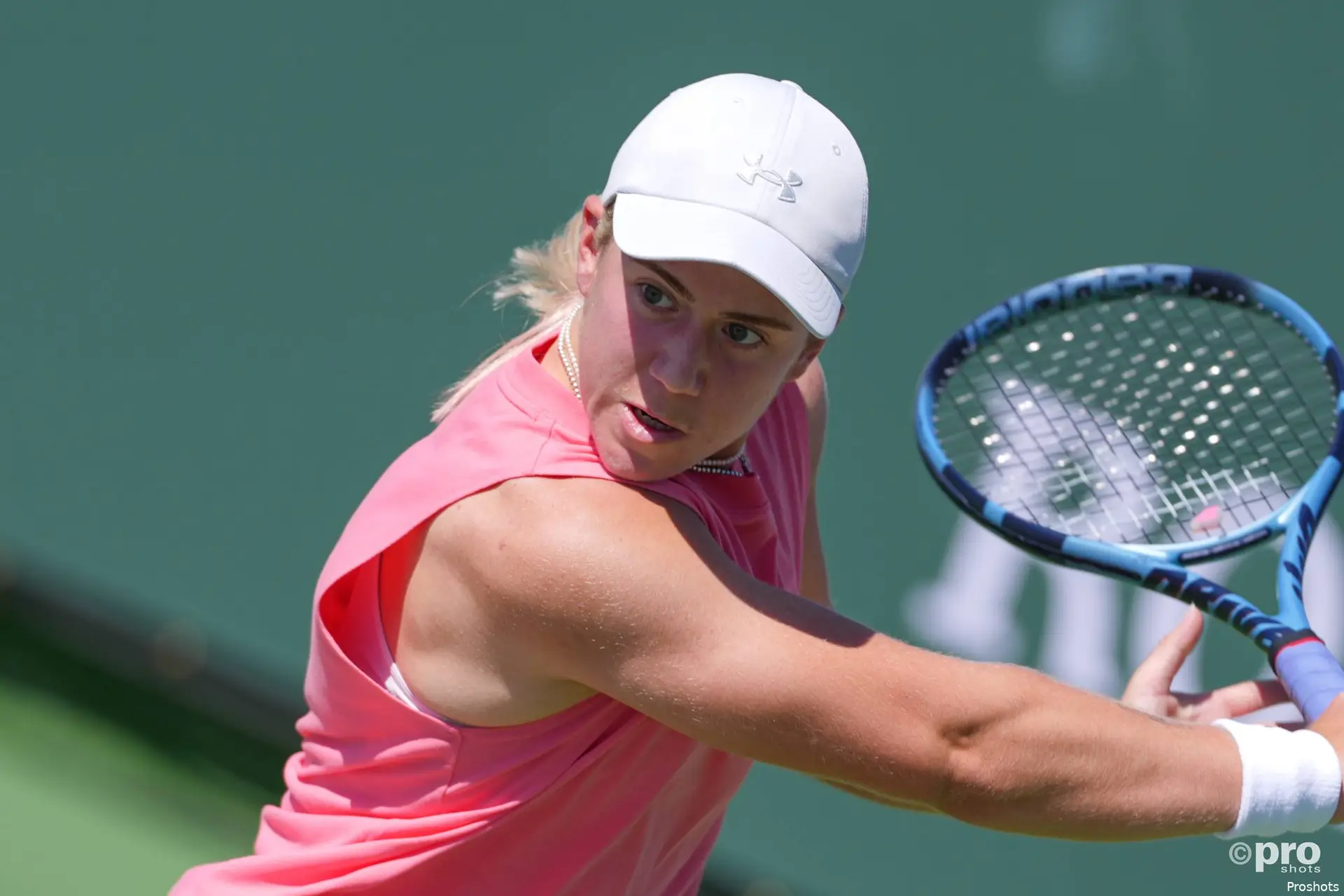
Sonay Kartal hadn't played a tour-level match since retiring injured against Elena Rybakina at Indian Wells in March. Six months, a back injury, and one Billie Jean King Cup defeat later, she's won two matches on her comeback in Beijing, beating Wang Xinyu 6-3, 6-2 to reach the third round of the China Open.
Waiting for her there is Alina Charaeva — the Armenian qualifier-turned-giant-killer who, two days ago, became the lowest-ranked player since 1975 to beat a reigning world No. 1, sending Rybakina out in her very first match as the top seed.
That's a genuinely strange collision of storylines on paper. But the more interesting story isn't really about Charaeva at all. It's about what Kartal's ranking looked like the day she walked into this draw, and what it's about to look like in a week's time — because almost nowhere else on tour does the gap between a player's ranking and her actual level get exposed as clearly as it has for Kartal in Beijing this week.
At last year's China Open, Kartal reached the quarterfinals, meaning a result before that round would have cost her ranking position. She has already absorbed part of that drop and currently sits at No. 166 in the live rankings. Her next challenge will be against a player outside the top 100, and even the round of 16 looks like a realistic possibility, with world No. 27 Marie Bouzkova or the unpredictable Qinwen Zheng — currently No. 54 — potentially waiting there.
A protected ranking doing exactly what it's designed to do
Kartal entered this tournament ranked world No. 129. She did not enter it as world No. 129. The China Open's own entry list shows her listed alongside wildcards and qualifiers under a separate heading: protected ranking, the mechanism that lets an injured player use the ranking she held before she got hurt to gain direct entry into a draw her current number wouldn't otherwise reach.
The number behind that protected entry tells its own story. In the weeks before her retirement against Rybakina, Kartal was floating in the low 50s — she'd cracked the top 50 in February, having reached a career-high No. 44 the previous July off the back of a Wimbledon fourth round and her first WTA 1000 quarterfinal, right here in Beijing. A 96-draw event like this one typically needs a ranking somewhere in that range for guaranteed direct acceptance. No. 129 does not get you into a WTA 1000 main draw. No. 50-something does, assuming it's frozen in time by the rules governing injury.
That's the real headline buried under the Charaeva matchup: protected ranking isn't a loophole, it's the tour explicitly deciding that a six-month injury shouldn't erase a level a player had already proven she could play at. Without it, Kartal would most likely have been stuck trying to qualify through ITF and WTA 125 events for months, rebuilding from close to scratch against players well below the level she was beating in March. Instead, she's two wins into a WTA 1000 main draw, facing the player who just eliminated the world No. 1.

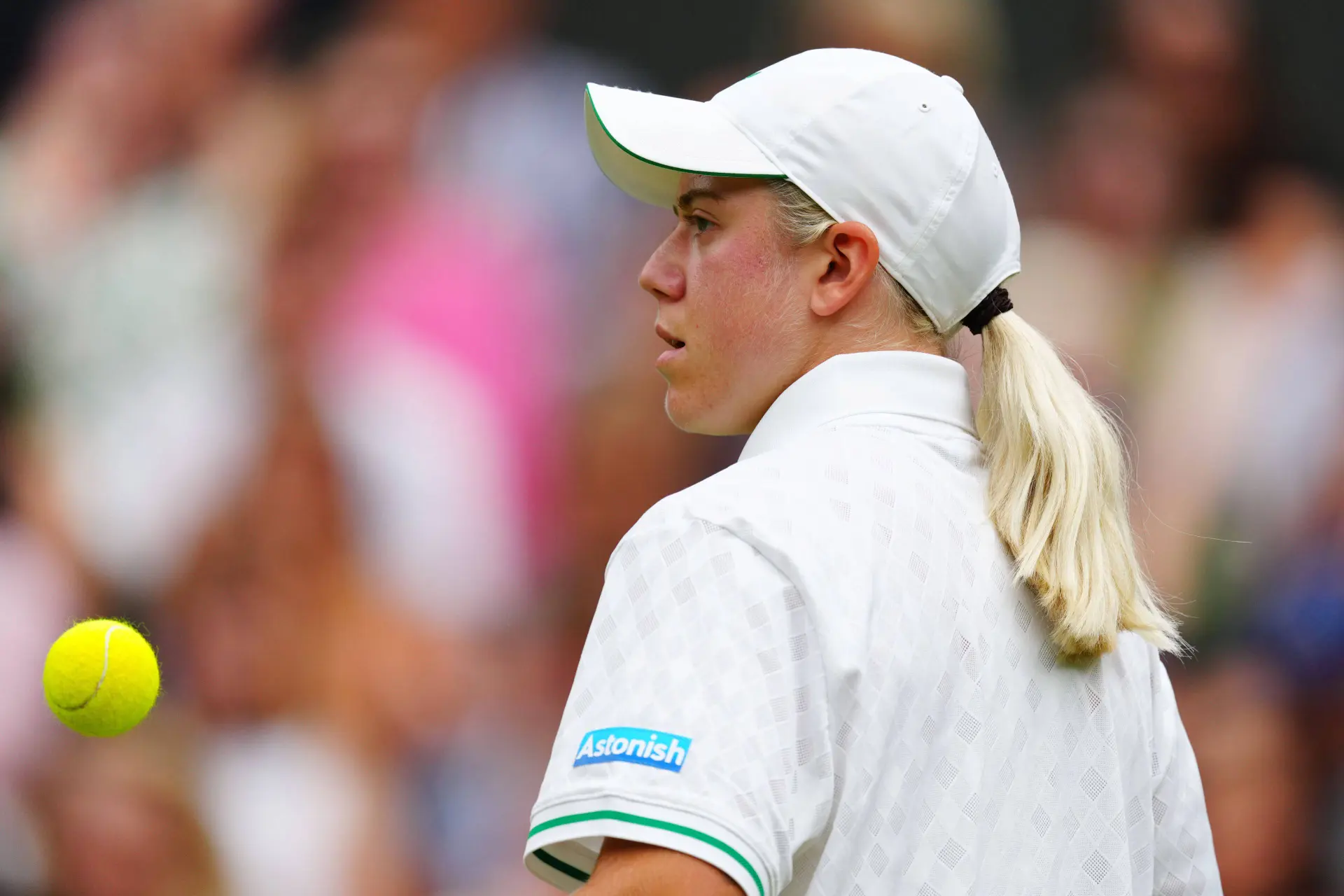
Kartal at Wimbledon.
The points she's defending — and the ones she technically isn't
Here's where it gets genuinely odd, in a way that says something about how blunt the ranking system can be. Last year's Beijing run is the best WTA 1000 result of Kartal's career: she beat 14th seed Daria Kasatkina, Eastbourne champion Maya Joint, Alycia Parks, and then fifth-seeded Mirra Andreeva in the fourth round, before finally losing to Linda Noskova in the quarterfinals. That result is worth 215 ranking points — by far the single biggest number sitting in her 52-week total.
You'd assume, reasonably, that this week is about defending those 215 points directly. It isn't, quite. Because this year's China Open falls a week later than last year's did, the WTA's own ranking calculations route around that gap, meaning Kartal's "points defending" obligation for this specific week is pegged to a much smaller WTA 125 result from October 2025 instead of the Beijing quarterfinal.
The 215 points from last year's run are still on their way out of her ranking — they just age off on a different calendar date than the one everyone assumes, almost entirely disconnected from how she actually performs against Charaeva.
The practical upshot is that nearly everything Kartal earns in Beijing this week is pure upside rather than defense. A No. 129 ranking with six months of inactivity baked into it has very little left to protect. Beat Charaeva and she's already banked more ranking currency than a routine week should produce for a player coming off a comeback win; go deep, and the comparison to last year's run becomes less of a defense and more of a genuine do-over, built from a number that had nowhere to go but up.
Sonay Kartal's 2026, by the numbers
| Moment | Ranking |
| Mid-February 2026 | No. 50 |
| 11 March 2026 (retires hurt vs. Rybakina, Indian Wells) | No. 54 |
| 22 September 2026 (Billie Jean King Cup return, loses to Bouzkova) | No. 129 |
How far can she actually climb
Nobody can hand you an exact number here, because a single ranking jump depends on what everyone else around her does in the same window, but the scale of the opportunity is real. A third-round finish alone nets a modest points bump; matching last year's quarterfinal again — beating Charaeva, then a round-of-16 opponent — would mean banking another 215-point result on a ranking that currently has almost nothing recent propping it up. That's the kind of single-tournament swing that can move a player 40 or 50 places inside a fortnight when the base ranking is this thin.
For now, Kartal is No. 166 in the live rankings due to the points from last year's China Open coming off, and reaching the round of 16 would move her close to No. 140. The top 100 would still have to wait, however, as Kartal would need to reach at least the semifinals in Beijing — three more wins — to put herself in that conversation.
The path would be difficult. After Charaeva, she could face Zheng or Bouzkova, with a potential quarterfinal against Elina Svitolina or Belinda Bencic — or even Maria Sakkari, who are all in the same quarter.
It's a difficult route, but a possible one for a player who already defeated a top-five opponent in Andreeva at this same tournament last year.

Why Beijing specifically has become such a strange tournament for her
There's a pattern here that's easy to miss if you only look at the calendar once. This city, specifically, is where Kartal produced her best-ever WTA 1000 result and is now the site of her comeback after the longest injury layoff of her career. Beijing isn't just another stop on the Asian swing for her; it's become the one tournament where her ceiling and her floor have both been tested in consecutive years.
After six months away from the courts, it will be vital for the Brit to show that she can stay physically fit through long tournaments and then remain competitive across several consecutive weeks. The reality is that Beijing is becoming a stage where Kartal has shown she can particularly perform, and it is precisely the kind of result she needs after such a long time away from the tour.
She is already No. 102 in the WTA Race, and Kartal will be looking to finish the year inside the top 100 at the very least, although her place in the Australian Open is already secured thanks to her protected ranking.
The opportunity the Asian swing specifically creates
Returning during the Asian swing, rather than easing back in at a smaller clay-court 250 in the spring, is itself a deliberate bet. The swing carries two WTA 1000 events inside three weeks, meaning the points on offer for any kind of run are substantially larger than almost anywhere else a comeback could be staged. For a player trying to rebuild a ranking from close to nothing, that concentration of high-value points in a short window is close to the best-case scenario the calendar offers.
Read also

It's also, fittingly, a stretch of tennis defined this month by exactly the kind of chaos that creates opportunities for players outside the top 100. Rybakina losing her first match as world No. 1 to a woman ranked 118th isn't just a shocking headline; it's a reminder that the Asian hard courts, late in a long season, are where fatigue and unfamiliar conditions can level a draw that looks top-heavy on paper.
A returning player with nothing to defend and genuinely fresh legs is not the worst profile to have in a week like that.

Cristhián AvilaTennis Journalist
Cristhián Ávila is a tennis journalist based in Santiago, Chile, and has been part of the TennisUpToDate team since early 2023. He covers the ATP and WTA Tours as well as all four Grand Slams, producing breaking news, match reports, analysis, and regular liveblogs from major tournaments.
His reporting combines statistical analysis with clear explanation, helping readers understand tactical developments, player form, and broader storylines across the tour. Working fluently in both Spanish and English, Cristhián collaborates with an international editorial team and contributes to comprehensive global coverage. As part of his work, he has conducted interviews and media interactions with leading figures in the sport, including Caroline Wozniacki and John McEnroe.
In his journalism, Cristhián places strong emphasis on careful sourcing, editorial accuracy, and updating articles promptly when new, verified information becomes available. His coverage is grounded in research, context, and direct engagement with professional tennis.
claps 0visitors 0
Just In

Popular News



Latest Comments
- Does Sinner need that 4.5 mil? I doubt it. He can make that with three modelling gigs!😅🤣Rapunzel21-10-2026
- Did "People Magazine" purchase this website? This nonstop storyline is bullshit.
 mandoist21-10-2026
 - Listen... this is of no concern to anyone but these two. Deal with your own issues -- most of us have our own. Thanks, media, for these insignificant follow-ups which are meaningless.mandoist21-10-2026
- This is so very very sad, for all three of them. I truly thought they had an unbreakable bond, but life throws up so many differing challenges. Having your homeland suffering in such a terrible way, makes happiness lose out to guilt as well. Our thoughts are with them. X💔bjsexton20-10-2026
- I have lost all respect for Svitolina! Could she not have waited until he had played at the Paris Masters!!! She is selfish and don't give a damn about Gael. That is NOT how love is demonstrated Elina!!Rapunzel19-10-2026
- Perhaps convenient tennis tour sex is not a strong enough experience in which to base a marriage?mandoist19-10-2026
- Fight the Good Fight... Tennis (sports in general) need more Humans such as yourself.mandoist18-10-2026
- When is WTA going to mandate Genetic Testing (DNA) ???mandoist18-10-2026
- Hey, Dan... you just wake up from a coma? Regardless -- Thanks for the comedy this morning!mandoist18-10-2026
- Two Things: 1. Stop allowing these Spoiled Trust-Fund Elitists to behave badly. Your little hand-slaps do not deter them. 2. STOP the incessantly annoying "towel wiping" nonsense!!!!mandoist15-10-2026

Loading