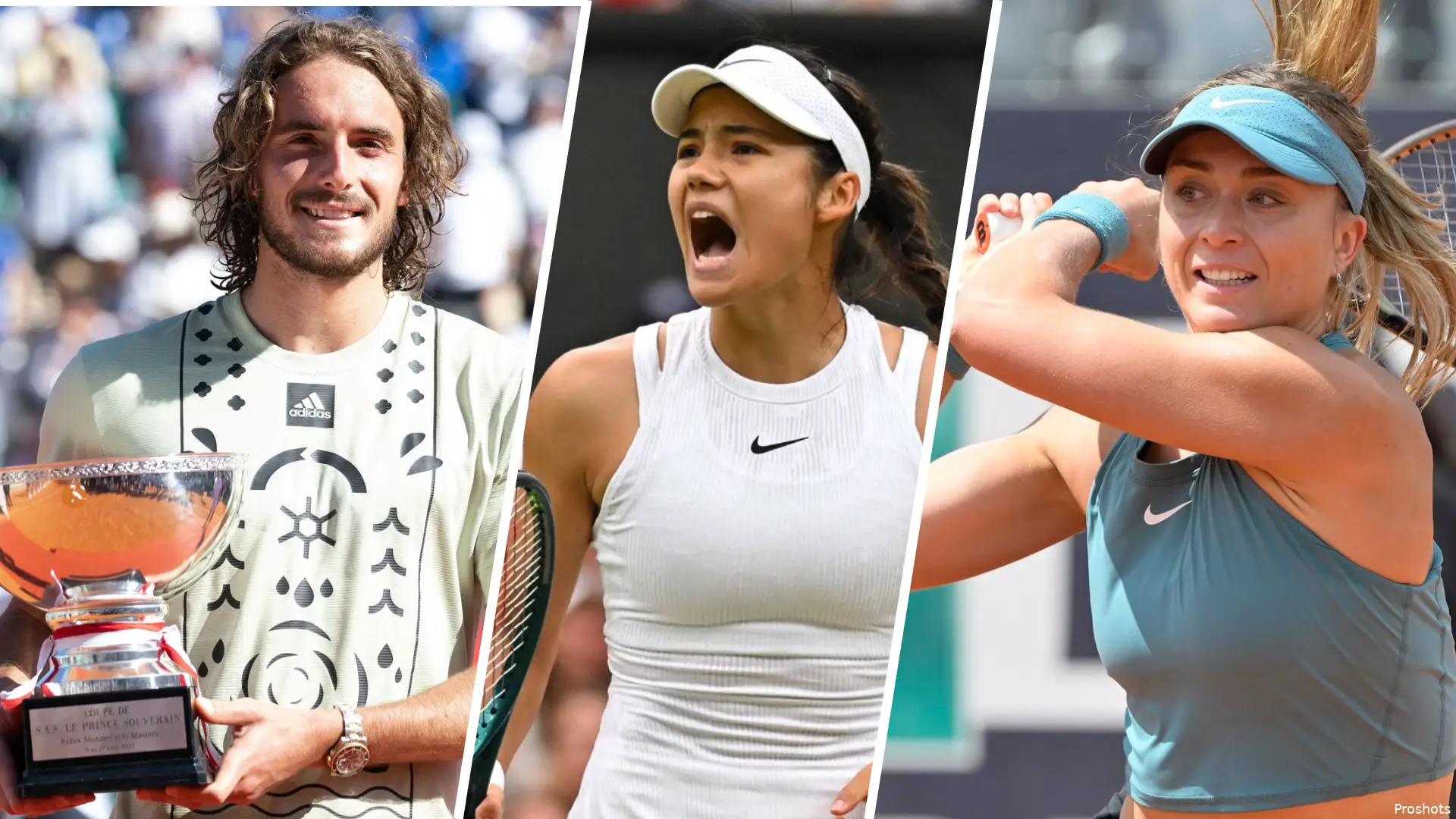
Every tour has a layer of players who once looked like permanent fixtures near the top of the sport and have since quietly disappeared from the conversation entirely. Not retired, not injured beyond repair — just gone from where anyone expects to see them, playing early rounds at tournaments they used to be seeded to win. Six names in particular illustrate just how far, and how fast, that fall can go.
From Grand Slam champions such as Emma Raducanu and Sofia Kenin to major contenders who spent years among the top seeds at the biggest tournaments, such as Stefanos Tsitsipas and Denis Shapovalov, below we look at some of the names who seemed destined to dominate the Tour but have lost ground as the years have gone by.
Between them, these six players have held rankings as high as No. 2 in the world, reached Grand Slam finals, and won majors outright. All six are currently ranked outside the top 30. Here's how each of them got there.
Peak vs. now
| Player | Career-high ranking | Current ranking | Peak achievement |
| Stefanos Tsitsipas | No. 3 (Aug 2021) | No. 44 | Two Grand Slam finals (RG 2021, AO 2023) |
| Hubert Hurkacz | No. 6 (Aug 2024) | No. 46 | Wimbledon semifinal (2021) |
| Denis Shapovalov | No. 10 (Sep 2020) | No. 50 | Wimbledon semifinal (2021) |
| Paula Badosa | No. 2 (Apr 2022) | No. 57 | Indian Wells champion (2021); AO semifinal (2025) |
| Emma Raducanu | No. 10 (Jul 2022) | No. 98 | 2021 US Open champion |
| Sofia Kenin | No. 4 (2020) | No. 106 | 2020 Australian Open champion; 2020 French Open finalist |
Stefanos Tsitsipas
Tsitsipas reached world No. 3 in August 2021 off the back of a French Open final and a genuinely feared all-court game built around a one-handed backhand that made him a stylistic outlier as much as a results-based one. He added a second major final at the 2023 Australian Open and won three Masters 1000 titles along the way, looking for years like the clearest candidate to eventually succeed the Big Three.
The decline has been driven almost entirely by his body and his team rather than a collapse in level. Persistent back problems disrupted him for roughly 18 months, at one point severe enough that he admitted the pain had nearly pushed him toward retirement, and his ranking fell as low as outside the top 75 in mid-2026, a career low. Compounding the physical toll has been an unusually turbulent coaching situation: his father, Apostolos, coached him from childhood through 2024, left, returned, watched Tsitsipas briefly hire Goran Ivanišević, and was finally, permanently, let go in June 2026 in favour of Thomas Perrin.
At 28, Tsitsipas has shown flashes that the talent hasn't disappeared — a July 2026 title in Gstaad, his first in 16 months — but he's now rebuilding almost everything at once: fitness, ranking, and a coaching setup outside his own family for the first time in his career.

Hubert Hurkacz
Hurkacz's game was always built for speed — a huge serve, aggressive net play, and a style that made him one of the toughest outs on fast hard courts and grass. That combination carried him to a Wimbledon semifinal in 2021 and a career-high No. 6 in August 2024, cementing him as the highest-ranked Polish man in the Open Era.
The fall since has been steep and largely injury-driven. Hurkacz dropped outside the world's top 100 for a stretch in 2026 before rebuilding to his current No. 47, a run that's included genuinely encouraging signs — a fourth-round run at Wimbledon this year that included wins over Casper Ruud and Tommy Paul suggests the ceiling is still there when his body cooperates.
His coaching setup has been unusually unstable too, cycling through Ivan Lendl, Nicolás Massú and now Gilles Cervara inside the space of about eighteen months, a search for the right voice that's coincided almost exactly with the ranking slide.

Hubert Hurkacz at the ATP Finals in 2023
Denis Shapovalov
Shapovalov's rise was built on flair as much as results: a one-handed backhand and an all-out attacking left-handed game that beat Rafael Nadal in Montreal as an 18-year-old and carried him to the 2021 Wimbledon semifinal and a career-high No. 10 in September 2020. For a stretch, he looked like the most naturally gifted shot-maker of his Canadian generation, ahead even of Felix Auger-Aliassime.
Consistency, not talent, has been the recurring problem since. His ranking has settled around the high 40s in 2026, a level that still produces the occasional reminder of what he's capable of — a title in Dallas in 2025, beating Casper Ruud in the final, and a third-round run at this year's US Open against Ben Shelton — without ever stabilising into a sustained run back toward the top 20. Three coaching changes in under two years haven't helped settle the picture either.

Shapovalov, in action, has now fallen into tough times.
Paula Badosa
Badosa's peak came fast and was built on genuine physicality: an Indian Wells title in 2021 and a run to world No. 2 by April 2022 made her, briefly, the standard-bearer for Spanish women's tennis. What derailed her wasn't a single event but a long run of physical breakdowns, most seriously a stress fracture in her back that cost her extended stretches in both 2022 and 2023.
A genuine comeback arrived in 2025, when she reached the Australian Open semifinal and looked, for a moment, like she'd fully rebuilt. That progress hasn't held into 2026: her season has included just a second-round Australian Open exit and a first-round Wimbledon loss, and her ranking has slid to No. 70, a long way from the No. 2 she held less than four years ago. At 28, the physical fragility that first interrupted her career remains the biggest swing factor in whether she ever gets back near that peak.

Badosa is now sitting on a precipice.
Emma Raducanu
A few breakthroughs in tennis history were as sudden as Raducanu's: an 18-year-old qualifier who won the 2021 US Open without dropping a set, becoming the first qualifier ever to win a major. She backed it up with a career-high No. 10 ranking the following July but almost immediately began cycling through coaches and injuries that never allowed her to build a settled team around that result.
2026 has followed the same pattern that has defined her career since. A brief resurgence pushed her ranking to No. 23 in March, her best position since 2022, and later in the season she reached her first WTA 500 final at the Queen's Club Championships, raising hopes just weeks before Wimbledon.
However, the injuries returned once again. A stress fracture in her leg forced her to miss both Wimbledon and the US Open. Her ranking decline quickly followed, and she has watched herself slide down the rankings week after week while waiting for her return.
She is set to fall outside the top 100 soon and will return in 2027 with the task of once again rebuilding her ranking from the bottom. More importantly, Raducanu will need to find the confidence required to return to the level that once made her one of the most talked-about young players in tennis, something she has spent several years trying to rediscover.

Great Britain's Emma Raducanu with the runners-up trophy following her loss to Croatia's Donna Vekic after the women's singles final match on day seven of the HSBC Championships at The Queen's Club
Sofia Kenin
Kenin's 2020 season remains one of the more remarkable Grand Slam years of the last decade: she won the Australian Open at 21 and reached the French Open final in the same season, climbing to a career-high No. 4. It looked, briefly, like the start of a genuine multi-major run.
Read also

Instead, the results dried up almost immediately, and it took years of rebuilding before Kenin re-established herself near the top 30, finally finishing 2025 ranked No. 28 in a season widely seen as her genuine second act.
That progress has completely unravelled in 2026: she's fallen outside the world's top 100, carrying a 5-17 record for the season with just two wins in her last eleven matches, a level of sustained losing that stands in stark contrast to the player who beat Serena Williams and Sofia Kenin's own idol Victoria Azarenka en route to a major title six years ago.

Cristhián AvilaTennis Journalist
Cristhián Ávila is a tennis journalist based in Santiago, Chile, and has been part of the TennisUpToDate team since early 2023. He covers the ATP and WTA Tours as well as all four Grand Slams, producing breaking news, match reports, analysis, and regular liveblogs from major tournaments.
His reporting combines statistical analysis with clear explanation, helping readers understand tactical developments, player form, and broader storylines across the tour. Working fluently in both Spanish and English, Cristhián collaborates with an international editorial team and contributes to comprehensive global coverage. As part of his work, he has conducted interviews and media interactions with leading figures in the sport, including Caroline Wozniacki and John McEnroe.
In his journalism, Cristhián places strong emphasis on careful sourcing, editorial accuracy, and updating articles promptly when new, verified information becomes available. His coverage is grounded in research, context, and direct engagement with professional tennis.
claps 5visitors 2
Just In

Popular News

Latest Comments
- I have lost all respect for Svitolina! Could she not have waited until he had played at the Paris Masters!!! She is selfish and don't give a damn about Gael. That is NOT how love is demonstrated Elina!!Rapunzel19-10-2026
- Perhaps convenient tennis tour sex is not a strong enough experience in which to base a marriage?
 mandoist19-10-2026
 - Fight the Good Fight... Tennis (sports in general) need more Humans such as yourself.mandoist18-10-2026
- When is WTA going to mandate Genetic Testing (DNA) ???mandoist18-10-2026
- Hey, Dan... you just wake up from a coma? Regardless -- Thanks for the comedy this morning!mandoist18-10-2026
- Two Things: 1. Stop allowing these Spoiled Trust-Fund Elitists to behave badly. Your little hand-slaps do not deter them. 2. STOP the incessantly annoying "towel wiping" nonsense!!!!mandoist15-10-2026
- A healthy Qinwen may be hard to stop next season. She was already scaring her opponents before her medical leave(s). Unfortunately, Zheng insisted on singing again. On the positive side -- Mirra did not sing!! ;~}mandoist11-10-2026
- Where is it written that athletes, entertainers... People in general... are mandated to keep looking at -- or even using [anti]Social Media? Public & private figures consistently complain and reveal their concerns about negativity and violence thrown at them -- yet they insist on participating. Avoid it, don't use it, don't read it. It's okay to occasionally look up at the World instead beating your eyes & thumbs to death on The Inventions out there.mandoist11-10-2026
- great articlestennisseserver07-10-2026
- Medvedev was leading Djokovic 7-5, 3-5 when an attempted return..' NO you ignorants, Djokovic was leading .weiss05-10-2026

Loading