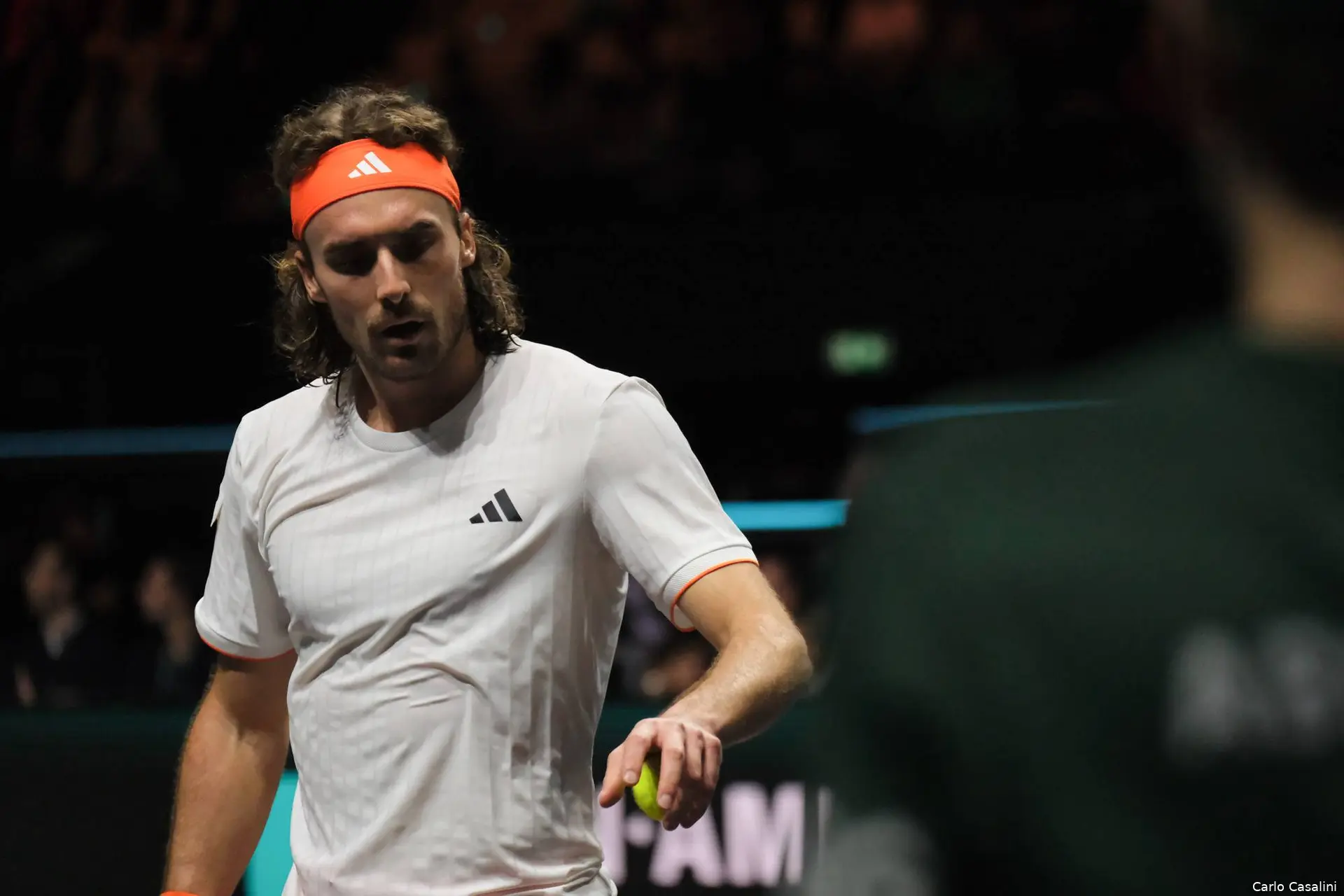
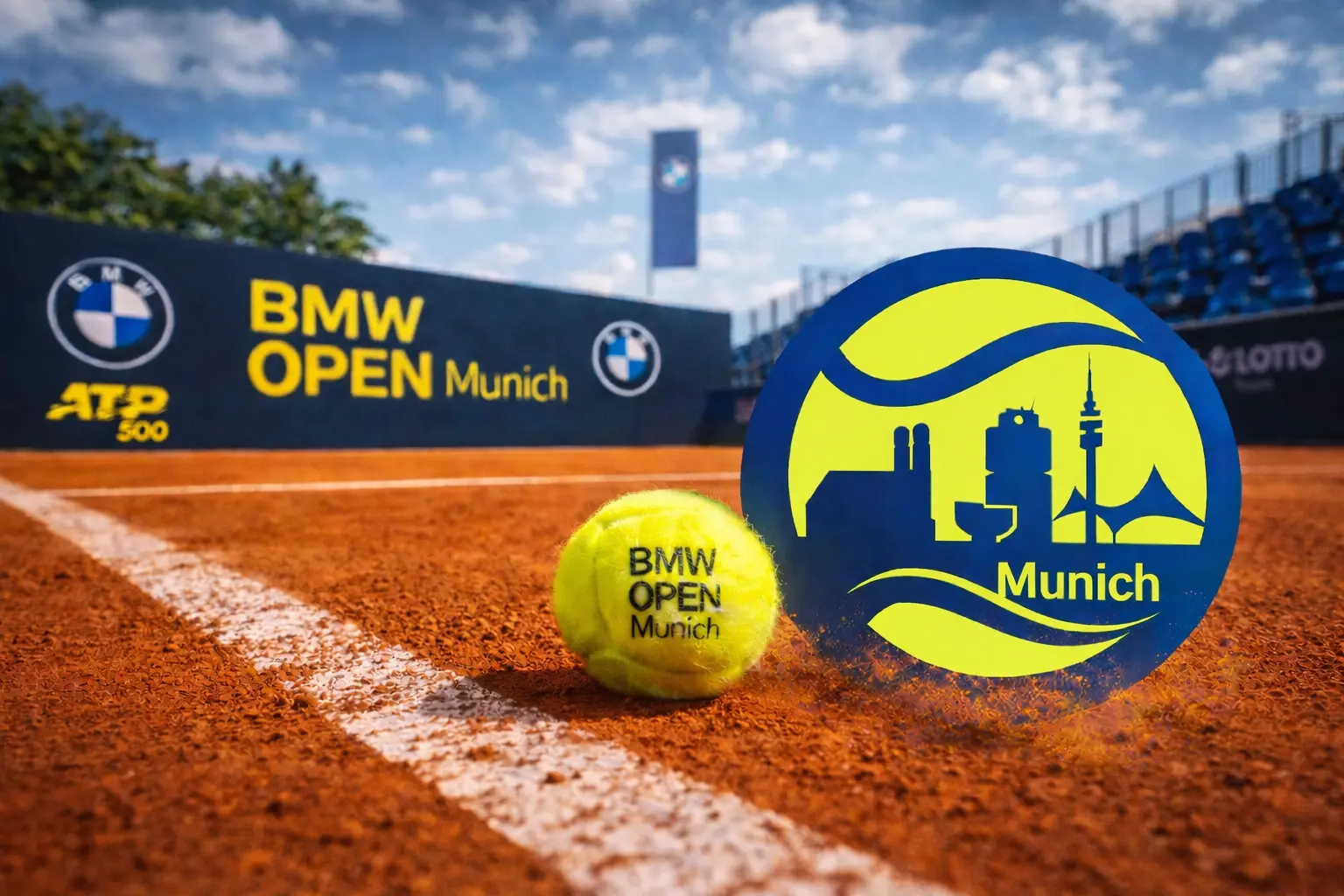
Stefanos Tsitsipas saw his first-round match at the BMW Munich Open suspended overnight after failing to convert a match point against Fabian Marozsan. The Greek had been within one point of advancing in straight sets before losing the second-set tie-break, forcing the contest into a decider that could not be completed due to fading light.
The match, which began at 7 p.m. local time, was halted at 2-2 in the final set after Tsitsipas held serve to stay level. The late start and deteriorating visibility ultimately prevented completion, leaving both players to return the following day to resolve a tightly contested opening-round encounter on clay.
For Tsitsipas, the interruption comes within a broader period of transition. The former world No. 3 has slipped to No. 67 in the ATP rankings following an injury-affected 2025 season, arriving at the clay swing in need of results and continuity. The Munich event, new to his schedule, represents part of a recalibrated approach.
Despite the ranking drop, Tsitsipas has projected a more stable outlook in recent days, pointing to improved physical condition and a renewed competitive mindset. His presence in Munich instead of his usual Barcelona stop reflects a deliberate shift in preparation as he looks to rebuild rhythm through varied conditions and increased match exposure.
New environment signals broader reset
Tsitsipas’ decision to compete in Munich rather than Barcelona highlights a willingness to move beyond familiar patterns. Traditionally comfortable in warmer conditions and established tournament settings, the Greek has instead embraced a different environment as part of a broader reset during this clay swing.
“It’s a new place for me. I’ve never had the opportunity to play here. I’m used to the warm weather in Barcelona,” the former world No. 3 explained in press conference according to Punto de Break. “In recent years I’ve played there and done quite well. I received a nice invitation to come and play here. I thought it would be a cold place even before packing my bags, and I wasn’t too wrong.”
He also pointed to the atmosphere surrounding the event as a positive factor, underlining the importance of environment during a rebuilding phase. “But I have to say the hospitality is incredible. That’s what makes the atmosphere here so positive and so good. The tournament director is probably one of the kindest people I’ve met so far at an event. It’s important to have that kind of interaction with the people organising tournaments at this level.”
Physical recovery and ranking reality shape outlook
A central component of Tsitsipas’ improved outlook is his physical condition. After a prolonged period of discomfort, he now reports being free of pain, allowing him to train consistently and focus on rebuilding his game without interruption.
“I’m not frustrated anymore because there’s no pain interrupting my daily training. I wouldn’t say there’s anything significant bothering me right now. In fact, I feel like I’m in the perfect place to keep developing a better game.”
He linked that physical stability directly to his broader objective of returning to his previous level, framing the current phase as part of a structured process rather than a setback. “I’m trying to get back to where I feel I belong. So far, nothing has been bothering me. I’m on a straight path trying to do the right things and hopefully put together some winning streaks again and recover the ranking where I used to be.”
At No. 67 in the rankings, Tsitsipas faces a different competitive reality, frequently encountering higher-ranked opponents in early rounds. This shift has required a recalibration of expectations as he navigates a more demanding draw structure.
Rebuild focused on volume and acceptance
Tsitsipas has adopted a pragmatic approach to his current ranking, emphasising the need for match volume as a key driver of improvement. Rather than avoiding difficult paths, he has accepted the necessity of competing more frequently and across different tournament levels.
“I’m aware that this year I might have to face big players in earlier rounds at different tournaments. It’s not easy to have to play them so soon. But I also accept the challenge and I accept my current position, understanding that this is part of the process.”
That acceptance extends to his scheduling strategy, where he is prepared to adjust his calendar in order to accumulate matches and regain rhythm. “If I have to play ATP 250 events, if I have to play extra tournaments, I will,” the 27-year-old Greek player added. “Matches help me find my game again. I’m a player who needs matches, who needs to play a lot of sets to feel his tennis better.”

Cristhián AvilaTennis Journalist
Cristhián Ávila is a tennis journalist based in Santiago, Chile, and has been part of the TennisUpToDate team since early 2023. He covers the ATP and WTA Tours as well as all four Grand Slams, producing breaking news, match reports, analysis, and regular liveblogs from major tournaments.
His reporting combines statistical analysis with clear explanation, helping readers understand tactical developments, player form, and broader storylines across the tour. Working fluently in both Spanish and English, Cristhián collaborates with an international editorial team and contributes to comprehensive global coverage. As part of his work, he has conducted interviews and media interactions with leading figures in the sport, including Caroline Wozniacki and John McEnroe.
In his journalism, Cristhián places strong emphasis on careful sourcing, editorial accuracy, and updating articles promptly when new, verified information becomes available. His coverage is grounded in research, context, and direct engagement with professional tennis.
claps 1visitors 1
Just In

Popular News
Latest Comments
- A healthy Qinwen may be hard to stop next season. She was already scaring her opponents before her medical leave(s). Unfortunately, Zheng insisted on singing again. On the positive side -- Mirra did not sing!! ;~}
 mandoist11-10-2026
 - Where is it written that athletes, entertainers... People in general... are mandated to keep looking at -- or even using [anti]Social Media? Public & private figures consistently complain and reveal their concerns about negativity and violence thrown at them -- yet they insist on participating. Avoid it, don't use it, don't read it. It's okay to occasionally look up at the World instead beating your eyes & thumbs to death on The Inventions out there.mandoist11-10-2026
- great articlestennisseserver07-10-2026
- Medvedev was leading Djokovic 7-5, 3-5 when an attempted return..' NO you ignorants, Djokovic was leading .weiss05-10-2026
- No more bullshit "Wildcards" to these two. Qualify like everyone else -- there will be cameras there, too. Time to scream... WTF ????!!!!mandoist29-09-2026
- Let's not BS the general public -- Sabalenka started showing cracks in her game last season. Her losses and near-losses started at about the same time she began being distracted by Fame (constant Selfies, making TV commercials, magazine shoots, endless Social Media nonsense, etc., etc.) One would think even Saba could recognize the parallels with others who failed before her -- Raducanu, Giorgi, Bouchard to name a few.mandoist25-09-2026
- Gross!! Hey Raducanu, Giorgi, and Bouchard -- reserve a seat at your Social Media Selfie table for Saba + Naomi. They're heading in your direction soon enough.mandoist24-09-2026
- And then these same players will complain about how lengthy their season’s were and need more time-off. I’m all for more tennis but the amount of tennis we get now is actually kind of crazy! We all need a break, especially the players.DaveyWavey23-09-2026
- You should do a comparison article for "different kinds of justice" the courts decide for tennis players. I can think of at least three players who received very small bans of a few months, however Tara Moore has been fighting for her literal survival the past few years. It seems odd considering she is not a "name" player, unlike the other cases.DaveyWavey22-09-2026
- PRIZE MONEY & POINTS Winner - $185,500 Finalist - $114,500 Semi-Finalist - $66,003 Quarter-Finalist - $35,000 Round of 16 - $18,045 Round of 32 - $13,005 Winner - 500 Finalist - 325 Semi-Finalist - 195 Quarter-Finalist - 108 Round of 16 - 60 Round of 32 - 1DaveyWavey20-09-2026

Loading