"I see that we’re very close to significant change" - PTPA co-founder Vasek Pospisil gives update on lawsuit against tennis governing bodies
ATP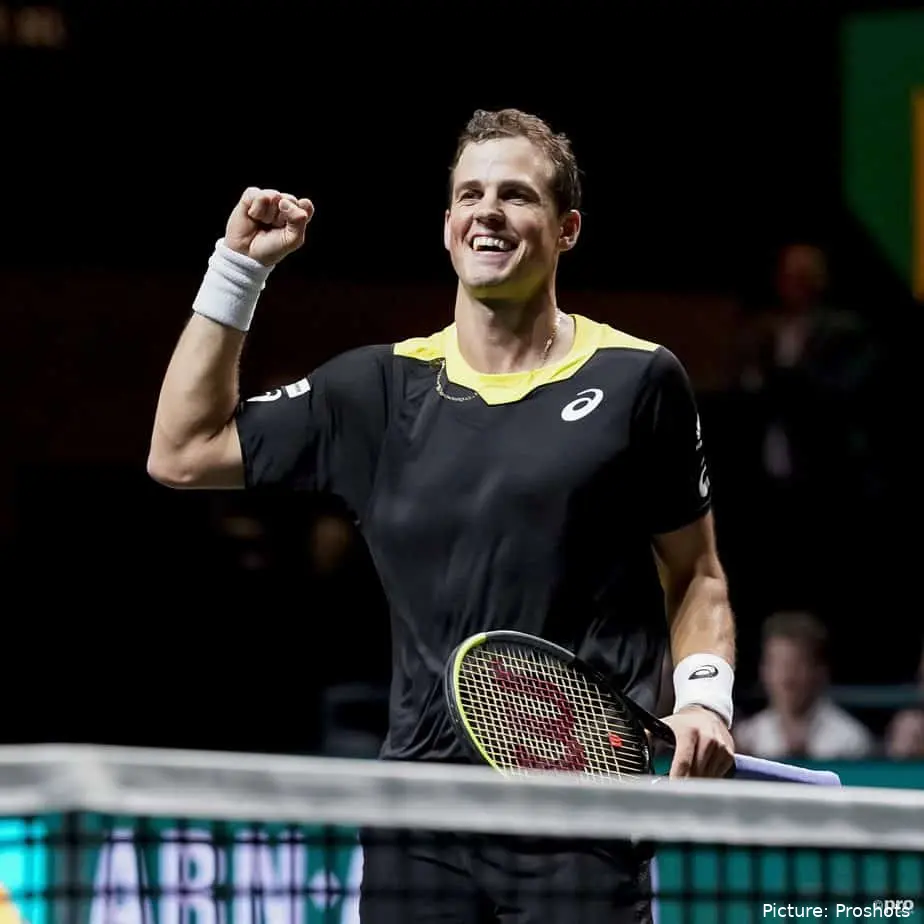
In 2019, Serbian tennis superstar Novak Djokovic joined forces with Canadian doubles specialist Vasek Pospisil to launch the Professional Tennis Players Association, PTPA, in an attempt to create an alternative tennis association for players worldwide.
The PTPA's mission is to create transparency and equity in the sport, as it represents singles players in the top 500 and doubles players in the top 200 of both the ATP and WTA associations. Their goal is to provide players with a system of self-governance that is independent from the established governing bodies of tennis.
Several players have voiced their support for the new association, with American Reilly Opelka, Polish star Hubert Hurkacz and Canadian Denis Shapovalov all speaking in favor of the new tennis body. WTA stars Paula Badosa and Ons Jabeur are also involved in the running of the organization.
In March 2025, the PTPA brought a lawsuit against the major tennis governing bodies (ATP, WTA, ITF and ITIA) seeking better treatment and fair compensation for their talent through equitable revenue sharing based on attendance, along with other grievances. The case is still ongoing, although the major tennis governing bodies have rejected the allegations brought in the lawsuit.
Pospisil delves into nature of the lawsuit
On the latest edition of his blog, Behind the Racket, Pospisil went into detail on the idea behind the PTPA. Furthermore, the former doubles World No.4 shed some light on the current lawsuit against the ATP, WTA, ITF and ITIA.

"The most important lesson I’ve learned over the past five years concerns the tennis system," began the Canadian. "I’ve seen that it’s far more disorganized than I thought. Today, for the first time, I see that we’re very close to significant change, the kind we need to give players a real voice and an idyllic environment for their development.
"Tennis has lagged behind other sports, which is why we’ve been trying to collaborate with certain governing bodies all these years. We wanted to give them the opportunity to collaborate with us, but to move forward, we had no choice but to resort to legal action.
"The ultimate goal is to give players an independent voice. That’s our main wish in response to the lawsuit. It will pave the way for everything else: higher prize money and better revenue sharing. Having a say in all these issues that affect our livelihoods—whether it’s travel, schedules, balls, or winnings—is essential for us."
"Tennis has lagged behind other sports, which is why we’ve been trying to collaborate with certain governing bodies all these years. We wanted to give them the opportunity to collaborate with us, but to move forward, we had no choice but to resort to legal action.
"The ultimate goal is to give players an independent voice. That’s our main wish in response to the lawsuit. It will pave the way for everything else: higher prize money and better revenue sharing. Having a say in all these issues that affect our livelihoods—whether it’s travel, schedules, balls, or winnings—is essential for us."

Growing up in a household where soccer was king, my earliest memories are filled with chants from packed stadiums and the rhythm of a ball being passed across neighborhood streets. But somewhere along the way, the quiet elegance and raw emotion of tennis pulled me in. What began as a curiosity became a lifelong passion; not just for the sport itself, but for the stories it tells: of grit, of heartbreak, of improbable comebacks and human resilience.
As a tennis writer, I bring the observational lens of someone who didn’t grow up in the sport, but fell in love with it as an outsider; a perspective that lets me see both its technical beauty and its emotional depth. Over the years working with TennisUpToDate, I’ve had the privilege of reaching more than 3.5 million readers worldwide, with one of my features ranking among the site’s top three articles.
With a background in storytelling and a creative mind always searching for meaning beyond the scoreboard, I aim to craft narratives that go deeper than results and rankings. Whether it’s a rising star breaking through or a veteran fighting off Father Time, I try to capture the heartbeat behind the headlines.
claps 0visitors 0
Just In


Popular News
Latest Comments
- A healthy Qinwen may be hard to stop next season. She was already scaring her opponents before her medical leave(s). Unfortunately, Zheng insisted on singing again. On the positive side -- Mirra did not sing!! ;~}
 mandoist11-10-2026
 - Where is it written that athletes, entertainers... People in general... are mandated to keep looking at -- or even using [anti]Social Media? Public & private figures consistently complain and reveal their concerns about negativity and violence thrown at them -- yet they insist on participating. Avoid it, don't use it, don't read it. It's okay to occasionally look up at the World instead beating your eyes & thumbs to death on The Inventions out there.mandoist11-10-2026
- great articlestennisseserver07-10-2026
- Medvedev was leading Djokovic 7-5, 3-5 when an attempted return..' NO you ignorants, Djokovic was leading .weiss05-10-2026
- No more bullshit "Wildcards" to these two. Qualify like everyone else -- there will be cameras there, too. Time to scream... WTF ????!!!!mandoist29-09-2026
- Let's not BS the general public -- Sabalenka started showing cracks in her game last season. Her losses and near-losses started at about the same time she began being distracted by Fame (constant Selfies, making TV commercials, magazine shoots, endless Social Media nonsense, etc., etc.) One would think even Saba could recognize the parallels with others who failed before her -- Raducanu, Giorgi, Bouchard to name a few.mandoist25-09-2026
- Gross!! Hey Raducanu, Giorgi, and Bouchard -- reserve a seat at your Social Media Selfie table for Saba + Naomi. They're heading in your direction soon enough.mandoist24-09-2026
- And then these same players will complain about how lengthy their season’s were and need more time-off. I’m all for more tennis but the amount of tennis we get now is actually kind of crazy! We all need a break, especially the players.DaveyWavey23-09-2026
- You should do a comparison article for "different kinds of justice" the courts decide for tennis players. I can think of at least three players who received very small bans of a few months, however Tara Moore has been fighting for her literal survival the past few years. It seems odd considering she is not a "name" player, unlike the other cases.DaveyWavey22-09-2026
- PRIZE MONEY & POINTS Winner - $185,500 Finalist - $114,500 Semi-Finalist - $66,003 Quarter-Finalist - $35,000 Round of 16 - $18,045 Round of 32 - $13,005 Winner - 500 Finalist - 325 Semi-Finalist - 195 Quarter-Finalist - 108 Round of 16 - 60 Round of 32 - 1DaveyWavey20-09-2026

Loading
