"Is it more than when I played? It’s not": Jim Courier weighs in on Carlos Alcaraz 'nuanced' scheduling complaints amid Saudi Arabia move
ATP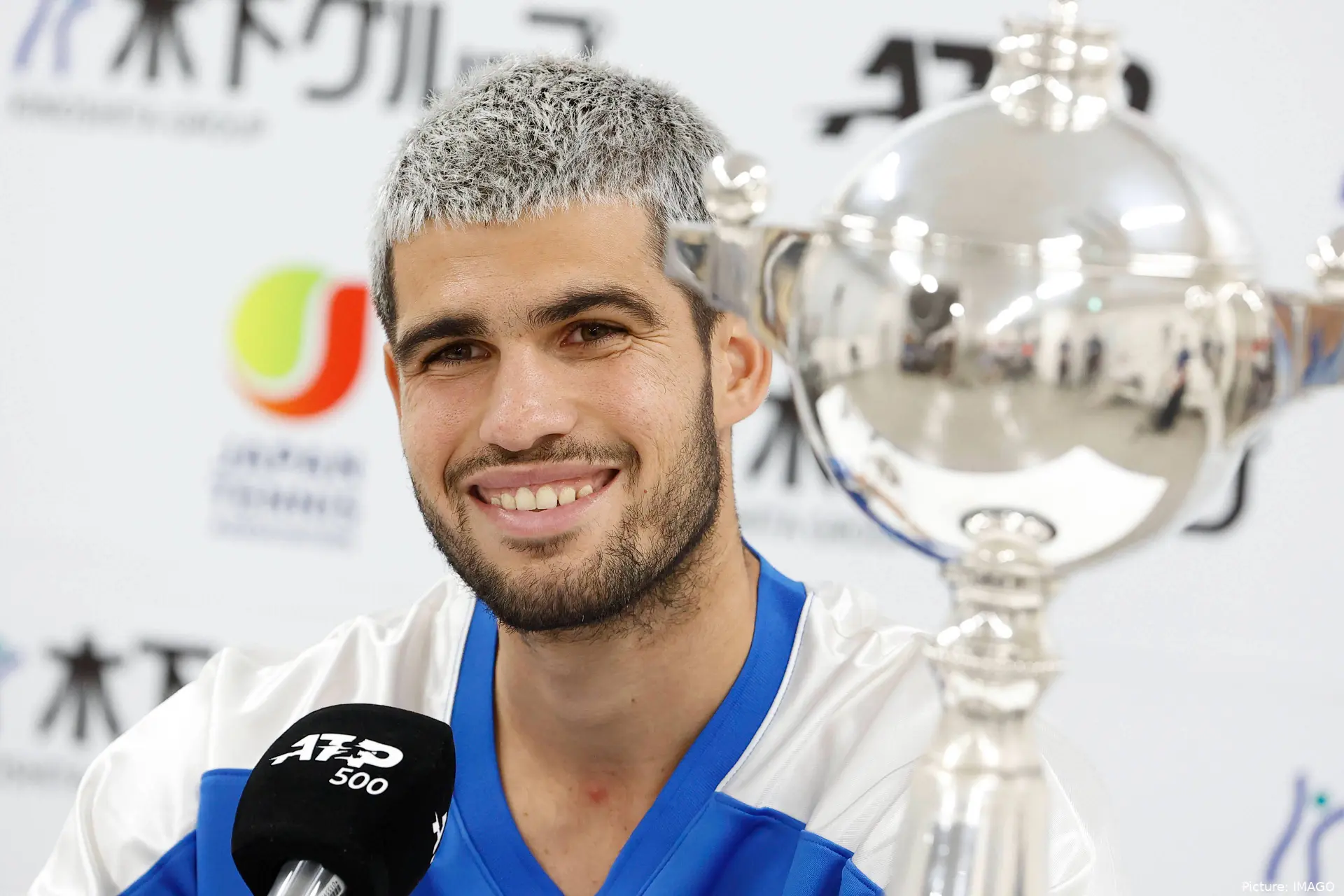
One of the biggest stories in tennis this week is the ATP’s announcement that it will add a 10th Masters 1000 tournament in 2028, with Saudi Arabia joining the elite list of host nations. The move further strengthens the Kingdom’s growing presence in global sport — but it has already sparked debate within the tennis community.
Within 48 hours of the announcement, world No. 2 Carlos Alcaraz voiced concerns over the increasingly congested ATP schedule, telling reporters that “the amount of tournaments we have to play is too high.”
On Tennis Channel, Jim Courier and Jon Wertheim weighed in on the topic, breaking down the realities of the modern tour calendar and what the Saudi event could mean for players.
“The good news, Carlos, is that Saudi Arabia is optional.”
Jim Courier was quick to point out that while the addition of a 10th Masters 1000 sounds like more compulsory tennis, the new event won’t be mandatory for players.
“The good news, Carlos, is that Saudi Arabia is an optional tournament,” Courier said. “It’s not mandatory, in the same way that Monte Carlo is a non-mandatory Masters 1000. So while there might be ten starting in 2028, there are only eight that you’re required to play if you want to get your multi-million-dollar bonus.”
Courier explained that while the ATP calendar looks crowded, there’s a distinction between required and optional play.
“There’s a lot to unpack about what’s real and necessary to play on the ATP Tour,” he continued. “If you want to make all your bonuses, you’ve got to play 13 weeks at the Masters 1000s — because those eight tournaments bleed into multiple weeks. Some of them are two weeks. We’ve got Canada and Cincinnati, which are three weeks combined. But it’s 13 weeks for those.”
He outlined the full competitive load for top players: “Then you’ve got the Slams — that’s eight weeks if you go the distance — and you have to play five ATP 500-level events. That’s tournaments like last week in Basel and Vienna, or like Tokyo and Beijing. And if you qualify, you have to play the ATP Finals. So that’s 27 weeks total in competition. Of course, that doesn’t include the prep weeks where you have to be on-site — before the majors, all the players are there at least five days in advance. You’re going to be in Indian Wells at least four days early for the time zone if you’re a European. So it’s more than 27 weeks — it’s a lot.”
Still, Courier said the length of the season isn’t much different from his playing days. “Is it more than when I played? It’s not. It’s always been like this. We’ve always been fighting as players for shorter off-seasons. But to be clear, the players who fight for shorter off-seasons are the top players — because the rest of the players want more playing opportunities. They want more weeks on the calendar. They don’t have the match load that the top players have.”
“So this is a very nuanced conversation based on where you are in the rankings and what your needs and wants are. Alcaraz isn’t wrong that the requirements are a lot but he has options. He’s supposed to play those events if he wants the money. He doesn’t have to. Keep that in mind, people.”
“Where does this event go on the calendar?”
Jon Wertheim agreed that the announcement raised as many logistical questions as it answered.
“I’m glad you asked,” he said. “We’ve had this big splashy announcement, all this chatter — and one kind of critical detail was missing: where is this event going to go? That wasn’t part of the press release.”
According to Wertheim, the most likely window is in February, between the Australian Open and the North American Masters swing. “I’m told it’s most likely going to be in February, which makes sense — after the Australian Open and before Indian Wells and Miami. There are a few other options being floated, though. One of them, strangely enough, is the ‘week zero’ — the very last week of December bleeding into January. Then everyone could take a private jet to Australia! That’s been discussed. But most likely, it’ll be in February.”
He also pointed to the balance of interests between the sport’s elite and the rest of the field. "Jim raised a critical point — this is not mandatory. That also means they could pay appearance fees, by the way. But also, for as many players who complain, ‘I’m exhausted, I play these finals, these 27 weeks,’ there’s a whole cohort of players who want more playing opportunities, more chances for points and money. So it’s not quite as simple as Carlos Alcaraz saying he’s too tired.”
“You cannot accept appearance money at Masters 1000s.”
Courier stepped in to clarify a key point about ATP regulations.
“Let me just clarify one thing, Jon — you cannot accept any kind of appearance money at the Masters 1000 level. That’s absolutely a no-no. I’m not sure where you got that info, but you can’t do that in Monte Carlo, nor in Indian Wells or Saudi Arabia or anywhere — unless they change the rules.”
From a scheduling perspective, Courier also sees February as the only logical slot for the new event.
“I can’t see where the Saudi event would go anywhere other than February, because you already have a Middle East swing there — you’re already in Doha and Dubai anyway. So why not make that a one-month play over there for all the players?
“Putting that in ‘week zero’? Can you imagine if you’re in Australia — if you’re Alex de Minaur, for example — like, ‘Wait, I’m getting ready to play the Australian Open… oh, but I’ve got to go to Saudi Arabia and then come back to Australia?’ It makes no sense whatsoever. That’s a lot of miles.”
“There may actually be fewer events overall.”
Wertheim added that the Saudi deal reportedly includes a “buyback” provision, which could see certain tournaments removed from the calendar when the new event debuts.
“We were told, Andy Roddick and I, that for non-mandatory events there is a way to have appearance fees,” Wertheim explained. “But I also think we should note that part of this Saudi deal includes a buyback clause — where there will be some events that are eliminated, basically bought out. So there may actually be fewer events on the calendar in 2028 when this kicks in, even though you’ll have this 10th Masters. The question is — will there be fewer tournament weeks on the calendar?”
Courier added that what truly matters isn’t just the number of events, but when they’re scheduled. "You can buy back all the tournaments you want — but if you’re not buying back the right weeks, like the ones after the U.S. Open, it really doesn’t matter.”

Samuel GillEditor-in-Chief
Samuel Gill is the Chief Content Officer (CCO) of TennisUpToDate.com, a role he has held since 2020. He is responsible for editorial governance across the platform, including setting content standards, overseeing accuracy and consistency, and guiding long-term editorial strategy. Since joining, he has contributed more than 10,000 articles and editorial pieces across the TennisUpToDate network, playing a central role in the daily operation and development of the site.
Based in Leicester, Samuel has a broad background in tennis media. In his current role, he works closely with editors and writers to ensure coverage meets clear journalistic standards, with particular attention to verification, consistency, and timely updates when new information becomes available.
claps 0visitors 0
Just In

Popular News
Latest Comments
- A healthy Qinwen may be hard to stop next season. She was already scaring her opponents before her medical leave(s). Unfortunately, Zheng insisted on singing again. On the positive side -- Mirra did not sing!! ;~}
 mandoist11-10-2026
 - Where is it written that athletes, entertainers... People in general... are mandated to keep looking at -- or even using [anti]Social Media? Public & private figures consistently complain and reveal their concerns about negativity and violence thrown at them -- yet they insist on participating. Avoid it, don't use it, don't read it. It's okay to occasionally look up at the World instead beating your eyes & thumbs to death on The Inventions out there.mandoist11-10-2026
- great articlestennisseserver07-10-2026
- Medvedev was leading Djokovic 7-5, 3-5 when an attempted return..' NO you ignorants, Djokovic was leading .weiss05-10-2026
- No more bullshit "Wildcards" to these two. Qualify like everyone else -- there will be cameras there, too. Time to scream... WTF ????!!!!mandoist29-09-2026
- Let's not BS the general public -- Sabalenka started showing cracks in her game last season. Her losses and near-losses started at about the same time she began being distracted by Fame (constant Selfies, making TV commercials, magazine shoots, endless Social Media nonsense, etc., etc.) One would think even Saba could recognize the parallels with others who failed before her -- Raducanu, Giorgi, Bouchard to name a few.mandoist25-09-2026
- Gross!! Hey Raducanu, Giorgi, and Bouchard -- reserve a seat at your Social Media Selfie table for Saba + Naomi. They're heading in your direction soon enough.mandoist24-09-2026
- And then these same players will complain about how lengthy their season’s were and need more time-off. I’m all for more tennis but the amount of tennis we get now is actually kind of crazy! We all need a break, especially the players.DaveyWavey23-09-2026
- You should do a comparison article for "different kinds of justice" the courts decide for tennis players. I can think of at least three players who received very small bans of a few months, however Tara Moore has been fighting for her literal survival the past few years. It seems odd considering she is not a "name" player, unlike the other cases.DaveyWavey22-09-2026
- PRIZE MONEY & POINTS Winner - $185,500 Finalist - $114,500 Semi-Finalist - $66,003 Quarter-Finalist - $35,000 Round of 16 - $18,045 Round of 32 - $13,005 Winner - 500 Finalist - 325 Semi-Finalist - 195 Quarter-Finalist - 108 Round of 16 - 60 Round of 32 - 1DaveyWavey20-09-2026

Loading