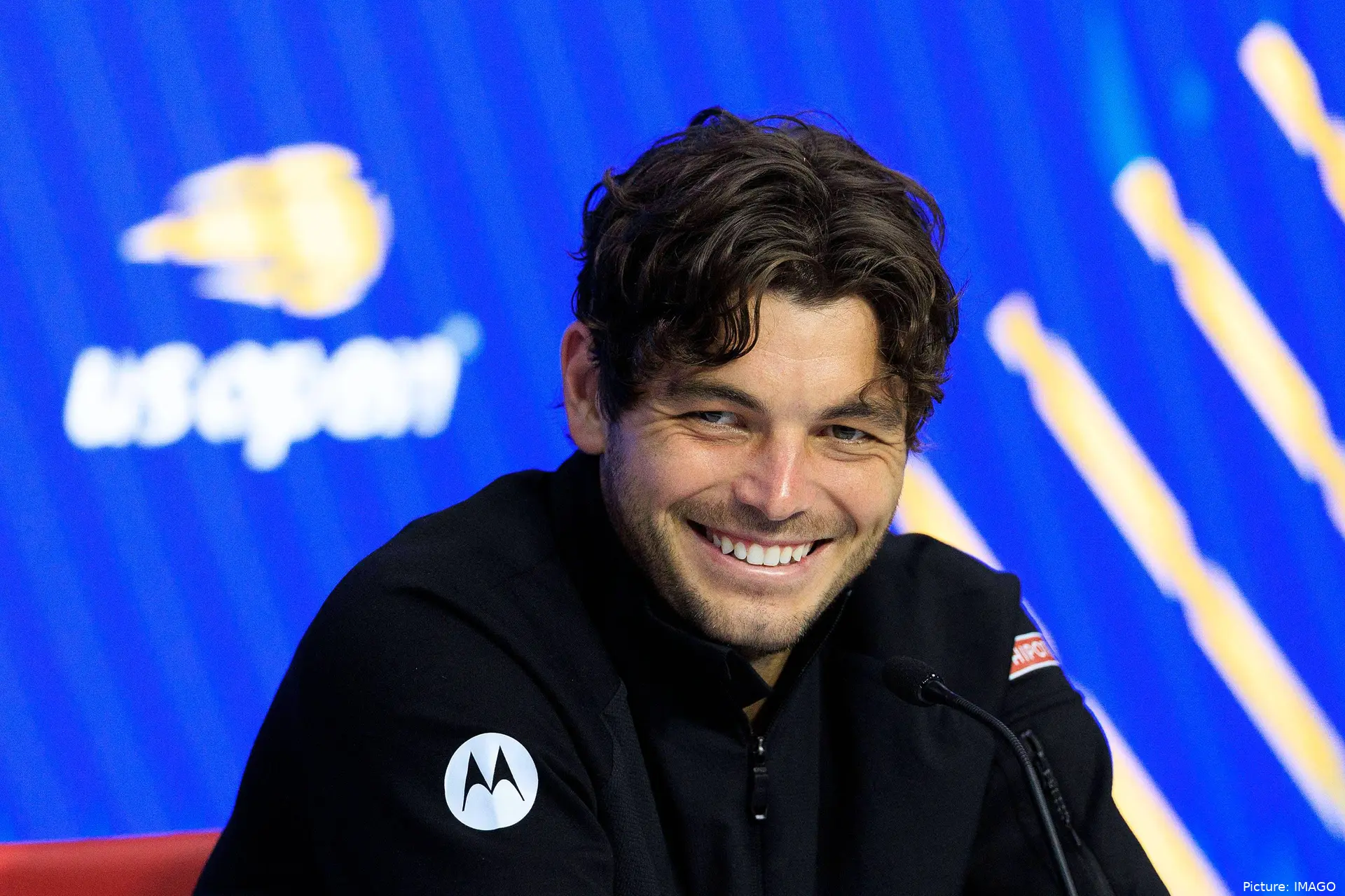
Taylor Fritz took part in an internet-based Q&A session with Wired, where he responded to fan-submitted questions covering both technical and psychological aspects of modern tennis. The American used the format to move between tactical explanations, personal experiences and broader reflections on how the sport has evolved in recent years.
The timing of the interview coincides with his grass-court swing following a disrupted start to the season. Fritz returned to competition after a two-month injury layoff, with limited clay-court action and no wins during that stretch, before finding stronger form on grass.
He reached the Stuttgart Open final and followed it with another deep run in Halle, where he defeated Alexander Zverev en route to the final before losing to Frances Tiafoe. The results have placed him into Eastbourne with renewed momentum and a 9–2 record on grass this season.
Within that context, Fritz’s answers in the Q&A covered equipment changes, serve mechanics, momentum swings and even controversial opinions on coaching, offering a wide snapshot of how he views the modern game.
Read also
“The balls are just substantially slower”: Fritz on modern tennis conditions
One of the central themes in Fritz’s responses was the perception that tennis has slowed down, which he argued is not primarily due to court surfaces but to the behaviour of modern tennis balls. “The court speeds probably haven’t changed. I agree, the court speeds probably haven’t changed. The balls are just substantially slower than when I started playing.”
He expanded on how modern balls interact differently with rackets and strings, producing more control but reducing pace and bounce intensity. In his view, this has a direct impact on how rallies and second serves are constructed at tour level.
“The balls nowadays that we play with more often, they’re just a bit softer, which it feels great off your racket when you’re hitting because it kind of sticks on your strings a bit longer. That softness makes the ball a bit easier to control, but it also makes everything a lot slower.”

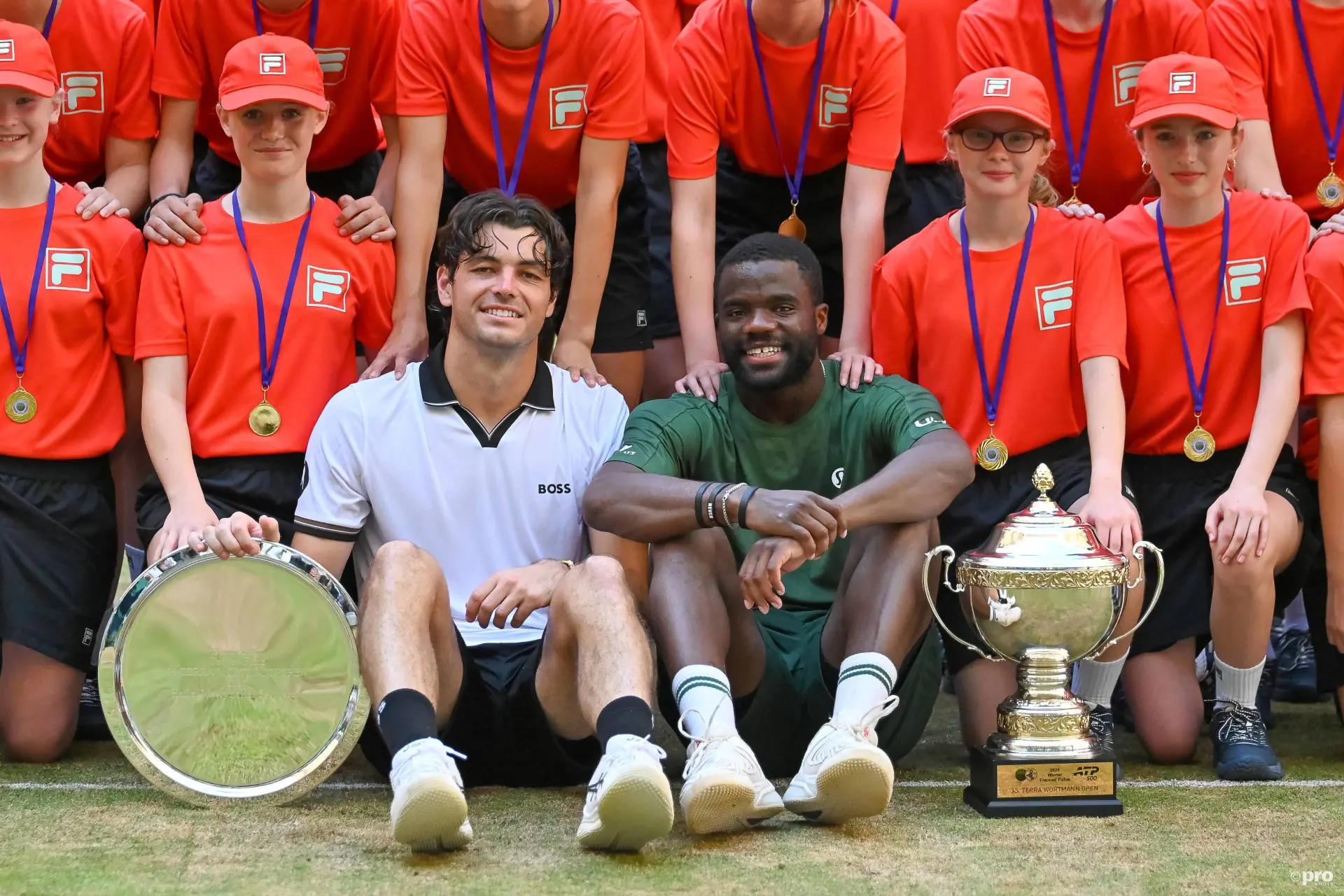
Frances Tiafoe and Taylor Fritz posing with their trophies after the Halle Open final
Fritz also linked these changes to tactical evolution, particularly the increasing variation in second serves rather than reliance on a single dominant kick pattern.
Beyond equipment, he emphasised the psychological component of tennis, identifying confidence as a key but often underestimated factor in performance swings. “Confidence is such an underlooked factor in tennis, not just in matches, but just in careers as well.”
He added that short sequences of points can significantly alter match dynamics, influencing aggression levels and decision-making under pressure.
“Lose the set 6-0, because I have a theory that when you lose a set 6-0 against someone you’re not supposed to lose a set 6-0 against, you’re going to win the next set. It kind of messes them up mentally. Try it sometime.”
Read also
“Everything should be slow until that moment”
Fritz also addressed technical elements of his game, particularly his serving philosophy. He described the motion as a controlled build-up followed by a sharp explosive action at contact.
“A serve should be very slow. Everything should be slow up until that moment when you’re about to hit it. That’s when everything speeds up. Think of a serve like an archer pulling a bow back.”
He further reflected on adaptability in unusual circumstances, recalling a junior incident in which he lost his racket bag on a train during a tournament in Belgium. With no access to his usual equipment, he was forced to compete using borrowed rackets with different specifications.
“I left my racket bag on a train. Happened very fast. I noticed that I left it when I stepped out, doors were closing, gone. It was going to take a couple days for me to get my exact racket there. So I used, at the time, my girlfriend’s racket.”

Cristhián AvilaTennis Journalist
Cristhián Ávila is a tennis journalist based in Santiago, Chile, and has been part of the TennisUpToDate team since early 2023. He covers the ATP and WTA Tours as well as all four Grand Slams, producing breaking news, match reports, analysis, and regular liveblogs from major tournaments.
His reporting combines statistical analysis with clear explanation, helping readers understand tactical developments, player form, and broader storylines across the tour. Working fluently in both Spanish and English, Cristhián collaborates with an international editorial team and contributes to comprehensive global coverage. As part of his work, he has conducted interviews and media interactions with leading figures in the sport, including Caroline Wozniacki and John McEnroe.
In his journalism, Cristhián places strong emphasis on careful sourcing, editorial accuracy, and updating articles promptly when new, verified information becomes available. His coverage is grounded in research, context, and direct engagement with professional tennis.
claps 0visitors 0
Just In



Popular News

Latest Comments
- Lena... Takin' care of business
 mandoist25-10-2026
 - Can you please stop publishing this nonsense? Stick to Tennis.mandoist25-10-2026
- Does Sinner need that 4.5 mil? I doubt it. He can make that with three modelling gigs!😅🤣Rapunzel21-10-2026
- Did "People Magazine" purchase this website? This nonstop storyline is bullshit.mandoist21-10-2026
- Listen... this is of no concern to anyone but these two. Deal with your own issues -- most of us have our own. Thanks, media, for these insignificant follow-ups which are meaningless.mandoist21-10-2026
- This is so very very sad, for all three of them. I truly thought they had an unbreakable bond, but life throws up so many differing challenges. Having your homeland suffering in such a terrible way, makes happiness lose out to guilt as well. Our thoughts are with them. X💔bjsexton20-10-2026
- I have lost all respect for Svitolina! Could she not have waited until he had played at the Paris Masters!!! She is selfish and don't give a damn about Gael. That is NOT how love is demonstrated Elina!!Rapunzel19-10-2026
- Perhaps convenient tennis tour sex is not a strong enough experience in which to base a marriage?mandoist19-10-2026
- Fight the Good Fight... Tennis (sports in general) need more Humans such as yourself.mandoist18-10-2026
- When is WTA going to mandate Genetic Testing (DNA) ???mandoist18-10-2026

Loading