Rome Open ATP Day Quarterfinals Round-Up | Casper Ruud overcomes Khachanov as Darderi hands Jodar a final-set bagel to reach semifinals
ATP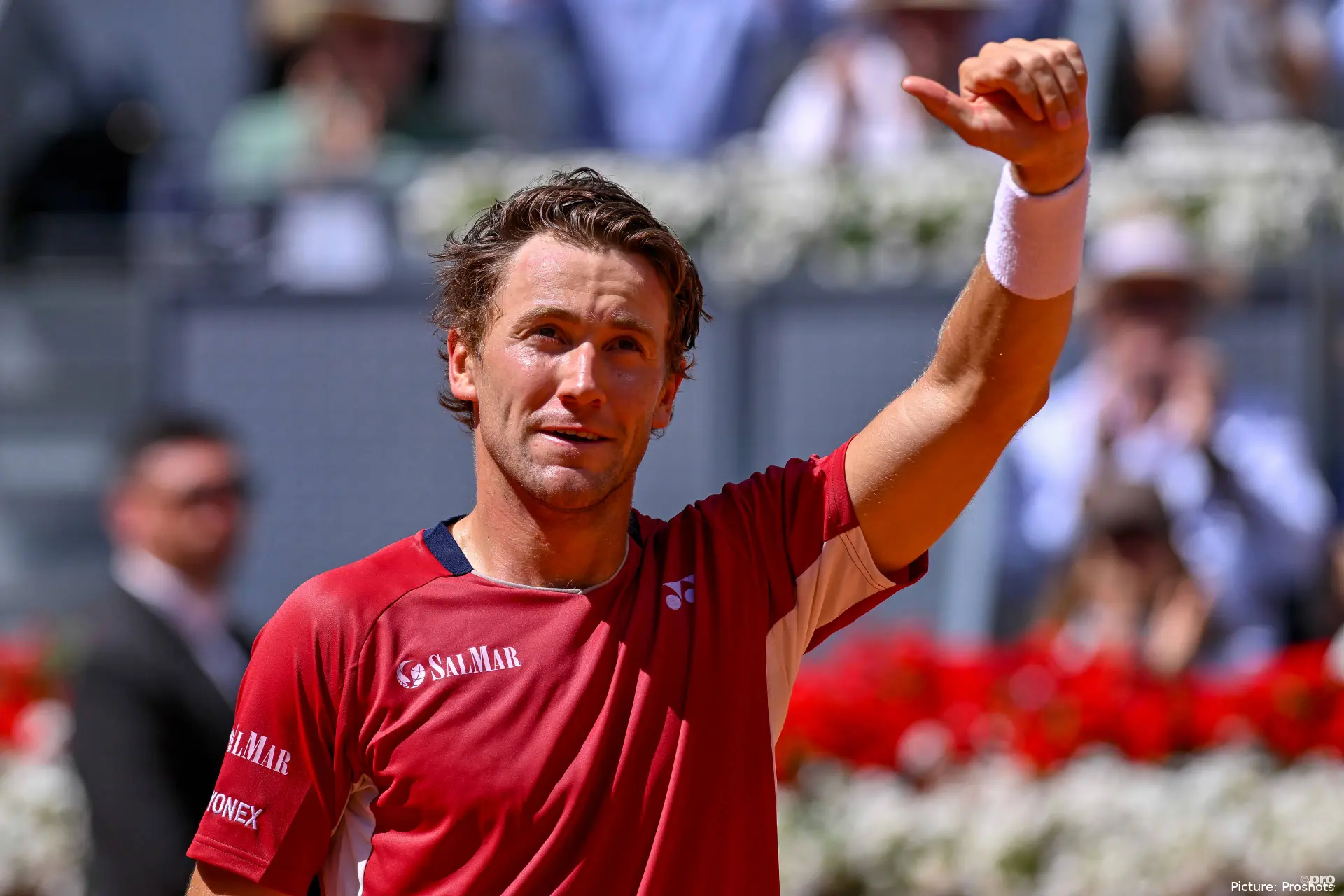
Casper Ruud and Luciano Darderi secured their places in the ATP Rome Open semi-finals after contrasting quarter-final victories on a day shaped by momentum swings and weather interruptions. Ruud recovered from a second-set collapse to defeat Karen Khachanov 6-1, 1-6, 6-2, while Darderi overcame Rafael Jodar 6-7, 7-5, 6-0 in a volatile encounter defined by late-set pressure and a one-sided decider.
Both matches highlighted shifting control patterns across extended baseline exchanges and service volatility, with Ruud ultimately reasserting authority after a post–rain delay dip in consistency, and Darderi managing decisive points more efficiently in key moments against Jodar.
Ruud reasserts control after second-set collapse to Khachanov
Casper Ruud def. Karen Khachanov 6-1, 1-6, 6-2
Casper Ruud opened the Rome Open quarter-final with a commanding first set against Karen Khachanov, building early scoreboard control through a break in the opening exchanges and consolidating it with efficient service games. The Norwegian quickly established baseline depth as the primary pattern, pushing Khachanov behind the baseline and limiting his ability to dictate first-strike rallies. A sequence of five consecutive games closed out the set 6-1, reflecting Ruud’s early dominance in neutral exchanges and return positioning.
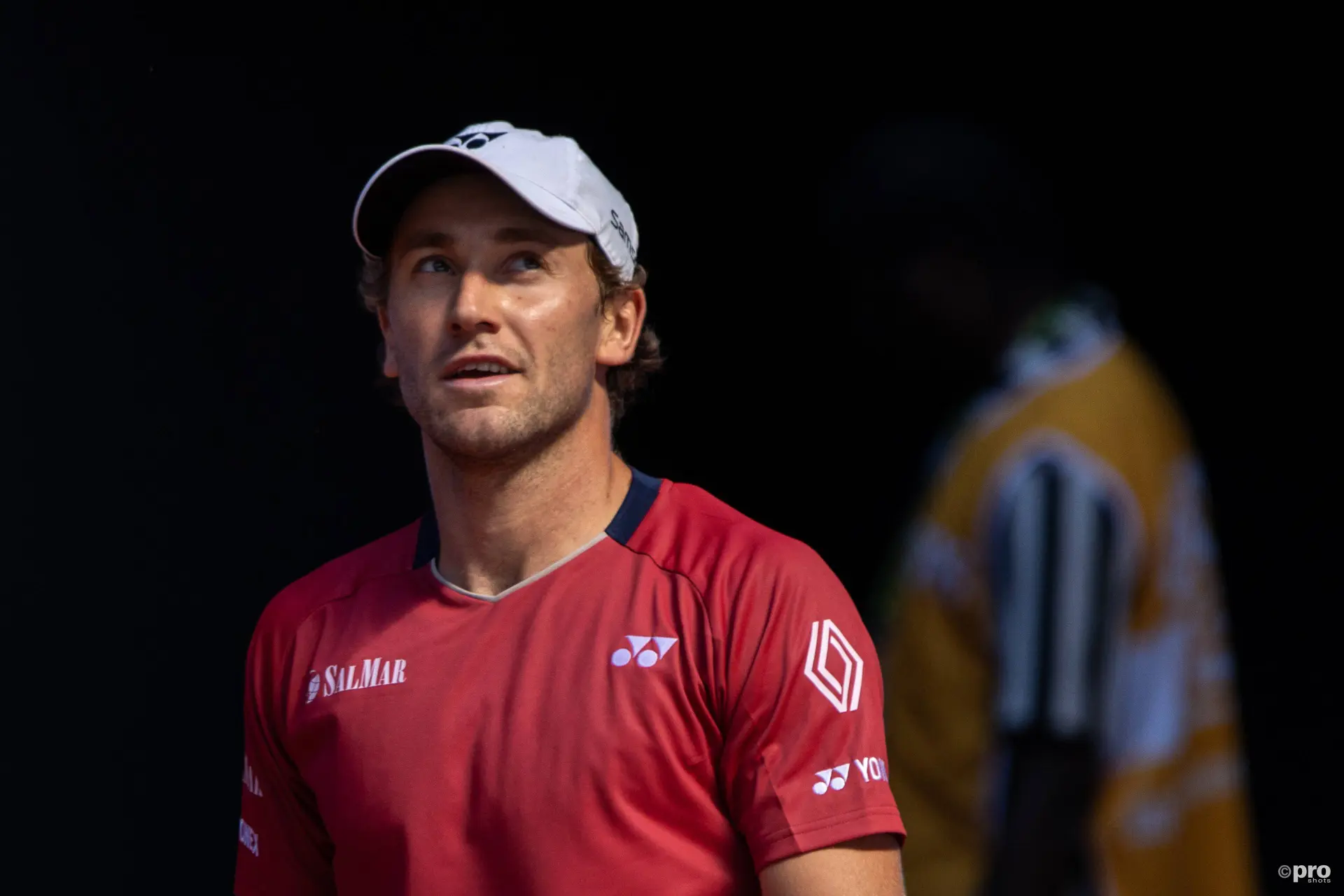
The match shifted sharply in the second set after the rain delay interruption, with Khachanov immediately increasing return aggression and targeting Ruud’s second serve. The Russian broke early and quickly extended into a double-break lead as Ruud’s unforced error count increased in baseline exchanges.
Khachanov’s depth and consistency improved significantly during this phase, while Ruud struggled to regain timing on both serve and forehand patterns, allowing the set to swing 6-1 in the opposite direction.
The decisive tactical adjustment arrived at the start of the third set, where Ruud stabilised his first-serve percentage and reduced second-serve exposure. He broke early to take control of the scoreboard and consolidated with improved rally tolerance, forcing Khachanov into longer defensive sequences. The Norwegian’s return positioning also moved further inside the baseline, increasing pressure on Khachanov’s second serve and limiting free points.

Casper Ruud waving and celebrating the victory in the game the Mutua Madrid Open 2026
From 2-0 onward, Ruud maintained structural control of the set through consistent service holds and higher break-point efficiency, while Khachanov’s level dropped in baseline exchanges and first-serve reliability. The Norwegian closed out the match 6-2 in the decider, with the statistical divergence across sets—particularly Ruud’s improved first-serve points won and reduced error rate in the third—defining the outcome and securing his place in the Rome Open semi-finals.
Darderi survives Jodar collapse before dominant decider in Rome
Luciano Darderi def. Rafael Jodar 6-7, 7-5, 6-0
Luciano Darderi opened the Rome quarter-final with immediate pressure on Rafael Jodar, breaking early and establishing baseline control through heavier depth and more consistent first-strike patterns. Jodar, however, gradually stabilised his service games and recovered the deficit, forcing a tightly contested opening set that ultimately reached a tiebreak after neither player could separate on return in the closing stages.
The first-set breaker swung in Darderi’s favour as he improved return positioning and reduced unforced errors in neutral rallies, edging a tight sequence of points to take it 7-6. That margin reflected marginal superiority on second-serve points and better decision-making under pressure, while Jodar remained competitive but struggled to convert early openings into sustained control during high-leverage moments.

The second set shifted through repeated momentum swings, with Jodar recovering from a break deficit and saving two match points on serve to extend the contest. The Spaniard even moved ahead late in the set after breaking at 6-5, before closing it out with a confident hold to force a decider, capitalising on a dip in Darderi’s consistency during extended baseline exchanges.
The final set, however, was completely one-sided as Darderi elevated his first-serve efficiency and return aggression to break repeatedly and dominate rallies from the baseline. He won six consecutive games to close out the match 6-0, converting sustained pressure into three straight breaks as Jodar’s level collapsed physically and structurally in the decider, sealing a commanding finish to a volatile encounter in Rome.
Read also

Lucas MichaelTennis Journalist
Lucas Michael is a tennis journalist based in Cambridge, UK, specializing in comprehensive coverage of the ATP and WTA tours. For the past 1.5 years, he has been a core contributor to TennisUpToDate, where he has authored more than 3,000 data-driven match reports, deep-dive analysis pieces, and engaging liveblogs.
Lucas pairs real-time statistical analysis with on-the-ground reporting, frequently traveling to tournaments to cover the action firsthand from the press box and player press conferences. This blend of advanced metrics and direct access allows him to provide sharp context regarding player form, tactical trends, and breaking tour developments.
He holds a BA (Hons) in Sports Journalism. Grounded in core journalistic ethics, Lucas places a strict emphasis on meticulous sourcing, editorial accuracy, and a commitment to updating live content swiftly as verified information emerges.
claps 0visitors 0
Just In

Popular News

Latest Comments
- Does Sinner need that 4.5 mil? I doubt it. He can make that with three modelling gigs!😅🤣Rapunzel21-10-2026
- Did "People Magazine" purchase this website? This nonstop storyline is bullshit.
 mandoist21-10-2026
 - Listen... this is of no concern to anyone but these two. Deal with your own issues -- most of us have our own. Thanks, media, for these insignificant follow-ups which are meaningless.mandoist21-10-2026
- This is so very very sad, for all three of them. I truly thought they had an unbreakable bond, but life throws up so many differing challenges. Having your homeland suffering in such a terrible way, makes happiness lose out to guilt as well. Our thoughts are with them. X💔bjsexton20-10-2026
- I have lost all respect for Svitolina! Could she not have waited until he had played at the Paris Masters!!! She is selfish and don't give a damn about Gael. That is NOT how love is demonstrated Elina!!Rapunzel19-10-2026
- Perhaps convenient tennis tour sex is not a strong enough experience in which to base a marriage?mandoist19-10-2026
- Fight the Good Fight... Tennis (sports in general) need more Humans such as yourself.mandoist18-10-2026
- When is WTA going to mandate Genetic Testing (DNA) ???mandoist18-10-2026
- Hey, Dan... you just wake up from a coma? Regardless -- Thanks for the comedy this morning!mandoist18-10-2026
- Two Things: 1. Stop allowing these Spoiled Trust-Fund Elitists to behave badly. Your little hand-slaps do not deter them. 2. STOP the incessantly annoying "towel wiping" nonsense!!!!mandoist15-10-2026

Loading