“That was magical for me" - Australian wheelchair tennis icon David Hall reminisces on pioneering career and Australian Tennis Hall of Fame induction
ATP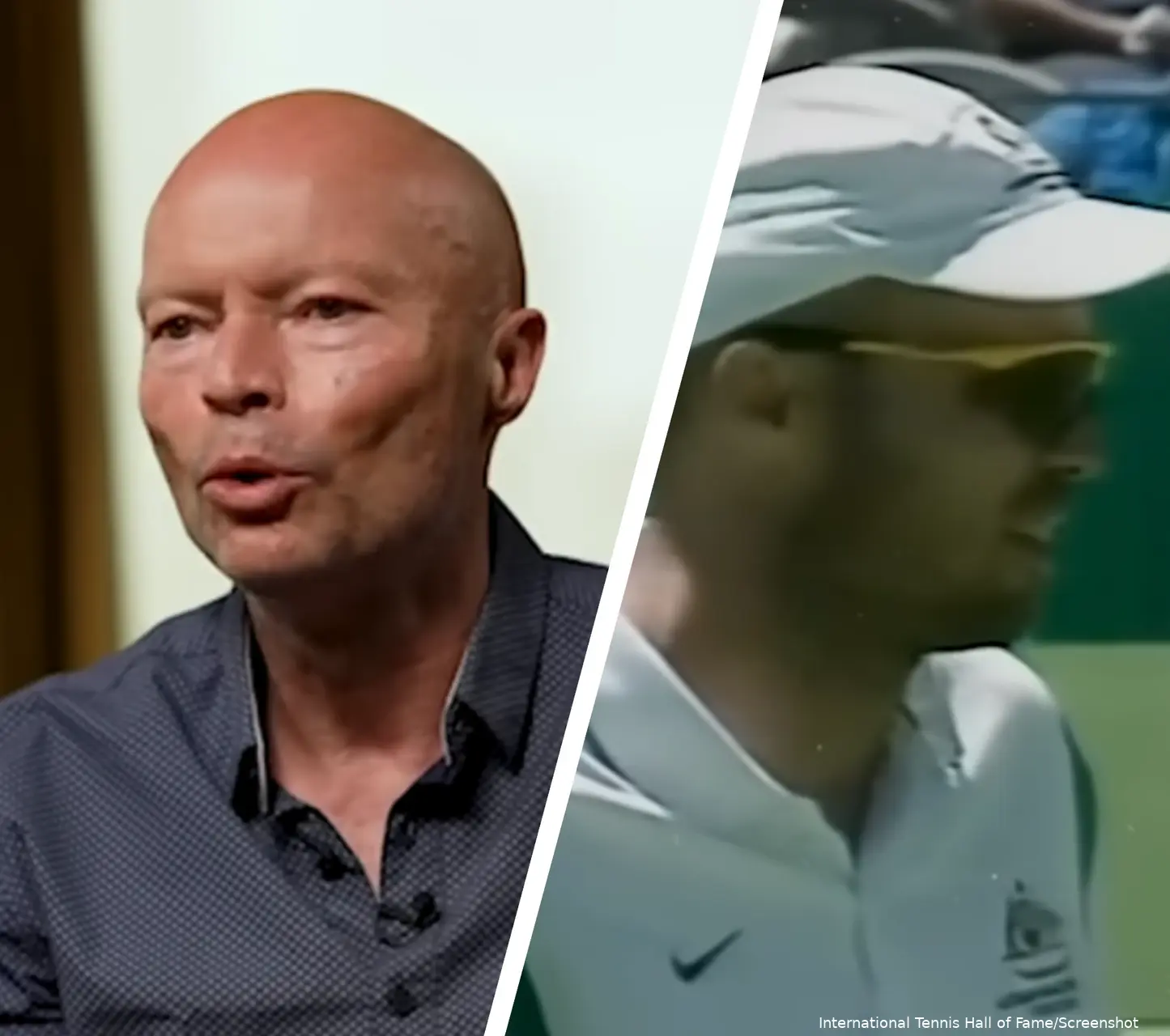
Australian tennis wheel chair legend David Hall has had a hugely decorated and inspiring career at the top of the sport. After a tragic accident as a teenager, he overcame all the obstacles to become a legend of the sport.
He ended his illustrious career with 17 Grand Slam titles. Nine Australian Open titles, seven Wimbledon triumphs and an astonishing eight US Open victories. He won six medals at the Paralympics, was a six-time ITF World Wheelchair champion and was the best wheelchair tennis player for a decade.
He has been widely recognised for his achievements, finding himself placed in numerous Hall of Fames throughout his time in the spotlight. The one which meant the most was his induction into the Australian Tennis Hall of Fame back in 2015.
“That was magical for me,” Hall recollected on The Sit Down Podcast. “It’s just so thrilling for me for it [my bronze bust] to be out there with Evonne [Goolagong Cawley], and Newk [John Newcombe], and Rod [Laver], and Frank Sedgman, and Ken [Rosewall], and all these iconic tennis players who have just changed the fabric of Australian society in so many ways – and I’m out there with them.”
Overcoming traumatic experience to become the world's best
As a teenager, Hall's life turned around. He lost both his legs after being hit by a car. As he attempted to readjust with prosthetic limbs, he fell in love with wheelchair tennis. While tennis had been a sport Hall had played regularly, this was a chance to once more show his talent and skill on the court despite the setbacks.
“Of course after having such a traumatic accident you feel sad, you feel angry, you’ve got all these emotions, and there’s a bit of ‘why me?’," Hall admitted. "But as you kind of move through that, you get out of hospital, you go into rehab, you try to transition into society."
This was when he made the decisive turn to wheelchair tennis. “I was learning to walk with prosthetic legs, and then at some point along the way I discovered wheelchair tennis, which was fantastic, because whatever negative energy I had I could kind of pour into hitting tennis balls," the Aussie confessed. "And so at some point, all that negativity, and anger, and confusion, and ‘why me?’ just got left in the past. If I was in a level of despair, I had to be willing to try to climb out of it. And I think that’s what that line [in the blurb] means – you have to be willing to find what’s out there. And that means not playing the victim, and it means just bearing your fangs, and maybe the alpha has to come out, a little.”
His stunning career has made him a popular person in society, with many people remembering him for his triumphs in the sport. He has had his legacy casted in bronze outside the Melbourne Park’s Garden Square. His statue stands proud among other legends of the sport. He remains the only person in a wheelchair to be in the Australian Hall of Fame showing his class.
“I just didn’t want to be remembered as the guy that couldn’t win gold, going in as the favourite in his own home town. The pressure was there,” Hall admitted. “But I just had to perform, not even like round to round at my best; I just had to perform when it mattered the most. The break points, in tiebreaks, in the third sets – and that’s all it took. I’ve played better at different tournaments; I didn’t play my best [in Sydney], but I could just turn it on when I needed to turn it on. If I get recognised, like in an elevator or something, it’ll be for that, for winning that [gold medal] match.”
Looking back on his career, Hall is very grateful to experience everything he did, making the most of an extremely tough situation. “I think the sport had given me so much. Not only did it give me dreams to chase, but it really helped me, early on, when I was coming out of rehab, with the social element as well," Hall said "I got to travel the world; I had a fantastic life for 15 years playing tournaments in all these different countries, meeting different people, [experiencing] different cultures, different food. Tennis was like this sweet carrot that I just wanted to taste year after year. And I was like: ‘I’ve eaten so many of these beautiful sweet carrots that I have to kind of reverse the situation. Now it’s my turn, I’ve got to give something to the sport."
Lucas MichaelTennis Journalist
Lucas Michael is a tennis journalist based in Cambridge, UK, specializing in comprehensive coverage of the ATP and WTA tours. For the past 1.5 years, he has been a core contributor to TennisUpToDate, where he has authored more than 3,000 data-driven match reports, deep-dive analysis pieces, and engaging liveblogs.
Lucas pairs real-time statistical analysis with on-the-ground reporting, frequently traveling to tournaments to cover the action firsthand from the press box and player press conferences. This blend of advanced metrics and direct access allows him to provide sharp context regarding player form, tactical trends, and breaking tour developments.
He holds a BA (Hons) in Sports Journalism. Grounded in core journalistic ethics, Lucas places a strict emphasis on meticulous sourcing, editorial accuracy, and a commitment to updating live content swiftly as verified information emerges.
claps 0visitors 0
Just In




Popular News
Latest Comments
- A healthy Qinwen may be hard to stop next season. She was already scaring her opponents before her medical leave(s). Unfortunately, Zheng insisted on singing again. On the positive side -- Mirra did not sing!! ;~}
 mandoist11-10-2026
 - Where is it written that athletes, entertainers... People in general... are mandated to keep looking at -- or even using [anti]Social Media? Public & private figures consistently complain and reveal their concerns about negativity and violence thrown at them -- yet they insist on participating. Avoid it, don't use it, don't read it. It's okay to occasionally look up at the World instead beating your eyes & thumbs to death on The Inventions out there.mandoist11-10-2026
- great articlestennisseserver07-10-2026
- Medvedev was leading Djokovic 7-5, 3-5 when an attempted return..' NO you ignorants, Djokovic was leading .weiss05-10-2026
- No more bullshit "Wildcards" to these two. Qualify like everyone else -- there will be cameras there, too. Time to scream... WTF ????!!!!mandoist29-09-2026
- Let's not BS the general public -- Sabalenka started showing cracks in her game last season. Her losses and near-losses started at about the same time she began being distracted by Fame (constant Selfies, making TV commercials, magazine shoots, endless Social Media nonsense, etc., etc.) One would think even Saba could recognize the parallels with others who failed before her -- Raducanu, Giorgi, Bouchard to name a few.mandoist25-09-2026
- Gross!! Hey Raducanu, Giorgi, and Bouchard -- reserve a seat at your Social Media Selfie table for Saba + Naomi. They're heading in your direction soon enough.mandoist24-09-2026
- And then these same players will complain about how lengthy their season’s were and need more time-off. I’m all for more tennis but the amount of tennis we get now is actually kind of crazy! We all need a break, especially the players.DaveyWavey23-09-2026
- You should do a comparison article for "different kinds of justice" the courts decide for tennis players. I can think of at least three players who received very small bans of a few months, however Tara Moore has been fighting for her literal survival the past few years. It seems odd considering she is not a "name" player, unlike the other cases.DaveyWavey22-09-2026
- PRIZE MONEY & POINTS Winner - $185,500 Finalist - $114,500 Semi-Finalist - $66,003 Quarter-Finalist - $35,000 Round of 16 - $18,045 Round of 32 - $13,005 Winner - 500 Finalist - 325 Semi-Finalist - 195 Quarter-Finalist - 108 Round of 16 - 60 Round of 32 - 1DaveyWavey20-09-2026

Loading