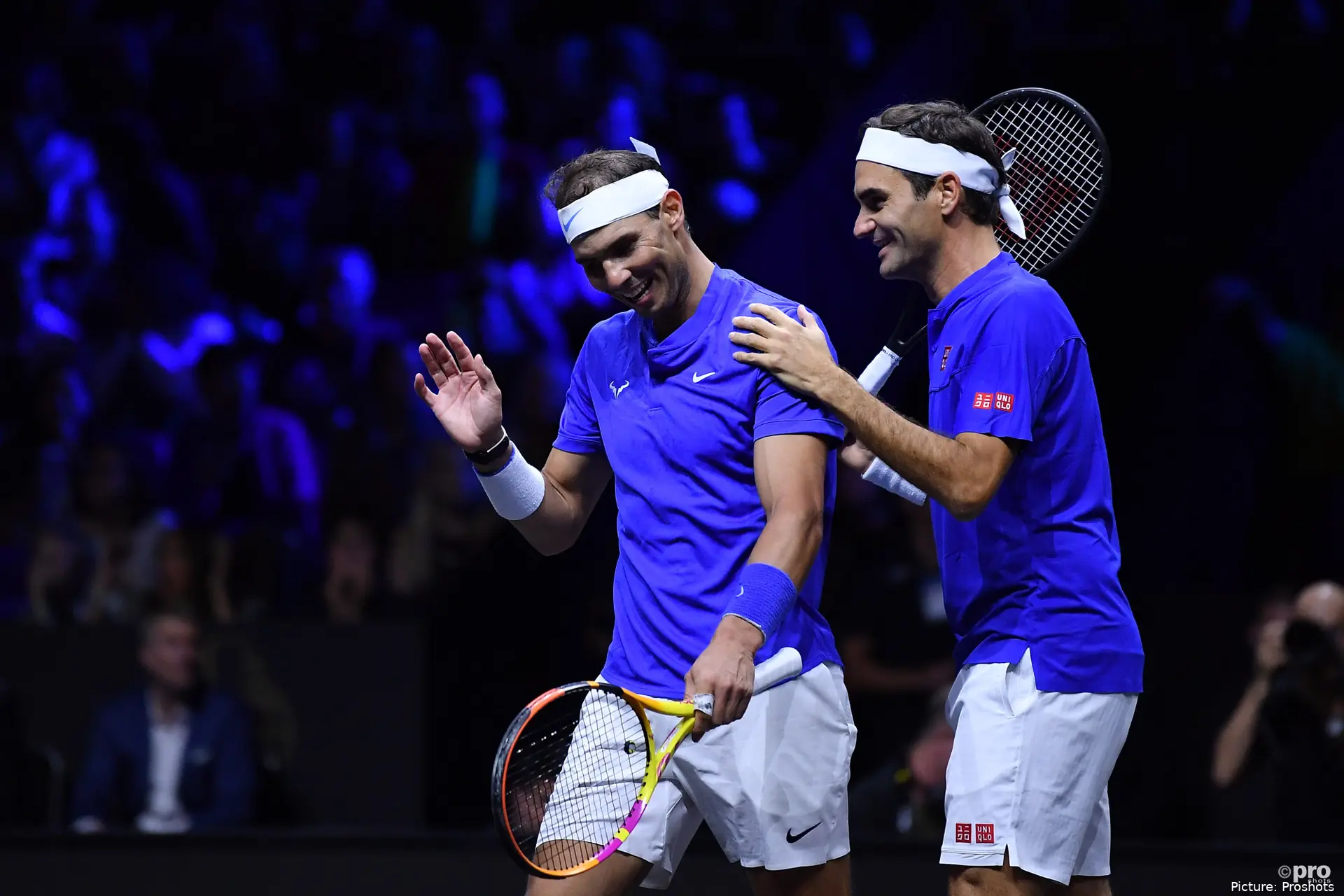
The Laver Cup didn't exist until 2017, which means one of the most fascinating hypothetical editions in tennis history never got to happen: 2006, the year Roger Federer produced arguably the greatest single season the Open Era has seen, a 19-year-old Rafael Nadal solidified himself as the one man capable of consistently beating him, and the gap between the sport's No. 3 and No. 15 was genuinely as thin as it's ever been.
Picking six Europeans against six non-Europeans from that season produces something today's format almost never does anymore: a top of the draw that's completely settled and a middle of the draw that's a total coin flip. Here's how that tie would have shaped up.
Team Europe
| Player | Country | 2006 ranking | Season snapshot |
| Roger Federer | Switzerland | No. 1 (year-end) | 92-5 record; won the Australian Open, Wimbledon, US Open and Tennis Masters Cup |
| Rafael Nadal | Spain | No. 2 (year-end) | Won the French Open, runner-up at Wimbledon; beat Federer in the Dubai final |
| Ivan Ljubičić | Croatia | No. 5 | French Open semifinalist; one of the tour's biggest serves |
| Nikolay Davydenko | Russia | No. 3 | Won the Paris Masters indoors; French Open quarterfinalist; the tour's most durable baseliner |
| Tommy Robredo | Spain | No. 7 | Hamburg Masters champion |
| Tommy Haas | Germany | No. 11 | Rebuilding after multiple shoulder surgeries; still capable of beating anyone on a good day. Former silver medallist in Olympic doubles |
Team World
| Player | Country | 2006 ranking | Season snapshot |
| James Blake | United States | No. 4 | Career-best season; beat Nadal in the Indian Wells semifinal; reached the year-end Masters Cup |
| Andy Roddick | United States | No. 6 | Reached the US Open final under new coach Jimmy Connors |
| David Nalbandian | Argentina | No. 8 | French Open semifinalist (retired injured); one of the tour's most dangerous returners |
| Fernando González | Chile | No. 10 | Reached the Madrid Masters final; would reach the Australian Open final in January 2007 |
| Lleyton Hewitt | Australia | No. 20 | Former world No. 1 and two-time major champion, past his peak but still relentless |
| Andre Agassi | United States | Outside the top 20 | 8-time Grand Slam champion in the last part of his career |
The Federer/Nadal factor
There's no ambiguity about who Team Europe's top two singles points would have been, or how heavily they'd have tilted the tie. Federer's 2006 remains one of the greatest seasons any man has produced — three majors, 12 titles overall, and a 92-5 record that included dropping only two matches all year, both to Nadal.
Nadal, in turn, was already the one player on the planet who knew how to beat him: he took the French Open final in four sets and pushed him to a fourth-set tiebreak at Wimbledon before losing.
But it's worth being precise about what that dominance actually covered. Federer's aura was close to absolute on every surface, while Nadal's was still overwhelmingly clay-specific. He did beat Federer in the Dubai final that February on hard court, snapping a 56-match hard-court winning streak — real proof the weapon existed.
The same season, though, brought a semifinal loss to Blake at Indian Wells and a second-round exit to countryman Carlos Moyá in Miami. On clay, this tie is over before it starts. On a hard court, in 2006, Nadal was dangerous rather than automatic — a genuinely important distinction for how close the overall result could have been.

Team Europe's other strengths
Below the top two, Europe's roster carried real, varied weapons of its own. Ljubičić reached a career-high No. 3 in May 2006 and had already helped Croatia win the 2005 Davis Cup, backed by one of the biggest and most reliable serves on tour — the kind of game that turns hard, fast conditions into an equalizer against almost anyone.
Davydenko, meanwhile, closed the season by winning the Paris Masters on indoor carpet without dropping a set in the final, proof that Europe's depth had real answers for exactly the kind of fast, indoor conditions a Laver Cup-style event tends to favor.
Robredo was already inside the top 10 by that point, although his strongest results had come primarily on clay courts. He perhaps lacked the same profile as some of his teammates and could have been more of a secondary figure in a team packed with stars, particularly when compared with the other options available to Europe.
Haas, by contrast, offered pure pedigree rather than current ranking: a former world No. 2 still fighting back from shoulder surgery, capable of the kind of big, fearless ball-striking that had beaten the best players in the world before.

Nikolay Davydenko at the Australian Open.
Team World's strengths, and the González factor
Team World's non-Federer, non-Nadal cases were, if anything, even stronger on paper. Blake was playing the best tennis of his career and had already beaten Nadal that season on his way to a year-end Masters Cup appearance. Roddick, freshly paired with Jimmy Connors, had just reached the US Open final and still carried one of the biggest serves in tennis history.
Nalbandian remained one of the sport's most feared ball-strikers when healthy, capable of the kind of explosive baseline tennis that had already produced a Masters Cup title against a red-hot Federer the year before. Hewitt and Agassi, both past their absolute peaks, still carried the specific danger of former world No. 1 and Grand Slam champions who each knew exactly how to grind out a tight, tactical match.

David Nalbandian at Indian Wells 2012
Then there's González, by the end of 2006, a genuine top-10 singles force in his own right — he'd reached the Madrid Masters final that October and would follow it, just weeks later, with a run to the Australian Open final in January 2007, one of the biggest forehands in the sport carrying him there.
His Olympic doubles gold from Athens 2004, alongside countryman Nicolás Massú, is a real bonus rather than his headline value: in a format built around a doubles rubber, a singles-caliber top-10 player who also happens to be an Olympic doubles champion is exactly the kind of matchup nightmare neither roster has an obvious equivalent for.
How the tie plays out
Put together, this looks far closer than the top line suggests. Europe's clearest edge is at the very top, where Federer is close to unbeatable regardless of surface and Nadal is a heavy favorite on anything resembling clay.
But the case for Team World's depth is genuinely strong, and the indoor-hard-court question the format itself would raise cuts both ways rather than clearly favoring Europe: Davydenko's Paris Masters title argues for Europe's comfort in exactly those conditions, but Nalbandian's own résumé in fast indoor tennis — a Masters Cup title over Federer in round-robin play, among other results — makes the case right back for Team World.
Read also

Add González's status as a genuine top-10 singles threat rather than a doubles specialist doing a job, and Team World's argument for winning three, four, or even five of the remaining points looks entirely credible.
That's the real shape of 2006: a genuine superpower at the very top of the sport, and one of the most competitive, unpredictable fields directly beneath it the game has produced in the last two decades.
A Laver Cup that year wouldn't have been a formality for either side. It would have been a fight decided by which handful of players outside the top two happened to be playing their best tennis that particular week — and on paper, that fight looks close to even.

Cristhián AvilaTennis Journalist
Cristhián Ávila is a tennis journalist based in Santiago, Chile, and has been part of the TennisUpToDate team since early 2023. He covers the ATP and WTA Tours as well as all four Grand Slams, producing breaking news, match reports, analysis, and regular liveblogs from major tournaments.
His reporting combines statistical analysis with clear explanation, helping readers understand tactical developments, player form, and broader storylines across the tour. Working fluently in both Spanish and English, Cristhián collaborates with an international editorial team and contributes to comprehensive global coverage. As part of his work, he has conducted interviews and media interactions with leading figures in the sport, including Caroline Wozniacki and John McEnroe.
In his journalism, Cristhián places strong emphasis on careful sourcing, editorial accuracy, and updating articles promptly when new, verified information becomes available. His coverage is grounded in research, context, and direct engagement with professional tennis.
claps 0visitors 0
Just In

Popular News
Latest Comments
- Two Things: 1. Stop allowing these Spoiled Trust-Fund Elitists to behave badly. Your little hand-slaps do not deter them. 2. STOP the incessantly annoying "towel wiping" nonsense!!!!
 mandoist15-10-2026
 - A healthy Qinwen may be hard to stop next season. She was already scaring her opponents before her medical leave(s). Unfortunately, Zheng insisted on singing again. On the positive side -- Mirra did not sing!! ;~}mandoist11-10-2026
- Where is it written that athletes, entertainers... People in general... are mandated to keep looking at -- or even using [anti]Social Media? Public & private figures consistently complain and reveal their concerns about negativity and violence thrown at them -- yet they insist on participating. Avoid it, don't use it, don't read it. It's okay to occasionally look up at the World instead beating your eyes & thumbs to death on The Inventions out there.mandoist11-10-2026
- great articlestennisseserver07-10-2026
- Medvedev was leading Djokovic 7-5, 3-5 when an attempted return..' NO you ignorants, Djokovic was leading .weiss05-10-2026
- No more bullshit "Wildcards" to these two. Qualify like everyone else -- there will be cameras there, too. Time to scream... WTF ????!!!!mandoist29-09-2026
- Let's not BS the general public -- Sabalenka started showing cracks in her game last season. Her losses and near-losses started at about the same time she began being distracted by Fame (constant Selfies, making TV commercials, magazine shoots, endless Social Media nonsense, etc., etc.) One would think even Saba could recognize the parallels with others who failed before her -- Raducanu, Giorgi, Bouchard to name a few.mandoist25-09-2026
- Gross!! Hey Raducanu, Giorgi, and Bouchard -- reserve a seat at your Social Media Selfie table for Saba + Naomi. They're heading in your direction soon enough.mandoist24-09-2026
- And then these same players will complain about how lengthy their season’s were and need more time-off. I’m all for more tennis but the amount of tennis we get now is actually kind of crazy! We all need a break, especially the players.DaveyWavey23-09-2026
- You should do a comparison article for "different kinds of justice" the courts decide for tennis players. I can think of at least three players who received very small bans of a few months, however Tara Moore has been fighting for her literal survival the past few years. It seems odd considering she is not a "name" player, unlike the other cases.DaveyWavey22-09-2026

Loading