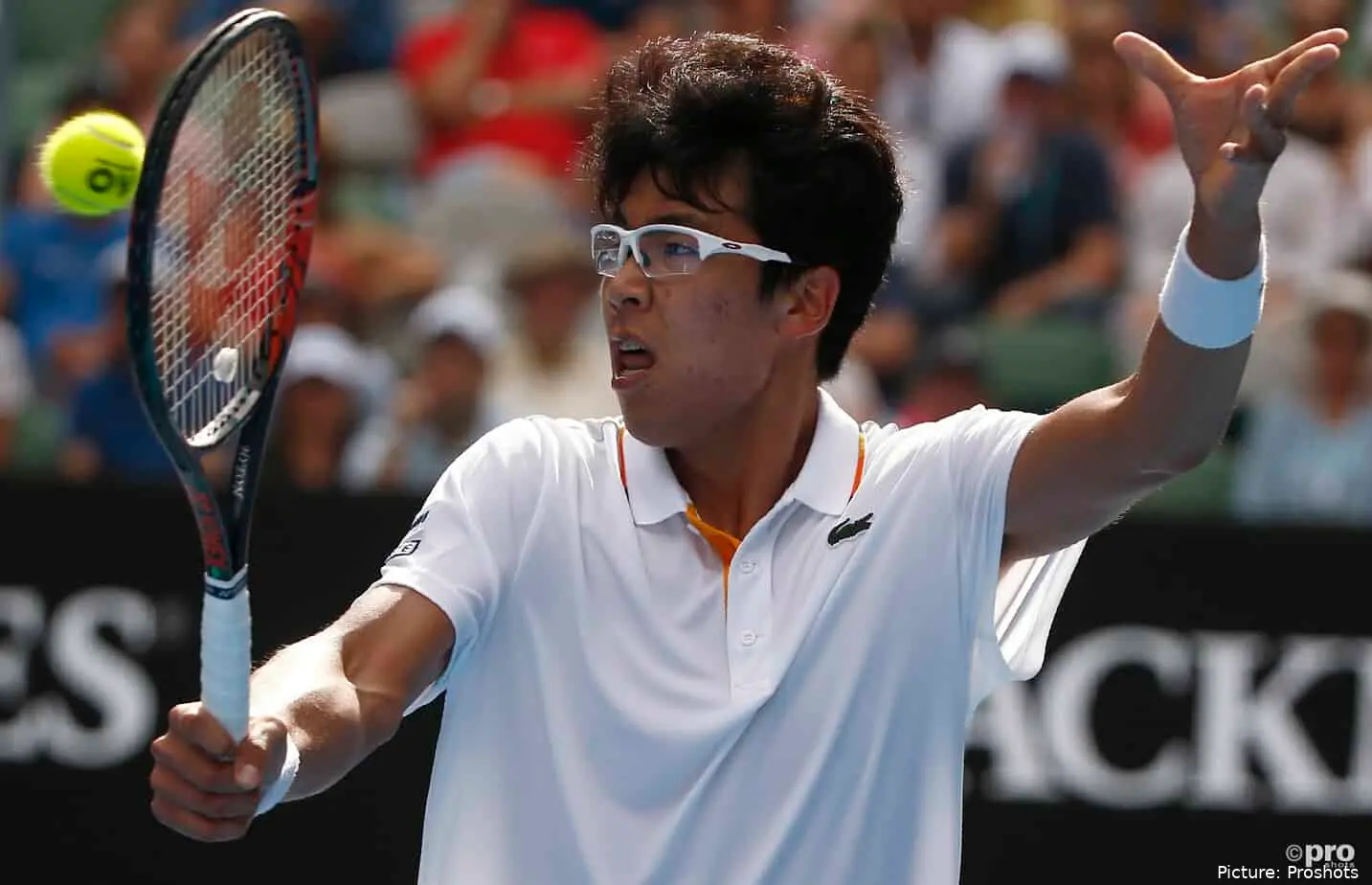
For two weeks in January 2018, Hyeon Chung looked like the future of men's tennis. Ranked No. 58 and largely unknown outside Asia, he beat Alexander Zverev and a six-time Australian Open champion in Novak Djokovic on his way to the semifinal in Melbourne, playing some of the cleanest, most complete tennis anyone had seen from a 21-year-old in years. Eight years later, he's 30, ranked outside the world's top 500, and still grinding through Challenger and ITF events trying to rediscover a fraction of that level.
Chung's story isn't really about a talent that disappeared. It's about a body that stopped cooperating right at the moment everything else had finally lined up — and a career that's spent most of the years since trying, and mostly failing, to get back to a level it touched only once.
Hyeon Chung — career snapshot
| Career-high ranking | No. 19 (2 April 2018) |
| Best Grand Slam result | Semifinal, Australian Open 2018 |
| Career ATP titles (finals) | 0 |
| Career singles record | 88–71 |
| Career prize money | $3,792,259 |
| Current Ranking | No. 549 (as of September 2026) |
A prodigy on the fastest possible timeline
Chung's rise through the junior and early professional ranks was rapid by any standard. He won the Australian Open boys' singles title in 2013, then capped 2017 by winning the inaugural Next Gen ATP Finals, the tour's showcase event for its best players under 21, and finished that season inside the world's top 60. It was the kind of résumé that made tennis insiders take notice well before the general public did.
That recognition arrived almost immediately. Two months after winning the Next Gen title, Chung walked into the 2018 Australian Open as a total outsider to the wider tennis audience and left it as one of the sport's most talked-about young players, regardless of what happened next.
Chung's run through that Australian Open draw remains one of the more remarkable underdog stories in recent Grand Slam history. He beat Zverev, then the world No. 4, in the third round, then dismantled Djokovic in straight sets in the fourth round — a result that stunned the tennis world given Djokovic's history at the tournament.
The run ended in the semifinal against Roger Federer, cut short by a foot problem that forced Chung to retire mid-match, already foreshadowing the issue that would come to define the rest of his career.
Hyeon Chung's 2018 Australian Open run
| Round | Opponent | Opp. ranking | Score |
| 1st round | Mischa Zverev | 32 | 6–2, 4–1 RET |
| 2nd round | Daniil Medvedev | 53 | 7–6(4), 6–1, 6–1 |
| 3rd round | Alexander Zverev | 4 | 5–7, 7–6(3), 2–6, 6–3, 6–0 |
| 4th round | Novak Djokovic | 14 | 7–6(4), 7–5, 7–6(3) |
| Quarter-final | Tennys Sandgren | 97 | 6–4, 7–6(5), 6–3 |
| Semi-final | Roger Federer | 2 | 1–6, 5–2 RET. |
The injury spiral that followed
The Melbourne run pushed Chung to a career-high No. 19 two months later, but the foot problem that ended his Federer match never fully resolved. Persistent foot issues kept recurring over the following seasons, forcing repeated withdrawals and preventing him from stringing together the consistent stretches of tour-level tennis needed to build on his one great result. Rather than launching a run toward the top 10, the breakthrough became something closer to a ceiling he could never approach again.
By the early 2020s, Chung had essentially disappeared from tour-level tennis, sidelined for extended stretches while his ranking drifted further from the No. 19 he'd once reached. The gap between the player who beat Djokovic in Melbourne and the player barely able to complete a full season only widened with time.
A comeback measured in setbacks
Chung's return to competition has been a genuinely difficult, incremental process rather than a clean second act. He played his first singles match in two and a half years at a Challenger event in Seoul in 2023, losing to Jordan Thompson, then followed it with a three-set defeat in Busan that he still described afterward as encouraging simply for how long he'd managed to compete. Across five Challenger events that year, he lost in the first round every single time.
An attempt to reach the Wimbledon main draw that year using a protected ranking produced a first-round win, briefly raising hopes of a real turning point, before a retirement in the second set of the following round underlined how far off full fitness he still was. 2024 brought a similar pattern at both ITF and Challenger level — inconsistent results, occasional signs of his old timing on the ball, but nothing resembling sustained form.
Chung's comeback, year by year
| Year | Status |
| 2018 | Reaches career-high No. 19 after Australian Open semifinal run |
| 2019–2022 | Recurring foot problems; extended absences from tour-level tennis |
| 2023 | Returns to competition; loses in the first round of all five Challenger events entered |
| 2024 | Splits time between ITF and Challenger events, seeking consistency |
| May 2026 | Wins an ITF M25 title in Nakhon Pathom, Thailand |
Where he stands now
Chung is 30 now, still active, and still competing almost entirely at Challenger, Davis Cup and ITF level rather than the tour stage that once seemed inevitable for him. His ranking sits around No. 549, a reflection of just how far the rebuild still has to go, but small signs of life continue to surface — including a title at an ITF M25 event in Nakhon Pathom, Thailand, this past May, his first meaningful piece of silverware in years.
Read also

It's a modest marker next to an Australian Open semifinal, but for a player whose career has been defined almost entirely by one extraordinary fortnight and the injuries that followed it, even a small title represents real progress. Whether Chung ever gets back to anything resembling his 2018 level remains genuinely uncertain. What's clear is that he hasn't stopped trying to find out.
There's also something worth remembering about what Chung's run actually meant at the time, beyond his own career trajectory. He was the first Korean man ever to reach a Grand Slam semifinal, and his run through Melbourne briefly turned tennis into a mainstream story back home in a way it rarely had been before.
That cultural weight hasn't disappeared just because the results that followed it did — it's part of why his comeback, however small the individual titles along the way, still gets covered as a genuine story rather than a routine Challenger-level grind.

Cristhián AvilaTennis Journalist
Cristhián Ávila is a tennis journalist based in Santiago, Chile, and has been part of the TennisUpToDate team since early 2023. He covers the ATP and WTA Tours as well as all four Grand Slams, producing breaking news, match reports, analysis, and regular liveblogs from major tournaments.
His reporting combines statistical analysis with clear explanation, helping readers understand tactical developments, player form, and broader storylines across the tour. Working fluently in both Spanish and English, Cristhián collaborates with an international editorial team and contributes to comprehensive global coverage. As part of his work, he has conducted interviews and media interactions with leading figures in the sport, including Caroline Wozniacki and John McEnroe.
In his journalism, Cristhián places strong emphasis on careful sourcing, editorial accuracy, and updating articles promptly when new, verified information becomes available. His coverage is grounded in research, context, and direct engagement with professional tennis.
claps 0visitors 0
Just In

Popular News
Latest Comments
- A healthy Qinwen may be hard to stop next season. She was already scaring her opponents before her medical leave(s). Unfortunately, Zheng insisted on singing again. On the positive side -- Mirra did not sing!! ;~}
 mandoist11-10-2026
 - Where is it written that athletes, entertainers... People in general... are mandated to keep looking at -- or even using [anti]Social Media? Public & private figures consistently complain and reveal their concerns about negativity and violence thrown at them -- yet they insist on participating. Avoid it, don't use it, don't read it. It's okay to occasionally look up at the World instead beating your eyes & thumbs to death on The Inventions out there.mandoist11-10-2026
- great articlestennisseserver07-10-2026
- Medvedev was leading Djokovic 7-5, 3-5 when an attempted return..' NO you ignorants, Djokovic was leading .weiss05-10-2026
- No more bullshit "Wildcards" to these two. Qualify like everyone else -- there will be cameras there, too. Time to scream... WTF ????!!!!mandoist29-09-2026
- Let's not BS the general public -- Sabalenka started showing cracks in her game last season. Her losses and near-losses started at about the same time she began being distracted by Fame (constant Selfies, making TV commercials, magazine shoots, endless Social Media nonsense, etc., etc.) One would think even Saba could recognize the parallels with others who failed before her -- Raducanu, Giorgi, Bouchard to name a few.mandoist25-09-2026
- Gross!! Hey Raducanu, Giorgi, and Bouchard -- reserve a seat at your Social Media Selfie table for Saba + Naomi. They're heading in your direction soon enough.mandoist24-09-2026
- And then these same players will complain about how lengthy their season’s were and need more time-off. I’m all for more tennis but the amount of tennis we get now is actually kind of crazy! We all need a break, especially the players.DaveyWavey23-09-2026
- You should do a comparison article for "different kinds of justice" the courts decide for tennis players. I can think of at least three players who received very small bans of a few months, however Tara Moore has been fighting for her literal survival the past few years. It seems odd considering she is not a "name" player, unlike the other cases.DaveyWavey22-09-2026
- PRIZE MONEY & POINTS Winner - $185,500 Finalist - $114,500 Semi-Finalist - $66,003 Quarter-Finalist - $35,000 Round of 16 - $18,045 Round of 32 - $13,005 Winner - 500 Finalist - 325 Semi-Finalist - 195 Quarter-Finalist - 108 Round of 16 - 60 Round of 32 - 1DaveyWavey20-09-2026

Loading