“I didn’t know how to slide at all”: Iva Jovic begins first full clay swing after rapid Top 20 rise
WTA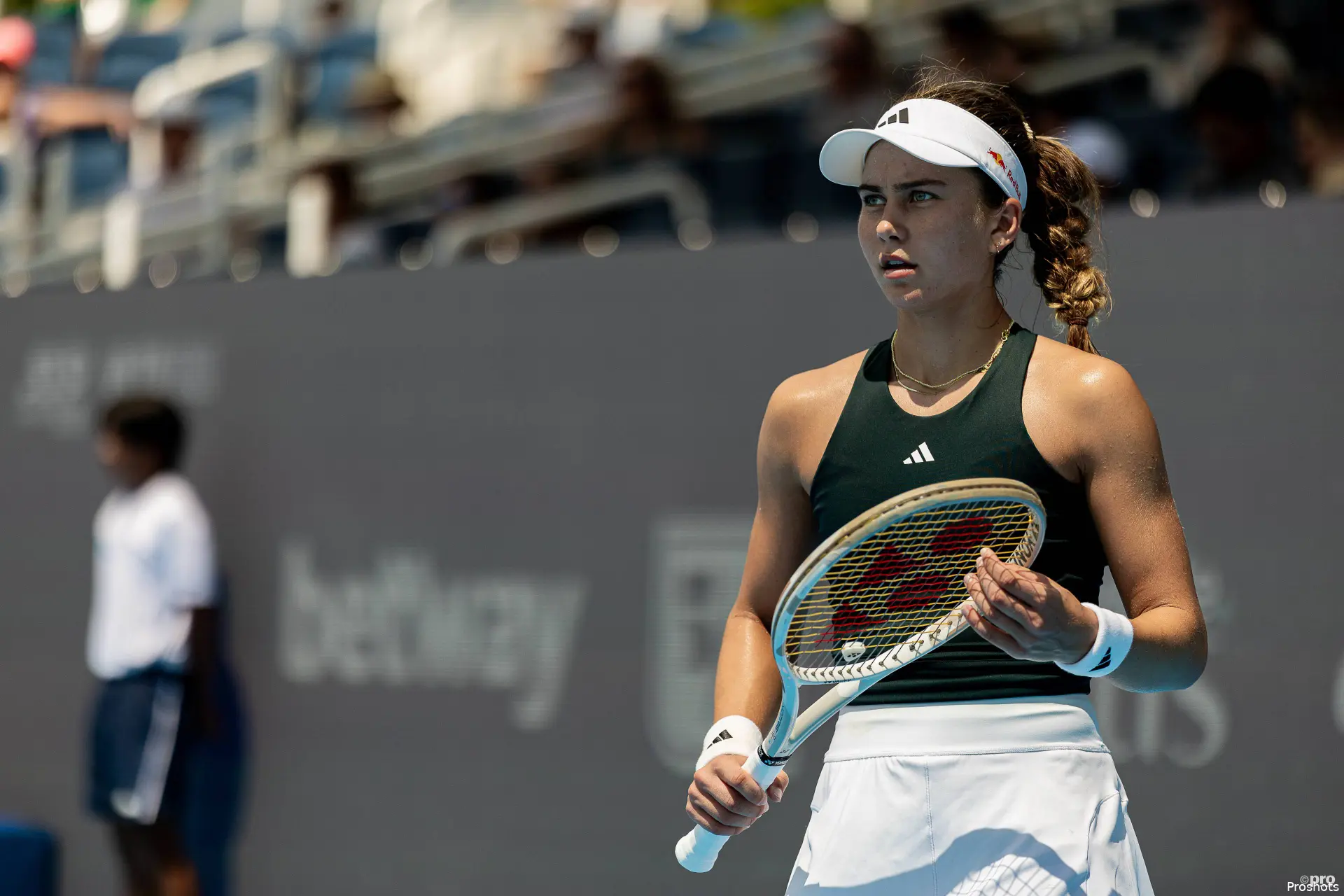
Iva Jovic arrives at the 2026 clay-court swing in a markedly different position from a year ago. Now ranked World No. 16, the 18-year-old American is no longer navigating the margins of the tour but establishing herself within its upper tier. Her breakthrough run to the Australian Open quarter-finals in January, including a win over a top-10 opponent, confirmed her capacity to compete at the highest level.
That rise has been supported by consistent results early in the season. Jovic reached the final in Hobart and the semi-finals in Auckland before Melbourne, building momentum that translated into her first deep Grand Slam run. The Sunshine Double offered a more mixed return, with no significant run at Indian Wells and a third-round exit in Miami, but her ranking has remained stable inside the top 20.
The transition to clay introduces a new phase in her development. Unlike many European peers, Jovic’s exposure to the surface has been limited, a factor she has acknowledged openly. Her previous clay experience consisted of a partial swing in 2025, including appearances in Bogotá and Roland Garros, alongside ITF events, without advancing beyond early rounds.
Now entering her first full clay campaign, beginning in Charleston, Jovic is approaching the surface as both a competitive challenge and a technical adjustment. Her comments reflect a player aware of the gap but also of the progress made in a relatively short period.
From limited clay exposure to structured adaptation
Jovic’s starting point on clay was notably delayed compared to many players on tour. She did not encounter the surface until her mid-teens, and her early experiences were defined more by unfamiliarity than adaptation. She has since reframed that gap as part of a longer-term development process.
“I didn't know how to slide at all (on clay). I didn't know anything about it,” she said on Media Day in Charleston. “I worked a lot in the past two years to get more comfortable on the clay, and I think now I'm in a much better place.”
That progression is central to her outlook entering Charleston, where she will compete on green clay. The surface, faster than traditional red clay, offers a transitional environment that aligns more closely with her hard-court base. Jovic has already experienced success on it at ITF level, which informs her confidence heading into the week.
“I really like the green clay, actually. Last year, I played one tournament on the green clay, I won it. So ITF event, slightly different than the tournaments nowadays, but I like it. I think it's quite faster than the red clay, so it's a good little transition to go from the hard to the green to the red.”
Her comments also reflect a broader structural difference in American development pathways. With limited access to red clay domestically, players often rely on green clay as an intermediate step, a factor that has historically influenced results at Charleston. “Us Americans usually we play well on the green. I think a lot of Americans won this tournament. We're more used to it. We don't have a lot of red here.”

Tactical evolution and expectations for the clay swing
Jovic’s objectives for the clay season are framed less around results and more around expanding her tactical range. The slower surface demands adjustments in point construction, including greater use of variation, spin and court positioning. That emphasis represents a shift from the more direct patterns that have underpinned her success on hard courts.
“Right now, I'm a lot about variety. A lot about mixing in some different plays, especially on the clay. It's slower. You need to find different ways of getting people off the court, maybe some slices, maybe some more angles playing around with your serve a little bit more. Different spins, different return positions.”
Her approach suggests a willingness to absorb short-term inconsistency in pursuit of longer-term gains. That aligns with her recent results, where a peak performance in Melbourne was followed by more uneven outcomes during the Sunshine Double. The pattern is consistent with a player transitioning from breakthrough to consolidation within the top tier.
At the same time, Jovic appears comfortable with the broader context of her development. Her ranking, age and trajectory provide margin for experimentation, particularly on a surface where expectations are naturally moderated. As she noted succinctly, the objective is to become “a little bit more unpredictable,” a trait often associated with effective clay-court players.
“It's really cool. Obviously, last year I didn't get to do — I played Bogota and I played French Open, some ITF, so this is the first time to do the whole official thing, which is exciting, and I've been working hard this past week after Miami to get used to the clay. It's obviously a little different with the movement and everything.”

Cristhián AvilaTennis Journalist
Cristhián Ávila is a tennis journalist based in Santiago, Chile, and has been part of the TennisUpToDate team since early 2023. He covers the ATP and WTA Tours as well as all four Grand Slams, producing breaking news, match reports, analysis, and regular liveblogs from major tournaments.
His reporting combines statistical analysis with clear explanation, helping readers understand tactical developments, player form, and broader storylines across the tour. Working fluently in both Spanish and English, Cristhián collaborates with an international editorial team and contributes to comprehensive global coverage. As part of his work, he has conducted interviews and media interactions with leading figures in the sport, including Caroline Wozniacki and John McEnroe.
In his journalism, Cristhián places strong emphasis on careful sourcing, editorial accuracy, and updating articles promptly when new, verified information becomes available. His coverage is grounded in research, context, and direct engagement with professional tennis.
claps 0visitors 0
Just In



Popular News


Latest Comments
- Does Sinner need that 4.5 mil? I doubt it. He can make that with three modelling gigs!😅🤣Rapunzel21-10-2026
- Did "People Magazine" purchase this website? This nonstop storyline is bullshit.
 mandoist21-10-2026
 - Listen... this is of no concern to anyone but these two. Deal with your own issues -- most of us have our own. Thanks, media, for these insignificant follow-ups which are meaningless.mandoist21-10-2026
- This is so very very sad, for all three of them. I truly thought they had an unbreakable bond, but life throws up so many differing challenges. Having your homeland suffering in such a terrible way, makes happiness lose out to guilt as well. Our thoughts are with them. X💔bjsexton20-10-2026
- I have lost all respect for Svitolina! Could she not have waited until he had played at the Paris Masters!!! She is selfish and don't give a damn about Gael. That is NOT how love is demonstrated Elina!!Rapunzel19-10-2026
- Perhaps convenient tennis tour sex is not a strong enough experience in which to base a marriage?mandoist19-10-2026
- Fight the Good Fight... Tennis (sports in general) need more Humans such as yourself.mandoist18-10-2026
- When is WTA going to mandate Genetic Testing (DNA) ???mandoist18-10-2026
- Hey, Dan... you just wake up from a coma? Regardless -- Thanks for the comedy this morning!mandoist18-10-2026
- Two Things: 1. Stop allowing these Spoiled Trust-Fund Elitists to behave badly. Your little hand-slaps do not deter them. 2. STOP the incessantly annoying "towel wiping" nonsense!!!!mandoist15-10-2026

Loading