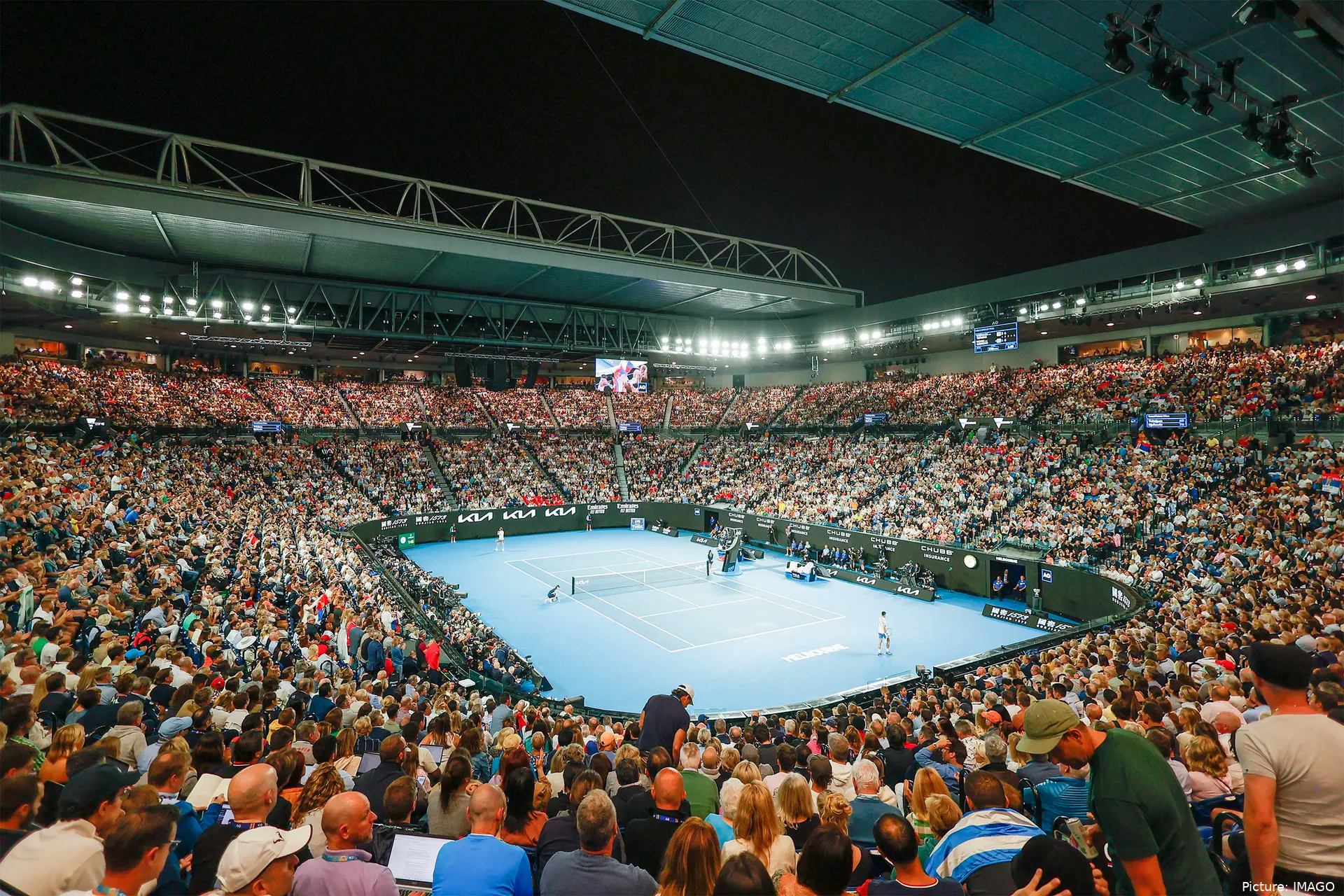
Hosting the Australian Open has become one of Victoria’s most significant long-term sporting commitments, backed by sustained public investment and an agreement with Tennis Australia whose full details remain out of public view. While the state government insists the tournament delivers clear economic returns, the scale and structure of that investment continue to attract scrutiny.
Unlike the Australian Grand Prix, where Victoria pays a hosting fee that climbed to $102 million in 2024, Tennis Australia maintains that no equivalent payment exists for staging the Australian Open. However, taxpayers have still contributed more than $1 billion since 2011 to upgrade Melbourne Park, ensuring the venue meets world-class standards and securing the tournament’s future in Melbourne until at least 2046.
The agreement between the state and Tennis Australia includes commitments to spend $972 million over a decade on infrastructure improvements, a program completed in 2021. That arrangement was further extended during the COVID-19 pandemic, when a $106 million state-government bailout locked the event in for an additional 20 years. Despite the lack of transparency surrounding the contract itself, Tennis Australia continues to emphasise the Open’s financial independence and broader value.
“The AO stands on its own two feet financially as well as making a major contribution to the Victorian economy. It is also the major revenue source for Tennis Australia to fund the sport and facilities throughout Australia,” a Tennis Australia spokesperson said.
Ongoing investment has not stopped there. The Melbourne and Olympic Parks Trust, which manages the precinct, reported spending at least $20 million on tennis-related upgrades during the 2024 financial year. These works included improvements to the retractable roof at John Cain Arena and the addition of new plunge pools and ice baths for players at Rod Laver Arena. A further $45 million was invested last year to ensure Melbourne Park “continues to meet Grand Slam standards” while supporting year-round events.
Economic impact, public spending and growing oversight
Melbourne Park now hosts more than 500 events annually, ranging from major concerts to rugby, football, basketball and netball. Tennis Australia remains the precinct’s largest tenant, paying $68.7 million last year in rent and associated expenses. According to Tennis Australia, the Open generated a “total expenditure stimulus” of $565.8 million last year, with projections suggesting the figure will exceed $600 million this year.
KPMG chief economist Brendan Rynne expressed confidence in the event’s overall return on investment but urged caution when interpreting headline figures. He warned that including spending by Melbourne locals—who made up 63 per cent of spectators—could overstate the true economic benefit, as that money would likely have been spent elsewhere regardless.
Still, Rynne highlighted intangible benefits that defy traditional measurement. “That positive feeling of knowing that we are one of the global destinations like London, like Paris and like New York; that we’re held in top-tier regard. There’s a sense of goodwill and positiveness associated with that,” he said, adding that the Open also strengthens Melbourne’s reputation as a destination capable of hosting major global events.
With the Victorian Auditor-General set to review state spending on major events in the 2026–27 financial year, the balance between public investment, transparency and long-term benefit is once again under the spotlight.

Cristhián AvilaTennis Journalist
Cristhián Ávila is a tennis journalist based in Santiago, Chile, and has been part of the TennisUpToDate team since early 2023. He covers the ATP and WTA Tours as well as all four Grand Slams, producing breaking news, match reports, analysis, and regular liveblogs from major tournaments.
His reporting combines statistical analysis with clear explanation, helping readers understand tactical developments, player form, and broader storylines across the tour. Working fluently in both Spanish and English, Cristhián collaborates with an international editorial team and contributes to comprehensive global coverage. As part of his work, he has conducted interviews and media interactions with leading figures in the sport, including Caroline Wozniacki and John McEnroe.
In his journalism, Cristhián places strong emphasis on careful sourcing, editorial accuracy, and updating articles promptly when new, verified information becomes available. His coverage is grounded in research, context, and direct engagement with professional tennis.
claps 0visitors 0
Just In

Popular News
Latest Comments
- Fight the Good Fight... Tennis (sports in general) need more Humans such as yourself.
 mandoist18-10-2026
 - When is WTA going to mandate Genetic Testing (DNA) ???mandoist18-10-2026
- Hey, Dan... you just wake up from a coma? Regardless -- Thanks for the comedy this morning!mandoist18-10-2026
- Two Things: 1. Stop allowing these Spoiled Trust-Fund Elitists to behave badly. Your little hand-slaps do not deter them. 2. STOP the incessantly annoying "towel wiping" nonsense!!!!mandoist15-10-2026
- A healthy Qinwen may be hard to stop next season. She was already scaring her opponents before her medical leave(s). Unfortunately, Zheng insisted on singing again. On the positive side -- Mirra did not sing!! ;~}mandoist11-10-2026
- Where is it written that athletes, entertainers... People in general... are mandated to keep looking at -- or even using [anti]Social Media? Public & private figures consistently complain and reveal their concerns about negativity and violence thrown at them -- yet they insist on participating. Avoid it, don't use it, don't read it. It's okay to occasionally look up at the World instead beating your eyes & thumbs to death on The Inventions out there.mandoist11-10-2026
- great articlestennisseserver07-10-2026
- Medvedev was leading Djokovic 7-5, 3-5 when an attempted return..' NO you ignorants, Djokovic was leading .weiss05-10-2026
- No more bullshit "Wildcards" to these two. Qualify like everyone else -- there will be cameras there, too. Time to scream... WTF ????!!!!mandoist29-09-2026
- Let's not BS the general public -- Sabalenka started showing cracks in her game last season. Her losses and near-losses started at about the same time she began being distracted by Fame (constant Selfies, making TV commercials, magazine shoots, endless Social Media nonsense, etc., etc.) One would think even Saba could recognize the parallels with others who failed before her -- Raducanu, Giorgi, Bouchard to name a few.mandoist25-09-2026

Loading