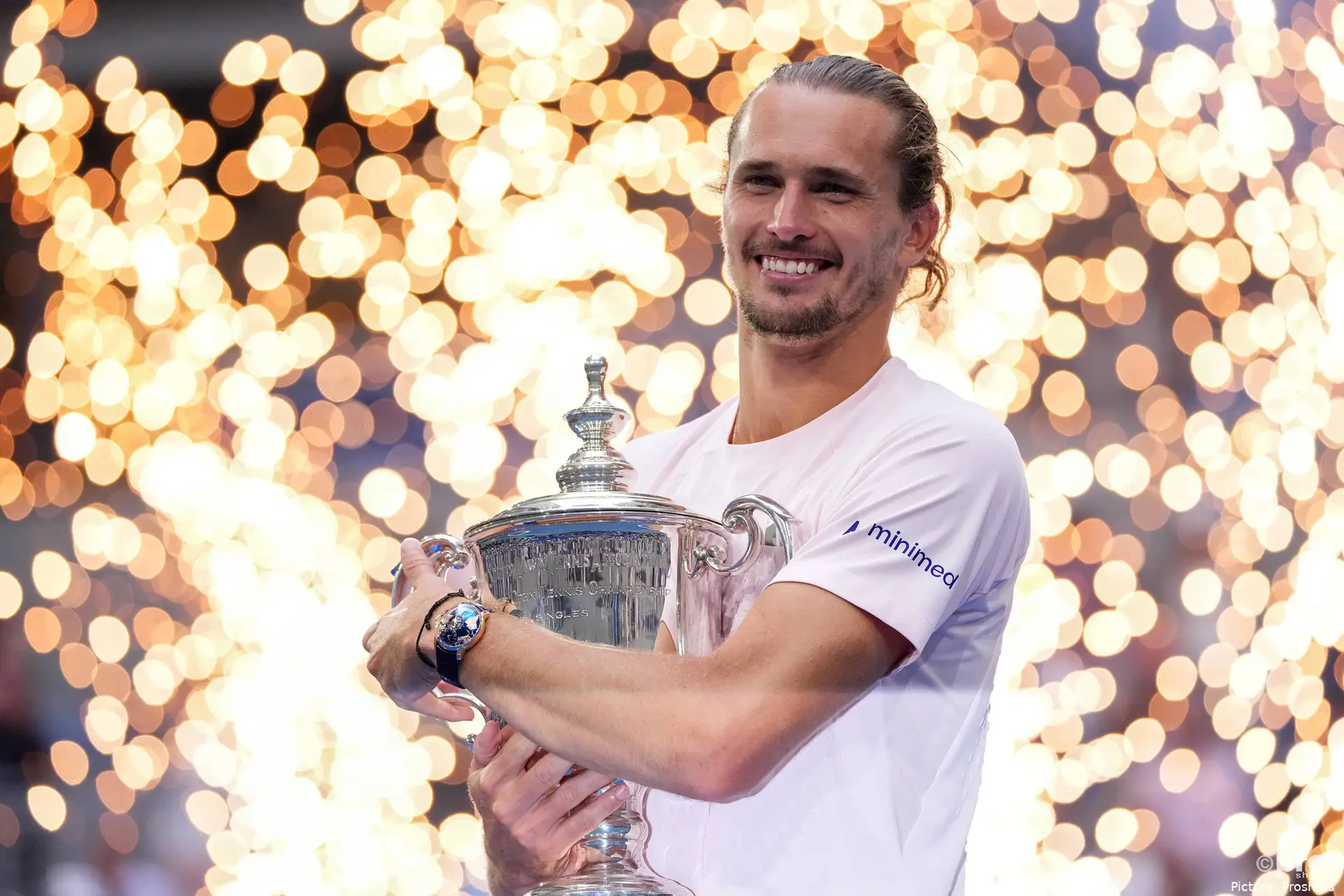
The question is no longer whether Alexander Zverev will reach No. 1. On Tuesday, Jannik Sinner confirmed that his 2026 season is over, shutting himself down to treat a knee injury that has kept him off court since Wimbledon. That guarantees the German will take over the top spot before the year ends, whatever he does in the weeks ahead. He will be the 30th man in ATP history to get there, and the first German since Boris Becker in 1991.
But mathematically inevitable is not the same as deserved. Zverev's season has real substance: two Grand Slam titles, four finals and roughly seventy matches played. It also comes with numbers that sit awkwardly next to the word "dominant" — his record against the top 10, his results against Sinner, Alcaraz and Djokovic, and the quality of the opposition he faced on the way to the US Open title.
The picture is more complicated than a champion arriving at the summit by right. Here is what the data actually says.
A year of big numbers, built partly on other people's absences
On paper, 2026 is the best Grand Slam season of Zverev's career: 25 wins and just two defeats across the four majors. He won Roland Garros over Flavio Cobolli in five sets, then the US Open over Ben Shelton, 6-3, 7-6(2), 5-7, 6-2.
He also reached the Wimbledon final, where Sinner beat him in four sets, and came within three points of beating Carlos Alcaraz in a 5-hour, 27-minute Australian Open semifinal. After losing three major finals before 2026 — the US Open in 2020, Roland Garros in 2024, the Australian Open in 2025 — he finally converted.

The context, though, is hard to ignore. Sinner has not played a match since lifting the Wimbledon trophy, missing Montreal, Cincinnati, the US Open and Beijing. Nevertheless, he won 44 of the 47 matches he played this year and claimed 6 titles across the 9 tournaments in which he participated.
Alcaraz completed the career Grand Slam in Melbourne in January, then lost four and a half months to a wrist injury, skipping Roland Garros and Wimbledon before returning in New York, where he lost a quarterfinal to Shelton.
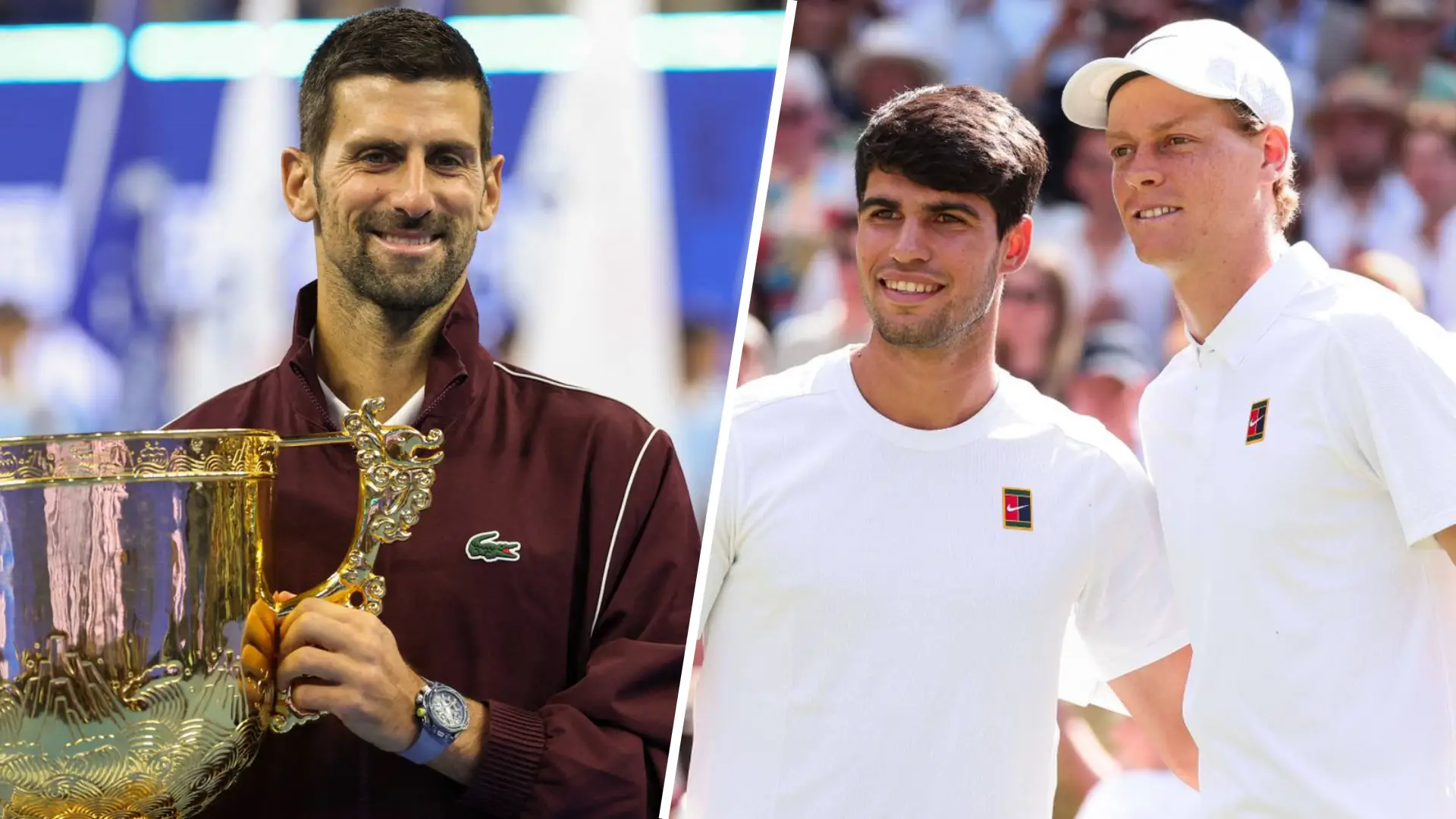
Djokovic, meanwhile, has produced some strong performances throughout the year, but with a reduced schedule of only a handful of tournaments. And while he continues to compete for the biggest titles, his ranking is increasingly incidental to the Serbian legend's career.
That left Zverev with an opportunity. But he still had to be there to take it.
The opportunity he truly seized
The first major opportunity came at Roland Garros, where Zverev reached his first Grand Slam final of the season and finally converted after losing three major finals in previous years. He defeated Flavio Cobolli in five sets to claim his first Grand Slam title of 2026, putting an end to a long wait for a major trophy and establishing himself as a serious contender for the top of the rankings.
At Wimbledon, Zverev reached his second Grand Slam final of the season, but faced only one top-10 opponent on his way there. He took advantage of a draw in which Taylor Fritz was not at full physical strength before eventually losing to Sinner in four sets. That is not an asterisk — you can only beat who stands across the net — but it matters when asking whether a title measures dominance or opportunity.
The US Open presented another opening. Zverev never met a top-20 opponent on his way to the final: his six victims were ranked between 22nd and 91st at the time, and he needed five sets to get through each of his first two rounds. In the final, however, he secured his second top-10 victory of the season against Shelton. The German delivered under pressure, using his experience to win in four sets and claim his second Grand Slam title.

Alexander Zverev of Germany and Ben Shelton of the United States pose for photos during the awarding ceremony after their men's singles final match at the 2026 US Open
The contrast is important. Zverev has consistently put himself in position to benefit when the draw opens up, and he has done the most important part by converting those opportunities. But against the top 10, his results have been far less convincing.
He owns a 2-8 record against top-10 opponents in 2026 and has repeatedly struggled when facing Sinner, Alcaraz or Djokovic. The ranking rewards consistency across an entire season, but those head-to-head results raise a legitimate question about whether Zverev has actually been the strongest player in the world.
The 2026 scorecard: Zverev against the three men he is about to replace
Numbers in isolation can mislead, so here is the season side by side with the three players who have defined it. The first thing that jumps out is volume: Zverev is the only one of the four to play all four Grand Slams and every Masters 1000 event so far, which is the foundation of his ranking case. The second is efficiency: Sinner won six titles and went 29-0 at Masters 1000 level in the events he entered.
| 2026 season (singles) | Sinner | Zverev | Alcaraz | Djokovic |
| Age | 25 | 29 | 23 | 39 |
| Ranking (Oct. 6) | No. 1 (11,000) | No. 2 (9,720) | No. 3 (5,560) | No. 8 (3,480) |
| Season record | 44-3 | 55-14 | 31-4 | 19-7 |
| Titles | 6 | 2 | 3 | 1 |
| Finals (W-L) | 6 (6-0) | 4 (2-2) | 4 (3-1) | 2 (1-1) |
| Grand Slam titles | 1 (Wimbledon) | 2 (Roland Garros, US Open) | 1 (Australian Open) | 0 |
| Grand Slam results (AO / RG / W / USO) | SF / 2R / W / withdrew | SF / W / F / W | W / withdrew / withdrew / QF | F / 3R / SF / 1R |
| Grand Slam match record | 13-2 | 25-2 | 11-1 | 12-4 |
| Grand Slams played (of 4) | 3 | 4 | 2 | 4 |
| Masters 1000 titles | 5 (5 finals) | 0 (1 final) | 0 (1 final) | 0 |
| Masters 1000 record | 29-0 | 20-7 | 9-3 | 2-3 |
| Record vs. top 10 | 10-1 | 2-8 | 4-2 | 5-2 |
Read the table one way and it favors Zverev: two majors, more matches and more events than anyone. Read it the other way and it favors Sinner, who won six titles in only 47 matches and was unbeaten at Masters level. What neither reading changes is the gap in the middle of Zverev's column — no Masters 1000 title, and a top-10 record that trails every rival on the list.
The number that sums up the dilemma
If one statistic captures the tension, it is this: Zverev has beaten only two top-10 opponents all season, against eight defeats. The wins came over Taylor Fritz (then No. 7) in the Wimbledon quarterfinals and Shelton (No. 9) in the US Open final. The losses read like a list of the sport's heavyweights: five to Sinner, one to Alcaraz, one to Fritz at Halle and one to De Minaur.
The number deserves nuance. A top 10 that was repeatedly thinned by injuries and withdrawals gave Zverev fewer chances to face elite opposition, and that is not his fault. But the career figure points the same way: 60 wins and 88 losses against top-10 players. It has also been a theme at the top-20 level, where his loss to Djokovic in Beijing was his tenth of the season against that group, after 15 last year.
Here is the uncomfortable part for anyone arguing he is the best player in the world. Neither of his Grand Slam titles required him to beat Sinner, Alcaraz or Djokovic. Both are real, and both count exactly the same in the record book. But a No. 1 ranking is supposed to say something about who you beat when it matters most, and on that front 2026 gives Zverev very little to point to.
Fourteen straight defeats to the three biggest names
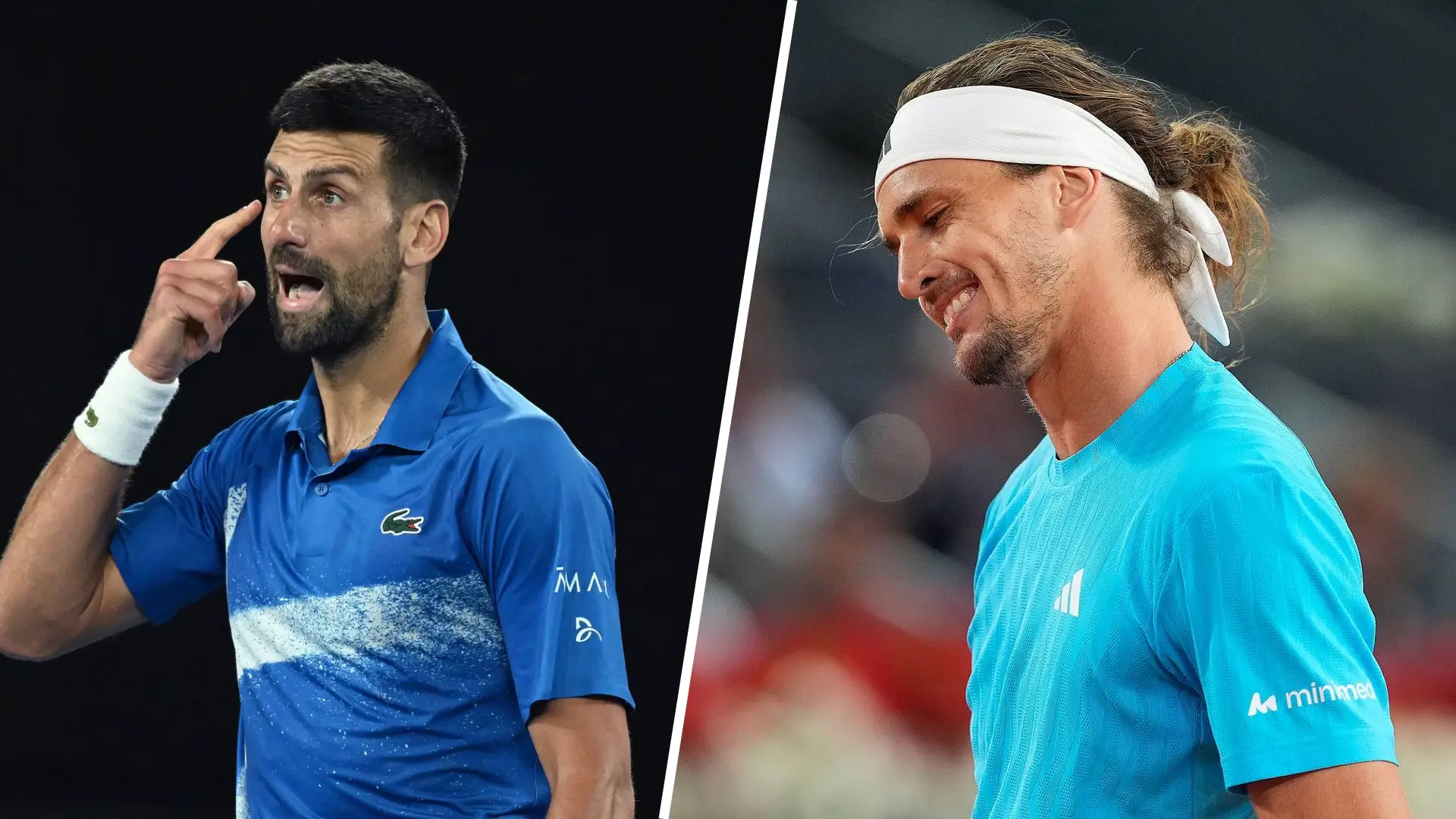
The harshest data point concerns his three great rivals. After losing to Djokovic in the Beijing quarterfinals, 4-6, 6-4, 6-4, Zverev has lost 14 consecutive matches against Djokovic, Sinner and Alcaraz combined.
| Zverev's record | Career H2H (Zverev–rival) | 2026 meetings | Current streak vs. Zverev | Zverev's last win |
| vs Jannik Sinner | 4-11 | 0-5: Indian Wells SF, Miami SF, Monte-Carlo SF, Madrid F, Wimbledon F | 10 straight | 2023 US Open |
| vs Carlos Alcaraz | 6-7 | 0-1: Australian Open SF | 2 straight | 2024 ATP Finals |
| vs Novak Djokovic | 5-10 | 0-1: Beijing QF | 2 straight | Jan. 2025 (Australian Open SF, Djokovic retired); last completed win: 2021 ATP Finals |
| Combined | 15-28 | 0-7 | 14 straight | Jan. 2025 (vs. Djokovic, by retirement) |
The Sinner column is the most severe: ten consecutive defeats, five of them this season, with both players healthy and in form. The Alcaraz and Djokovic numbers are less extreme but fit the same pattern. Zverev holds his own for long stretches, then loses the moments that decide matches, which is precisely what separates a very good player from the player who sets the standard.
It also reframes his ascent in an uncomfortable way. A new world No. 1 normally enters the role, having beaten the established order at least some of the time. Zverev will take the position without having beaten that order, in a completed match, for almost two years.

How the race for No. 1 was decided
Before Sinner's announcement, the live ranking gap was already manageable: 11,000 points for the Italian against 9,720 for Zverev, a difference of 1,280. The calendar did the rest. Sinner won the Beijing, Vienna, Paris and Turin titles last autumn, which means 3,550 points are due to fall off his total between now and the ATP Finals with nothing to replace them. Zverev has just under 1,000 to defend over the same stretch.
The Race to Turin, which counts only 2026 results, is even more settled. Zverev has already locked up the year-end No. 1 position there, with more than 8,700 points against Sinner's 7,950. Alcaraz, who sits on 4,550 after his Tokyo title, could add at most 3,500 across Shanghai, Paris and Turin, which would still leave him short. Zverev will receive the year-end No. 1 trophy during the ATP Finals.
None of this requires him to win another match. It is the ranking system working exactly as designed: it rewards points accumulated across 52 weeks, and no one on tour has accumulated more than Zverev this year. That is a legitimate argument, and for ranking purposes it is the only one that matters. Whether it is also the right answer to the question "who is the best player in the world?" is a separate matter.
Read also
The verdict
There is a strong case in Zverev's favor that goes beyond his rivals' absences. He played nearly seventy matches at tour level this season, a workload far above what Sinner or Alcaraz carried, and he won two Grand Slams outright. Those titles count exactly the same whoever was, or was not, on the other side of the net. The ranking rewards consistency and volume across an entire season, not just head-to-head results against the best players.
But the question in the headline has an honest, two-sided answer. On accumulated merit, Zverev absolutely deserves the No. 1 ranking. On proven superiority over the three best players on tour, the numbers say the opposite: fourteen straight combined losses is not the usual calling card of a new world No. 1, and a 2-8 mark against the top 10 only deepens the doubt.
Both things are true at once, and that tension will follow him from the first day of his reign. The next chances to resolve it come quickly: Shanghai this week, then the indoor swing, and finally the ATP Finals in Turin, where Alcaraz will be waiting and Sinner will be watching. At the Australian Open in January, a healthy Sinner will be back to ask the question again.

Cristhián AvilaTennis Journalist
Cristhián Ávila is a tennis journalist based in Santiago, Chile, and has been part of the TennisUpToDate team since early 2023. He covers the ATP and WTA Tours as well as all four Grand Slams, producing breaking news, match reports, analysis, and regular liveblogs from major tournaments.
His reporting combines statistical analysis with clear explanation, helping readers understand tactical developments, player form, and broader storylines across the tour. Working fluently in both Spanish and English, Cristhián collaborates with an international editorial team and contributes to comprehensive global coverage. As part of his work, he has conducted interviews and media interactions with leading figures in the sport, including Caroline Wozniacki and John McEnroe.
In his journalism, Cristhián places strong emphasis on careful sourcing, editorial accuracy, and updating articles promptly when new, verified information becomes available. His coverage is grounded in research, context, and direct engagement with professional tennis.
claps 0visitors 0
Just In


Popular News
Latest Comments
- great articlestennisseserver07-10-2026
- Medvedev was leading Djokovic 7-5, 3-5 when an attempted return..' NO you ignorants, Djokovic was leading .weiss05-10-2026
- No more bullshit "Wildcards" to these two. Qualify like everyone else -- there will be cameras there, too. Time to scream... WTF ????!!!!
 mandoist29-09-2026
 - Let's not BS the general public -- Sabalenka started showing cracks in her game last season. Her losses and near-losses started at about the same time she began being distracted by Fame (constant Selfies, making TV commercials, magazine shoots, endless Social Media nonsense, etc., etc.) One would think even Saba could recognize the parallels with others who failed before her -- Raducanu, Giorgi, Bouchard to name a few.mandoist25-09-2026
- Gross!! Hey Raducanu, Giorgi, and Bouchard -- reserve a seat at your Social Media Selfie table for Saba + Naomi. They're heading in your direction soon enough.mandoist24-09-2026
- And then these same players will complain about how lengthy their season’s were and need more time-off. I’m all for more tennis but the amount of tennis we get now is actually kind of crazy! We all need a break, especially the players.DaveyWavey23-09-2026
- You should do a comparison article for "different kinds of justice" the courts decide for tennis players. I can think of at least three players who received very small bans of a few months, however Tara Moore has been fighting for her literal survival the past few years. It seems odd considering she is not a "name" player, unlike the other cases.DaveyWavey22-09-2026
- PRIZE MONEY & POINTS Winner - $185,500 Finalist - $114,500 Semi-Finalist - $66,003 Quarter-Finalist - $35,000 Round of 16 - $18,045 Round of 32 - $13,005 Winner - 500 Finalist - 325 Semi-Finalist - 195 Quarter-Finalist - 108 Round of 16 - 60 Round of 32 - 1DaveyWavey20-09-2026
- Pegula withdrew from this Singapore event
 tennishappens19-09-2026
 - Serena Williams chose her tournaments. It's not such a bad idea.MuswellHillbilly17-09-2026

Loading