“His generation really wasn't [Rafael] Nadal and [Novak] Djokovic” Roger Federer’s agent sparks debate about the famous rivalry of ‘Big Three’
ATP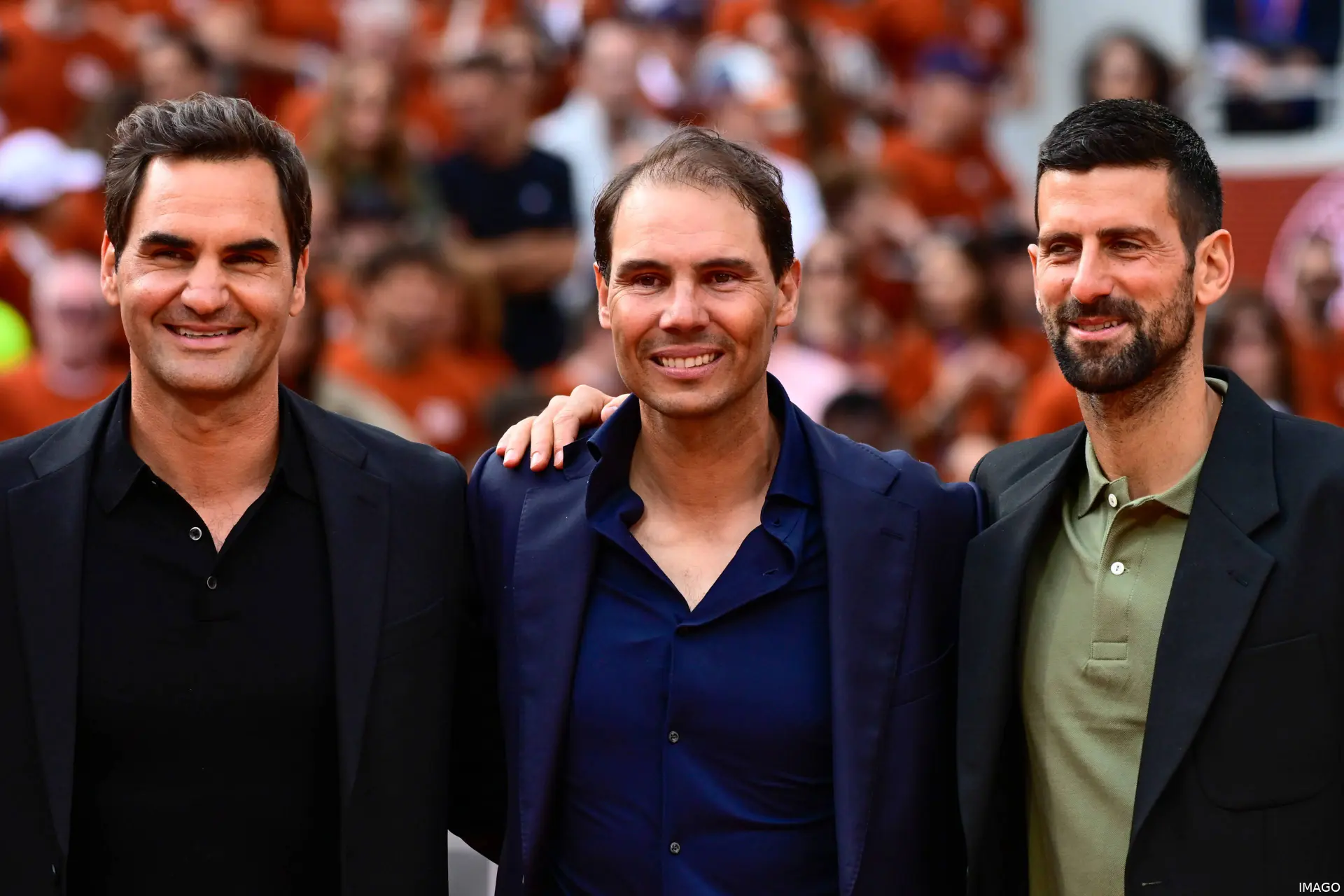
Tony Godsick, the agent of Roger Federer, has made an
interesting claim about which generation of players the former world number one
actually belong to. The 44-year-old is often regarded as one of the greatest
players in the history of men’s tennis in the singles category, having won as many
as 20 Grand Slam titles.
Federer’s dominance in men’s tennis was challenged by two
other players, Spain’s Rafael Nadal and Serbia’s Novak Djokovic. Nadal, who retired from the sport back in 2024, finished his career with 22 major titles, whereas Djokovic, who is the only active player out of the three, has won 24 Grand Slam titles in his illustrious career.
The three formed what is famously known as the ‘Big Three’ as they dominated men’s tennis like never before. Despite having such a great rivalry, Federer’s longstanding agent, Godsick, believes that the eight-time Wimbledon champion does not belong to the generation of Nadal and Djokovic.
While speaking in the recent episode of the Served with
Andy Roddick podcast, Godsick was of the opinion that Federer actually belonged
to the generation of Roddick, Russia’s Marat Safin, Australia’s Lleyton Hewitt and
Argentina’s David Nalbandian. “So, um, I, you know, I always say he, his
generation really wasn't Nadal and Djokovic,” Godsick. “It was you and, and
Safin and Albanian and, you know, yeah. And, and, and Layton and these guys. So,
um, so they were completely different.”
Federer, during his career, has won numerous endorsements, not only on the court but also off it. Godisck then explained how Federer’s
ability to speak multiple languages helped him in getting the sponsors on board
that he wanted. Godsick also highlighted that Federer was keen to have a few
brands associated with him, but the ones which would stick with him for a long
time.
This was our best one yet, says Godsick about Laver Cup 2025
“I think the language thing helped Roger a lot, you know,”
said Godsick. “Roger speaks perfect English, obviously speaks German, French,
you know, uh, so, so I think that helped. Um, and that was different, you know,
Rafa, um, you know, Roger had, we had a strategy to every single thing we did. We
thought like, okay, let's not accept the deal. If someone's going to scratch
their head saying, I don't quite understand the association. And that's one
strategy. I'm not saying that's the right strategy, but that was our strategy.
Others had strategies where if it was a really great deal and it made sense,
but you know, from a financial standpoint or time management standpoint or
whatever it might be, um, let's just do it. And that's a great strategy too,
because you don't know how long the career is going to last. And that was
really, that was very interesting with Roger. He wanted a few select partners
that he could sort of grow with for a long period of time. You know, I did not
think that, you know, basically three years being retired now that he'd still
have 13 sponsors.”
Godsick continued by saying: “And a lot of them have been
contracted for over 20 years. I mean, think of the likes of Rolex and, and
Mercedes and Credit Swiss, which is now UBS and, you know, Lint. And I mean,
these are, they keep renewing. And so we chose the let's first-class blue chip,
global brands that we could grow with and they would become part of our family.
It just wouldn't be a, um, you know, a contract and we show up and do it. And
it's over after three years that we would become part of the family. And that's
what's happened. And in some cases it gets kind of sad is he outlived some of
the management. Now it's some of these brands, which, you know, is you, you
spent all this time getting to know some of these wonderful people and they
retire or whatever it might be, but they were just different came from
different places. I think Roger being Swiss, I said this once years ago, and
I'll say this again, one of the greatest things about managing Roger was he
Swiss. I mean, just think about it. Rolex, um, you know, it was easy to get
Roger over to Rolex because Rolex is a Swiss brand. He was number one in the
world. They were a Wimbledon sponsor. He was holding up the trophy. And, and so
that was, you know, small country and a half million people, but big brands,
Lindt chocolate. Um, obviously the on story, um, you know, that was a Swiss
brand. I think that played a big role. So they were just different, different
geographies. And Roger loved going to China too. You know, Roger was one of the
few people that sort of opened up sort of that part of the world for the ATP,
uh, tour. And he was very comfortable travelling all around the world, which
helped as well. So they were just different, but they're all great.”

Godsick is the co-founder of Team8, which is the parent organisation
of the Laver Cup. The team-based competition was recently organised, where Team World came out on top against a star-studded Team Europe. While speaking about the
overall experience of the competition, Godsick stated that this year was probably
the best in the competition’s history. Godsick also explained that not many gave
Team World a chance to overcome Team Europe, but credited the captain Andre
Agassi and vice-captain Pat Raftar for producing an incredible result on the
court.
“Well, this one was very unique because this was, from
all metrics, this was our best one yet,” said Godsick. “So there was a lot of
people coming up to us like, come back, come back soon. And we're like, OK, but
we're moving on to London next year. I mean, there's a lot of, you know, a lot
of work with the sponsors to find out what they like, what they didn't like.
You know, talk to a lot of our constituents, a lot of fans, a lot of the
players, make sure we get the players off onto their flights to Asia and just
digest what took place. I mean, it was really exciting. We had our eighth
sellout, which was incredible. We had, I mean, the action was, I mean, no one
would have predicted on paper that Team World actually could win. I mean,
tribute to and credit to Andre Agassi, who put together, he and Pat Rafter put
together one of the most incredible coaching things. But we can get there
later. Just digesting what went on and seeing how we can do better. We tend to,
if you wait too long after an event, you tend to forget some of the things that
went well, what didn't go well and stuff. So just a whole debrief and then on
to London”
🫶 Roger Federer y #Shanghai, una historia de amor inexplicable. pic.twitter.com/TMhUMHyidH
— ESPN Tenis (@ESPNtenis) October 8, 2025
Azeem Siddiqui is a seasoned sports journalist and data analyst with a strong background in both digital media and live sports production.
He began his journalism career working with partners of The New York Times and has since contributed to several leading international sports publications, including Fox Sports Asia, Calciomercato, and GiveMeSport. Since 2023, Azeem has been part of the TennisUpToDate team, where he has played a key role in sustaining the platform’s growth and ensuring tennis fans receive timely and reliable coverage of the sport’s biggest stories.
In addition to his editorial work, Azeem has extensive experience as a data analyst in live sports broadcasting—particularly in cricket—where he combines analytical precision with creative storytelling. He has collaborated with multiple production companies and cricket boards worldwide, delivering real-time insights and data-driven narratives during live match coverage.
claps 0visitors 0
Just In

Popular News
Latest Comments
- A healthy Qinwen may be hard to stop next season. She was already scaring her opponents before her medical leave(s). Unfortunately, Zheng insisted on singing again. On the positive side -- Mirra did not sing!! ;~}
 mandoist11-10-2026
 - Where is it written that athletes, entertainers... People in general... are mandated to keep looking at -- or even using [anti]Social Media? Public & private figures consistently complain and reveal their concerns about negativity and violence thrown at them -- yet they insist on participating. Avoid it, don't use it, don't read it. It's okay to occasionally look up at the World instead beating your eyes & thumbs to death on The Inventions out there.mandoist11-10-2026
- great articlestennisseserver07-10-2026
- Medvedev was leading Djokovic 7-5, 3-5 when an attempted return..' NO you ignorants, Djokovic was leading .weiss05-10-2026
- No more bullshit "Wildcards" to these two. Qualify like everyone else -- there will be cameras there, too. Time to scream... WTF ????!!!!mandoist29-09-2026
- Let's not BS the general public -- Sabalenka started showing cracks in her game last season. Her losses and near-losses started at about the same time she began being distracted by Fame (constant Selfies, making TV commercials, magazine shoots, endless Social Media nonsense, etc., etc.) One would think even Saba could recognize the parallels with others who failed before her -- Raducanu, Giorgi, Bouchard to name a few.mandoist25-09-2026
- Gross!! Hey Raducanu, Giorgi, and Bouchard -- reserve a seat at your Social Media Selfie table for Saba + Naomi. They're heading in your direction soon enough.mandoist24-09-2026
- And then these same players will complain about how lengthy their season’s were and need more time-off. I’m all for more tennis but the amount of tennis we get now is actually kind of crazy! We all need a break, especially the players.DaveyWavey23-09-2026
- You should do a comparison article for "different kinds of justice" the courts decide for tennis players. I can think of at least three players who received very small bans of a few months, however Tara Moore has been fighting for her literal survival the past few years. It seems odd considering she is not a "name" player, unlike the other cases.DaveyWavey22-09-2026
- PRIZE MONEY & POINTS Winner - $185,500 Finalist - $114,500 Semi-Finalist - $66,003 Quarter-Finalist - $35,000 Round of 16 - $18,045 Round of 32 - $13,005 Winner - 500 Finalist - 325 Semi-Finalist - 195 Quarter-Finalist - 108 Round of 16 - 60 Round of 32 - 1DaveyWavey20-09-2026

Loading