"Let's see... I didn't think I'd be coaching Jannik in 2026, and yet here I am" - Darren Cahill opens up on future coaching plans alongside Jannik Sinner
ATP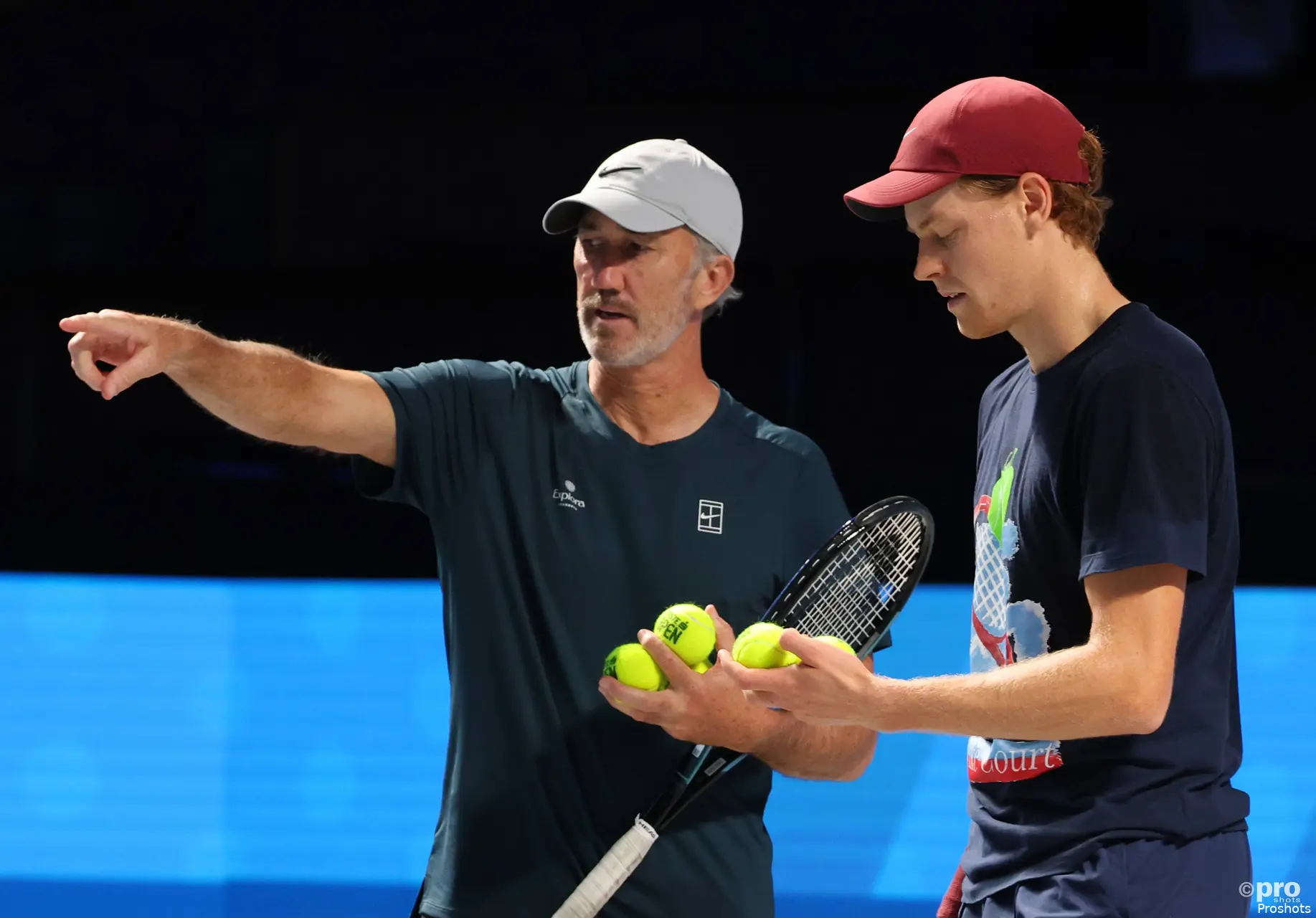
Jannik Sinner's rise in tennis and especially the recent success he has enjoyed on court have many people speechless. Behind every great player is a great coach, with Darren Cahill continuing to work his magic with the world number one. However, there is no guarantee that he will be by the Italian's side past 2026 as he leaves his future up in the air.
Currently in Italy with Sinner competing in his home event at the Rome Open, the 24-year-old is on the brink of yet more history. Two more wins and he will break Novak Djokovic's record for most consecutive Masters 1000 wins. The title will see him complete the full list of all Masters 1000 wins, joining the Serbian in that prestigious list.
His last loss at this level came at the Shanghai Masters where he retired against Tallon Griekspoor in the third round. He has since gone on to win the Paris Masters, Indian Wells, Miami Open, Monte-Carlo Masters and Madrid Open whilst dropping just two sets. The latest at Caja Magica saw the world number three Alexander Zverev blown away 6-1, 6-2 in a rampant final display. Already having disposed of Sebastian Ofner and Alexei Popyrin, fellow Italian Andrea Pellegrino has the daunting task of competing against the four-time Grand Slam champion on court at the last-16 stage.
In an interview with La Gazzetta dello Sport, Cahill discussed Sinner while opening up on his future alongside him.
What surprises Cahill about Sinner
Working with each other since 2022, the pair know each other very well, meaning any surprises about their personality are sparse. "I don't think there are any more surprises in terms of personality, because by spending so much time together in close contact you get to know each other very well, strengths and weaknesses," Cahill began. "But no one's perfect... Sinner has grown and matured a lot in recent years, now he's a young adult who knows how to manage himself better and better on and off the pitch."
There was something that surprised him on the human side. "He has great self-awareness. He knows his place in the tennis scene and in life: in tennis, that's important, in everyday life, not so much. And that's normal, because he plays a sport and does something he loves, but there are more important things in life than hitting a tennis ball. And he knows this well, which is why he manages to be humble and keep his feet on the ground. I think this comes largely from the upbringing he received from his parents."
He unveiled how good Sinner was in rebuffing pressure regularly placed upon him while also letting slip his curiosity trait. "He's incredibly curious," he said. "When he's in a group, everyone wants to know something from him, but he eventually finds a way to turn the tables and bombard them with questions, whether it's about sports or life, how to handle pressure, girlfriends, or anything else. He wants to learn from people who've been through experiences he'll likely have in the future. He wants to be prepared ahead of time."
While still being quite young, Sinner has the whole weight of a country's expectations firmly on him everywhere he goes. Currently competing in Rome, this pressure goes up a notch. Cahill admits that Sinner takes it all in his stride having learned how to deal with it on and off the court.
"He's living the dream he's had since he was a child and is mature beyond his years, also because tennis makes you mature quickly. You have to manage sponsors, fans, and the media. You learn early that you have to know what you're talking about, understand the problems, and address them appropriately. Tennis is a sport that exposes you to a lot of pressure at a young age. But the responsibility of being world number one is wonderful. He also handles the fact that he's so loved and followed in Italy very well. He's very proud of that."

Darren Cahill - head coach of Jannik Sinner
Coming back stronger after Roland Garros final defeat
Many people have claimed and joked that Sinner is a robot on court. However, the Aussie dismissed these claims linking him to that. "Not at all. There's a part of him that loves danger and that's not seen much on the court, because when he's in a match he has this internal computer that's constantly working, and there's a certain confidence in the way he plays.
"He calculates the probability of winning the point by choosing a certain shot with the least risk, and that's the hallmark of a winning player. In life, however, it's not quite like that. He loves car racing, speed. He loves adrenaline. But these two souls come together in a single, incredibly professional player: training, nutrition, rest, he tries to step onto the court every time with the goal of growing and improving. That's why he's a champion."
This drive and motivation would be needed after last year's Roland Garros disappointment. Sinner took a two-set lead against Carlos Alcaraz before missing three championship points. Alcaraz would complete an outstanding comeback and win a second title at Roland Garros to the dismay of his arch rival.
Whilst the defeat was excruciating, Sinner managed to bounce back and win Wimbledon. This stems down from his overall nature. "He has a special talent that we coaches can't teach," Cahill explained. "It's an inner drive that makes him want to learn from every situation. Jannik doesn't just learn from defeats, but also a lot from victories, because it's essential to 'go to school' in every tennis match. Win or lose, he looks at everything through the same lens: 'How can I improve today?'. That's his strength."
Working together with Vagnozzi
Cahill works closely with a whole team supporting Sinner. One of them is Simone Vagzozzi, who he described as the main coach. "Simone is the main coach," he confirmed. "I think the reason our relationship works so well is that our roles are fairly well-defined, yet intertwined in many ways. Simone and I discuss everything about Jannik, both technically and emotionally.
"He tries to learn from me in some areas, and I'm learning from him in many others, because he has an incredible technical eye, better than mine. He can see technical aspects of the game that very few coaches can. And he sees them very early, very clearly. But above all, he manages to convey them to the player so he can understand them and put them into practice."
Over time the pair of them have overseen and guided Sinner to new levels adapting and changing his game to make him almost unstoppable. "Simone has been extraordinary in the small changes he's made to Jannik's game. The serve is the most obvious example, and the data confirms the work they've done on this shot, now one of the best on tour. Simone is a special coach. He knows how to choose the right moment to convey a message to Jannik: he knows when he wants to hear something and when he should let him solve his problems on his own. Simone is the voice."
Vagnozzi had previously said that he was the bad cop and Cahill was the good cop. "No, no," he laughed. "He's the one who has to deliver messages in times of pressure, so yes, that can be more difficult than my role. I have to take care of the team culture and make sure everyone communicates well. Each of us knows our role and the goal we're working towards. I think that's our strength, and what gives Sinner great peace of mind."
What comes next
Cahill was uncertain when talking about how long left he will spend with Sinner. He agreed to continue alongside him for another year if he won the Wimbledon title, which he did. "Let's see... I didn't think I'd be coaching Jannik in 2026, and yet here I am," he stated. "For now, there's no bet; my goal is to do the best job possible for Sinner and the team this year. Then we'll talk at the end of the season, like we did last year, and we'll decide, with complete peace of mind."
The 60-year-old did confirm that Sinner will be his last ever player he coaches. "Absolutely yes. One hundred percent."
Once he has moved on from coaching Sinner in the future, Cahill wants to sit down and reminisce on the good times they had, seeking one key note from their time together. "Not just trophies, for sure. My idea of coaching is that, at the end of the journey, the person you coach is a better person," he commented. "It's a question of culture, of respect for colleagues, restaurant staff, drivers, ball boys, referees. So, if in five or ten years, when I'm no longer with him, I see him still playing, giving his all and showing respect for everyone around him, that will make me happy. Because if everything becomes just about titles, you lose the meaning of what you do. And Jannik, the tennis player, does it for love."
Lucas MichaelTennis Journalist
Lucas Michael is a tennis journalist based in Cambridge, UK, specializing in comprehensive coverage of the ATP and WTA tours. For the past 1.5 years, he has been a core contributor to TennisUpToDate, where he has authored more than 3,000 data-driven match reports, deep-dive analysis pieces, and engaging liveblogs.
Lucas pairs real-time statistical analysis with on-the-ground reporting, frequently traveling to tournaments to cover the action firsthand from the press box and player press conferences. This blend of advanced metrics and direct access allows him to provide sharp context regarding player form, tactical trends, and breaking tour developments.
He holds a BA (Hons) in Sports Journalism. Grounded in core journalistic ethics, Lucas places a strict emphasis on meticulous sourcing, editorial accuracy, and a commitment to updating live content swiftly as verified information emerges.
claps 0visitors 0
Just In


Popular News


Latest Comments
- Does Sinner need that 4.5 mil? I doubt it. He can make that with three modelling gigs!😅🤣Rapunzel21-10-2026
- Did "People Magazine" purchase this website? This nonstop storyline is bullshit.
 mandoist21-10-2026
 - Listen... this is of no concern to anyone but these two. Deal with your own issues -- most of us have our own. Thanks, media, for these insignificant follow-ups which are meaningless.mandoist21-10-2026
- This is so very very sad, for all three of them. I truly thought they had an unbreakable bond, but life throws up so many differing challenges. Having your homeland suffering in such a terrible way, makes happiness lose out to guilt as well. Our thoughts are with them. X💔bjsexton20-10-2026
- I have lost all respect for Svitolina! Could she not have waited until he had played at the Paris Masters!!! She is selfish and don't give a damn about Gael. That is NOT how love is demonstrated Elina!!Rapunzel19-10-2026
- Perhaps convenient tennis tour sex is not a strong enough experience in which to base a marriage?mandoist19-10-2026
- Fight the Good Fight... Tennis (sports in general) need more Humans such as yourself.mandoist18-10-2026
- When is WTA going to mandate Genetic Testing (DNA) ???mandoist18-10-2026
- Hey, Dan... you just wake up from a coma? Regardless -- Thanks for the comedy this morning!mandoist18-10-2026
- Two Things: 1. Stop allowing these Spoiled Trust-Fund Elitists to behave badly. Your little hand-slaps do not deter them. 2. STOP the incessantly annoying "towel wiping" nonsense!!!!mandoist15-10-2026

Loading