“Maybe if I win the tournament, it'll finally become clear to everyone: I don't mind clay”: Felix Auger-Aliassime pushes back on clay-court doubts at Roland-Garros
ATP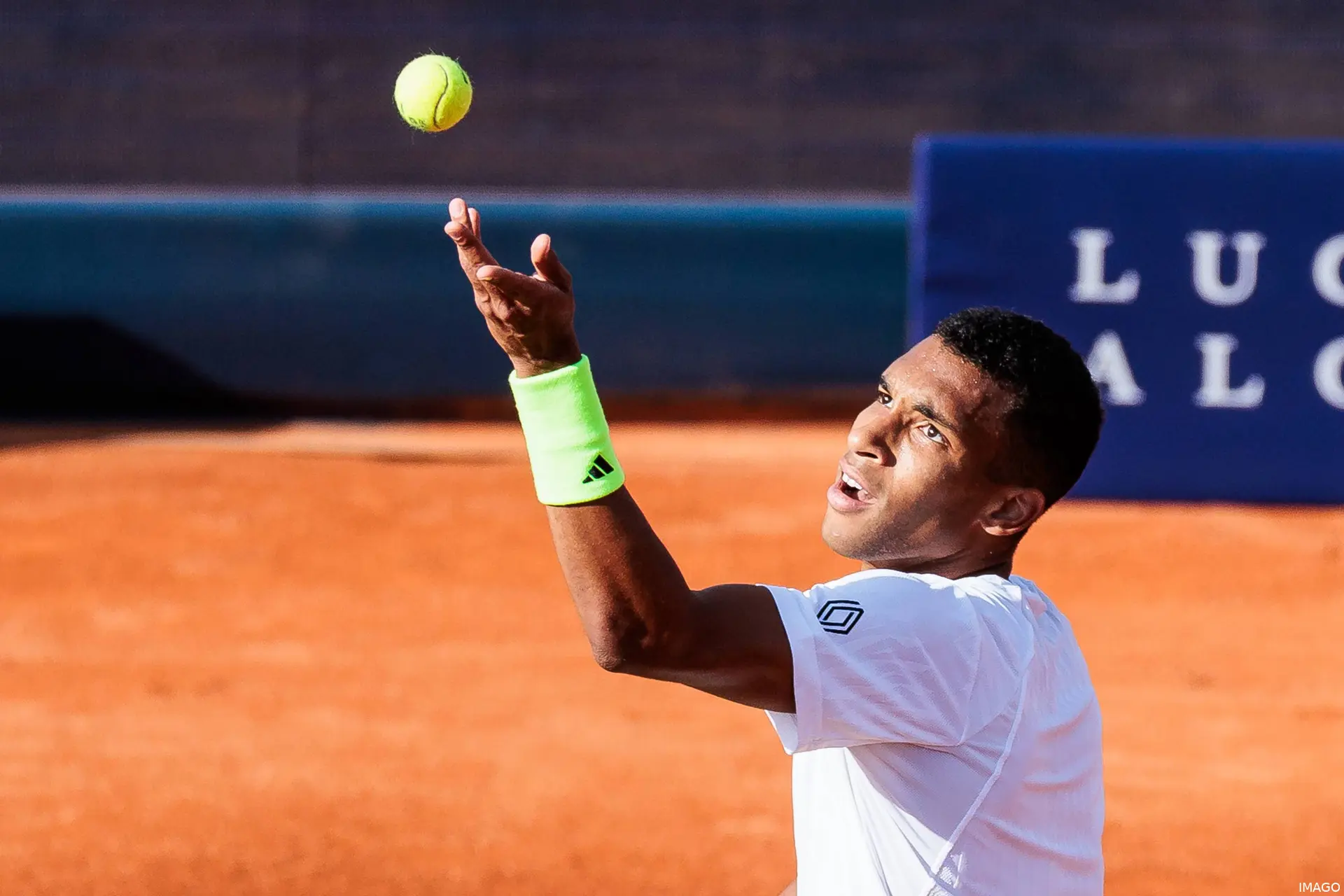
Felix Auger-Aliassime insisted that he “does not mind clay”, arguing that the perception around his surface consistency does not reflect his actual level, after reaching the Roland-Garros quarterfinals following wins over Daniel Altmaier, Román Andrés Burruchaga, Brandon Nakashima and Alejandro Tabilo in the fourth round, where he closed the match in straight sets.
The world No. 6 arrived in Paris without a previous quarterfinal appearance at Roland-Garros, despite having established himself as a regular presence deep in Grand Slams across his career. He also highlighted prior clay-court credentials, including reaching three ATP finals on the surface, among them a Masters 1000 final in Madrid, while stressing that surface perception is shaped largely by scheduling distribution rather than ability.
Auger-Aliassime advanced after what he described as his most complete performance of the tournament, pointing to improved control in baseline exchanges and more consistent aggression in key phases of the match. The result further reinforced his record of reaching the quarterfinal stage at all four Grand Slams, although he continues to search for a first semifinal appearance at Roland-Garros.
He is now set to face Flavio Cobolli in the quarterfinals, having already beaten him twice in 2024, entering the match after a physically demanding path marked by extended sets and decisive tiebreaks. Auger-Aliassime described Cobolli as a “very balanced player” and a difficult opponent, underlining that past meetings are not a reliable indicator for their upcoming clash in Paris.

Clay, consistency and the logic of surfaces
Auger-Aliassime addressed recurring questions about his relationship with clay, a surface often perceived as less natural to his game. He rejected the idea of a structural limitation, instead attributing fluctuations in results to scheduling and exposure across surfaces throughout his career.
"I've always liked playing on clay. It's never been a matter of not liking it," the world No. 6 said in press conference. "One of my biggest strengths is my serve, and then obviously indoors there is no sun and no wind, so I can be more consistent. The surface is also a bit faster, so my serve pays off even more indoors."

He also rejected simplified narratives around surface proficiency, arguing that opportunity distribution across the tour has a greater impact than technical suitability. According to Auger-Aliassime, his current profile is the result of exposure rather than limitation.
"I think also it's just that we play a lot on hard courts. I don't know what percentage of the season is on hard courts, but when I was 18 or 19, I was actually playing more on clay. So that's why I think also I don't play as much on clay anymore."
“I think I've repeated myself a lot throughout my career about this. Maybe if I win the tournament, it'll finally become clear to everyone: I don't mind clay. I really don't. I'll tell you a story. When I was 18, my coaches thought I should go play in South America because I was better on clay. So I went to Rio, Buenos Aires, and São Paulo. During the summer, I skipped the grass season to play on clay.”
“At 18, the schedule was actually built around playing more clay tournaments. As the years went by and my game evolved, it became more natural to play the bigger hard-court tournaments and the indoor events at the beginning and end of the year.
But I don't mind clay. I didn't bring Toni in just to become a better clay-court player. I wanted to learn from someone who had been at the highest level of tennis. That was the key, not simply improving on clay.”
Margins, tiebreaks and Grand Slam progression
A central theme of Auger-Aliassime’s assessment was the role of narrow scorelines in shaping his trajectory during the tournament. He highlighted a first-round comeback in which he recovered from two sets to one down, surviving a fifth-set tiebreak that he acknowledged could have ended his campaign immediately.
The Canadian linked his progress directly to these decisive moments, noting that small swings in tiebreak performance have historically determined whether he exits early or advances deep into tournaments. He contrasted his current run in Paris with previous Masters 1000 events in Madrid and Rome, where he lost multiple close sets and was unable to control match tempo.
"If that tiebreak doesn't go my way, it's, you know, go back home for me. So now I'm in the quarterfinals. I mean, I also won two tiebreaks in my last match. So when these tight sets go your way, you're able to sometimes capitalize on that and go deeper in tournaments and then find your best level as the tournament goes on."
Cobolli analysis and competitive landscape
Looking ahead to his quarterfinal against Flavio Cobolli, Auger-Aliassime offered a detailed scouting assessment based on previous encounters in Montreal and Acapulco. He stressed that past results are largely irrelevant in the current context, particularly given the evolution of both players since those meetings.
He recalled a difficult match in Montreal following his return from the Olympic Games, where he admitted to being physically and competitively unprepared. The Canadian also referenced a tighter encounter in Acapulco, which he described as more representative of Cobolli’s underlying quality.
"I remember when we played in Montreal, I came two days before from Paris Olympics. So I came because I was playing at home and I wanted to play in front of my crowd, but I was in no place to play well. So he destroyed me. I played terrible."

Despite those results, Auger-Aliassime was clear in his evaluation of Cobolli’s development, highlighting movement, shot quality and balance as defining traits. He described the Italian as a “very balanced player” with significant upside, while also situating him within a broader competitive group on tour where ranking gaps are increasingly narrow.
"I think there's a lot of players and we're all in this category. There's obviously the two players that are dominating the game currently. Zverev is in the deserved third position. And then there's myself and everyone after that we're all close in terms of points, in terms of level."


Cristhián AvilaTennis Journalist
Cristhián Ávila is a tennis journalist based in Santiago, Chile, and has been part of the TennisUpToDate team since early 2023. He covers the ATP and WTA Tours as well as all four Grand Slams, producing breaking news, match reports, analysis, and regular liveblogs from major tournaments.
His reporting combines statistical analysis with clear explanation, helping readers understand tactical developments, player form, and broader storylines across the tour. Working fluently in both Spanish and English, Cristhián collaborates with an international editorial team and contributes to comprehensive global coverage. As part of his work, he has conducted interviews and media interactions with leading figures in the sport, including Caroline Wozniacki and John McEnroe.
In his journalism, Cristhián places strong emphasis on careful sourcing, editorial accuracy, and updating articles promptly when new, verified information becomes available. His coverage is grounded in research, context, and direct engagement with professional tennis.
claps 0visitors 0
Just In

Popular News
Latest Comments
- Lena... Takin' care of business
 mandoist25-10-2026
 - Can you please stop publishing this nonsense? Stick to Tennis.mandoist25-10-2026
- Does Sinner need that 4.5 mil? I doubt it. He can make that with three modelling gigs!😅🤣Rapunzel21-10-2026
- Did "People Magazine" purchase this website? This nonstop storyline is bullshit.mandoist21-10-2026
- Listen... this is of no concern to anyone but these two. Deal with your own issues -- most of us have our own. Thanks, media, for these insignificant follow-ups which are meaningless.mandoist21-10-2026
- This is so very very sad, for all three of them. I truly thought they had an unbreakable bond, but life throws up so many differing challenges. Having your homeland suffering in such a terrible way, makes happiness lose out to guilt as well. Our thoughts are with them. X💔bjsexton20-10-2026
- I have lost all respect for Svitolina! Could she not have waited until he had played at the Paris Masters!!! She is selfish and don't give a damn about Gael. That is NOT how love is demonstrated Elina!!Rapunzel19-10-2026
- Perhaps convenient tennis tour sex is not a strong enough experience in which to base a marriage?mandoist19-10-2026
- Fight the Good Fight... Tennis (sports in general) need more Humans such as yourself.mandoist18-10-2026
- When is WTA going to mandate Genetic Testing (DNA) ???mandoist18-10-2026

Loading