
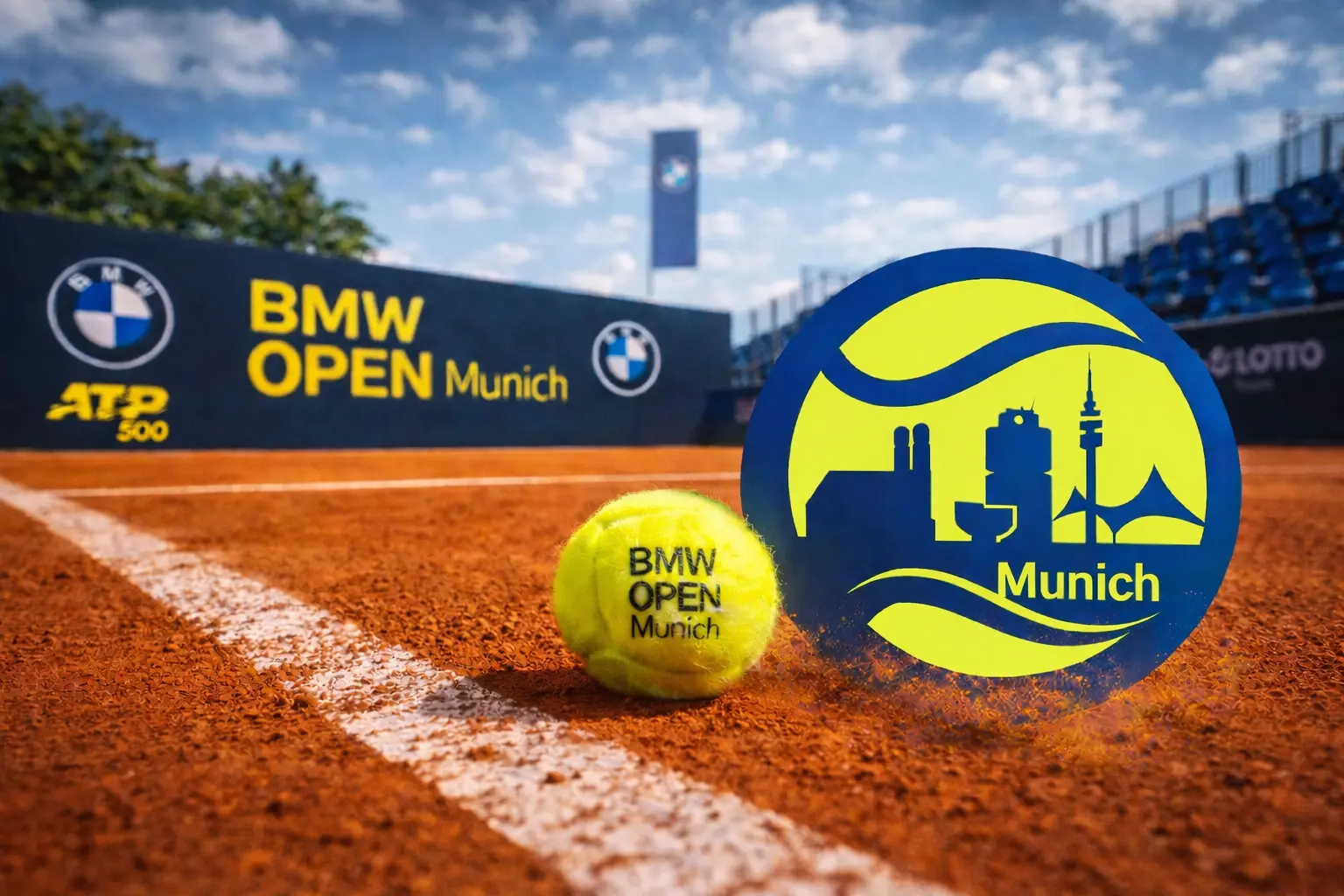
Flavio Cobolli broke down in tears after defeating Alexander Zverev 6-3, 6-3 to reach the final of the ATP 500 Munich Open, with emotional scenes immediately following match point drawing attention beyond the result itself. The Italian, who secured the biggest win of his career, remained seated on the bench, covering his face with a towel as he tried to process the moment.
The 23-year-old delivered a controlled performance to eliminate the world No. 3 and defending champion, striking 32 winners and losing just eight points on his first serve. However, the focus quickly shifted to his reaction, with Cobolli visibly overwhelmed as he wiped away tears after completing his first victory over a Top-5 opponent.
The emotional response appeared to reflect a combination of factors. Cobolli had just defeated a close friend on Tour in a high-stakes semi-final, while also dealing with the death of a friend’s 13-year-old son in Italy, news he had learned the previous day. In a message shared after that match, he wrote: “Every point I play, every ball I touch, every step I take, I will think of you.” The absence of celebration and the immediacy of the reaction underlined the weight of the moment.
With the win, Cobolli advances to his second ATP 500 final of the season after his title run in Acapulco, and the fifth Tour final of his career. He will face either Ben Shelton or Alex Molcan in Sunday’s final, but the defining image from the semi-final remains his emotional reaction rather than the scoreline.

Emotional release after career milestone
Cobolli described the match itself as one of the highest-level performances of his career, but his reaction suggested a broader weight attached to the result. The combination of defeating a top opponent, doing so in a high-stakes semi-final, and facing a player he considers a friend contributed to the visible release of emotion. "It was one of my best matches ever, against one of my best friends on Tour.”
The Italian had limited success against elite opposition prior to this week, entering the match with a 1–16 record against Top-10 players. The breakthrough therefore carried both competitive and psychological significance, reinforcing the sense that the moment extended beyond a single result. “He's a really good guy and we have a good relationship with everyone on his team, so it was a little bit tough to play against him.”
There were also clear personal factors behind the reaction. Cobolli’s tears came immediately after match point, without prolonged celebration, aligning with the message he had shared a day earlier and indicating that the moment carried significance beyond the competitive context.
Match control and performance data
From a technical standpoint, Cobolli delivered a structured and high-efficiency performance. He struck 32 winners and lost just eight points on his first serve, maintaining consistent pressure throughout both sets. His ability to shorten rallies and dictate from the baseline prevented Zverev from establishing rhythm.
The match turned early in the second set when Zverev produced a double fault to concede a break. Cobolli consolidated immediately and did not face sustained pressure on serve for the remainder of the contest, closing out the match in 69 minutes with minimal fluctuation in level. “Today I think I played one of my best matches and I'm really happy about my performance.”
The result also carries ranking implications, lifting Cobolli to No. 13 in the live ATP ranking and No. 10 in the Race. It places him among a small group of players, including Jannik Sinner and Carlos Alcaraz, who have reached ATP Tour finals on both clay and hard courts this season.
For Zverev, the defeat marks a fourth consecutive semi-final loss across events in Indian Wells, Miami, Monte Carlo and Munich. In contrast, Cobolli advances with momentum, but the defining image of the match remains his reaction—seated, emotional, and momentarily removed from the competitive context after a career milestone.

Cristhián AvilaTennis Journalist
Cristhián Ávila is a tennis journalist based in Santiago, Chile, and has been part of the TennisUpToDate team since early 2023. He covers the ATP and WTA Tours as well as all four Grand Slams, producing breaking news, match reports, analysis, and regular liveblogs from major tournaments.
His reporting combines statistical analysis with clear explanation, helping readers understand tactical developments, player form, and broader storylines across the tour. Working fluently in both Spanish and English, Cristhián collaborates with an international editorial team and contributes to comprehensive global coverage. As part of his work, he has conducted interviews and media interactions with leading figures in the sport, including Caroline Wozniacki and John McEnroe.
In his journalism, Cristhián places strong emphasis on careful sourcing, editorial accuracy, and updating articles promptly when new, verified information becomes available. His coverage is grounded in research, context, and direct engagement with professional tennis.
claps 0visitors 0
Just In

Popular News

Latest Comments
- Does Sinner need that 4.5 mil? I doubt it. He can make that with three modelling gigs!😅🤣Rapunzel21-10-2026
- Did "People Magazine" purchase this website? This nonstop storyline is bullshit.
 mandoist21-10-2026
 - Listen... this is of no concern to anyone but these two. Deal with your own issues -- most of us have our own. Thanks, media, for these insignificant follow-ups which are meaningless.mandoist21-10-2026
- This is so very very sad, for all three of them. I truly thought they had an unbreakable bond, but life throws up so many differing challenges. Having your homeland suffering in such a terrible way, makes happiness lose out to guilt as well. Our thoughts are with them. X💔bjsexton20-10-2026
- I have lost all respect for Svitolina! Could she not have waited until he had played at the Paris Masters!!! She is selfish and don't give a damn about Gael. That is NOT how love is demonstrated Elina!!Rapunzel19-10-2026
- Perhaps convenient tennis tour sex is not a strong enough experience in which to base a marriage?mandoist19-10-2026
- Fight the Good Fight... Tennis (sports in general) need more Humans such as yourself.mandoist18-10-2026
- When is WTA going to mandate Genetic Testing (DNA) ???mandoist18-10-2026
- Hey, Dan... you just wake up from a coma? Regardless -- Thanks for the comedy this morning!mandoist18-10-2026
- Two Things: 1. Stop allowing these Spoiled Trust-Fund Elitists to behave badly. Your little hand-slaps do not deter them. 2. STOP the incessantly annoying "towel wiping" nonsense!!!!mandoist15-10-2026

Loading
