“Second match on grass, I was not looking for perfection”: Jannik Sinner operates in transition mode at Wimbledon
ATP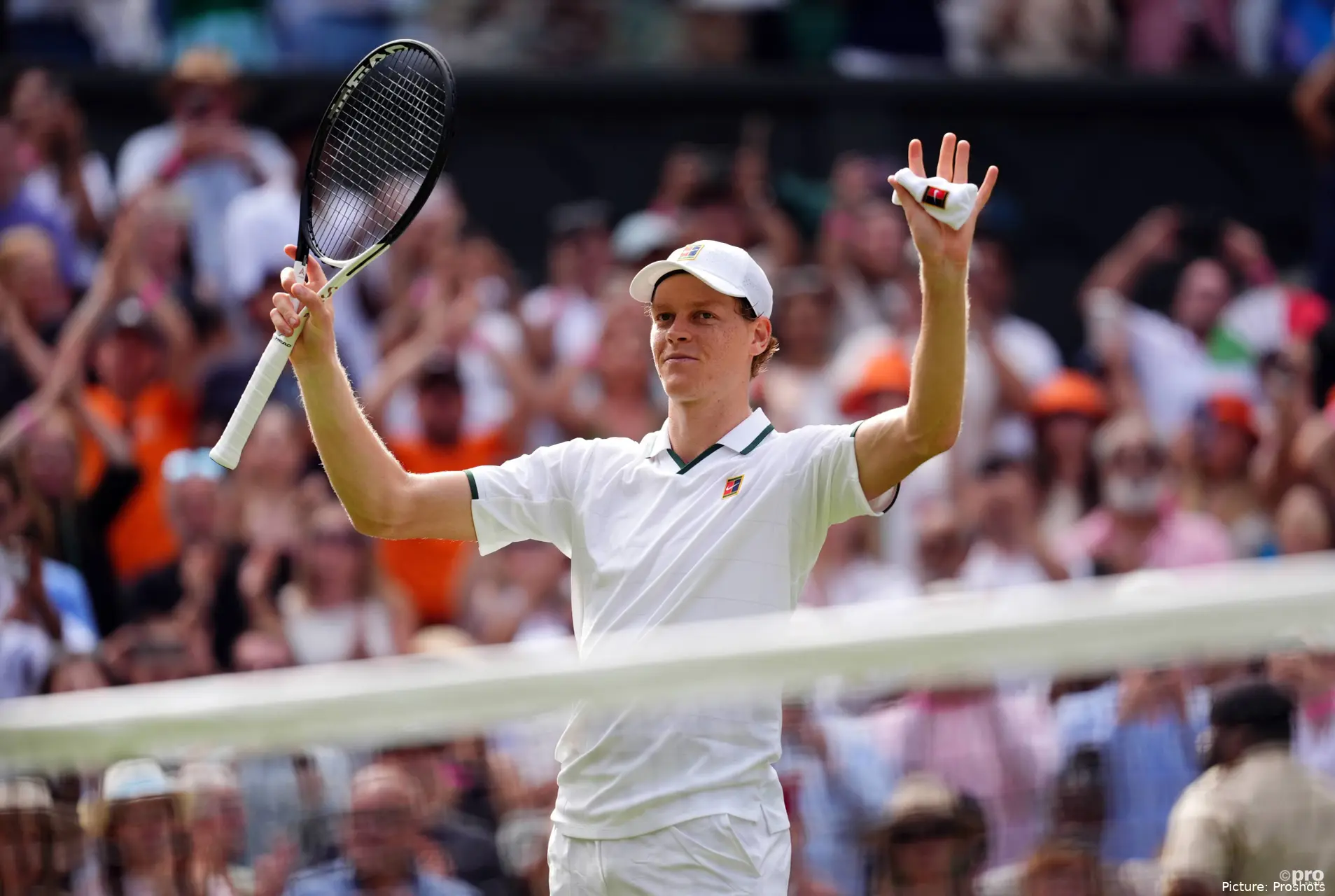
Jannik Sinner reached the third round of Wimbledon on the night of July 1 after a 7-6(4), 7-6(2), 6-4 win over Nuno Borges on Centre Court. The result extended his title defence, although the match itself stayed tight for long stretches and never fully opened up in his favour.
The contest lasted 2 hours and 32 minutes and was largely decided by small margins. Two tie-breaks shaped the opening two sets, and it was only a late break at 5-4 in the second that allowed Sinner to avoid a longer, more unpredictable finish.
The world No. 1 came into the match after a five-set opening round against Miomir Kecmanović, and again there was a sense that his grass-court level is still settling. Control came in phases rather than across the whole match, with service games doing most of the heavy lifting.
Even in victory, the numbers reflected that balance. Sinner landed 67 per cent of his first serves, won 82 per cent of those points, and struck 22 aces. He also moved to 95 Grand Slam main-draw wins, overtaking Nicola Pietrangeli to become the Italian with the most men’s singles victories in majors during the Open Era.

“Second match on grass, I was not looking for perfection”
Sinner did not try to frame the match as a complete performance. Instead, he described it as part of a process, where the focus is still on adjusting rather than executing at full consistency across every phase.
Much of the match revolved around Borges’ serve, which kept rallies short and made it difficult for Sinner to build rhythm from the baseline, especially early on when neither player managed to impose long stretches of control.
“I feel today’s tough to say because he was serving very well, very precise the first couple of sets," the defending champion said in press conference. "When he was serving for the second set, he struggled a little bit there. It’s also normal when you serve out for a set or a match, there’s a little bit more tension. Overall, I tried to stay a little bit more aggressive.”

Jannik Sinner of Italy celebrates following his match against Miomir Kecmanovic of Serbia during the Gentlemen's Singles on day one of the 2026 Wimbledon
That sense of adjustment also shaped how he described his own performance. It was not about precision or completeness, but about staying competitive while still testing patterns under match pressure.
“At times, it worked well. At times, I feel like there’s a little bit to improve. But second match on grass, I was not looking for perfection. I tried to improve, but at times I did. Then we’ll see how it goes.”
“There are no easy matches”
Sinner also placed the match in the wider context of Wimbledon, where even straight-sets wins can hide long periods of uncertainty. The scoreline suggested control, but the reality on court was closer than it looked.
One of the key moments came in the second set, where Sinner’s late break at 5-4 stopped Borges from taking the match deeper. He pointed to that phase as part of the natural swings that come with this stage of the tournament.
“Yeah, it was important. But even if you lose, it's still a long match, you know. Many things can happen. It's just that the dynamic can change, you know. I broke him very early. Then there was a lack of concentration again in the third set, but I tried to bounce back straight away, which I've done.”

He also confirmed there were no physical concerns after a fall earlier in the tournament, saying his recovery had been complete and that it did not affect how he moved or played against Borges.
“For sure, when you have a fall like this, it's... Woke up the next day, it was not perfect, but we recovered very well on court today. I felt good, so no issues at all. The foot was really good. So, yes, I feel all OK.”
Read also
Looking ahead, Sinner will face Jenson Brooksby in the third round, their first meeting since 2021 in Washington, with both players arriving very differently compared to that earlier encounter.
He also acknowledged that his grass-court game is still evolving, particularly in movement, net play, and second-serve return aggression, where he continues to adjust rather than settle into fixed patterns.
“Trying to go a little bit more to the net, trying to be a bit more aggressive. Also, the movement itself I can improve, I feel like, on grass. And, yes, also, again, the return of serve, especially second serves, trying to be a little bit more aggressive and then we see how it goes.”

Cristhián AvilaTennis Journalist
Cristhián Ávila is a tennis journalist based in Santiago, Chile, and has been part of the TennisUpToDate team since early 2023. He covers the ATP and WTA Tours as well as all four Grand Slams, producing breaking news, match reports, analysis, and regular liveblogs from major tournaments.
His reporting combines statistical analysis with clear explanation, helping readers understand tactical developments, player form, and broader storylines across the tour. Working fluently in both Spanish and English, Cristhián collaborates with an international editorial team and contributes to comprehensive global coverage. As part of his work, he has conducted interviews and media interactions with leading figures in the sport, including Caroline Wozniacki and John McEnroe.
In his journalism, Cristhián places strong emphasis on careful sourcing, editorial accuracy, and updating articles promptly when new, verified information becomes available. His coverage is grounded in research, context, and direct engagement with professional tennis.
claps 0visitors 0
Just In



Popular News
Latest Comments
- A healthy Qinwen may be hard to stop next season. She was already scaring her opponents before her medical leave(s). Unfortunately, Zheng insisted on singing again. On the positive side -- Mirra did not sing!! ;~}
 mandoist11-10-2026
 - Where is it written that athletes, entertainers... People in general... are mandated to keep looking at -- or even using [anti]Social Media? Public & private figures consistently complain and reveal their concerns about negativity and violence thrown at them -- yet they insist on participating. Avoid it, don't use it, don't read it. It's okay to occasionally look up at the World instead beating your eyes & thumbs to death on The Inventions out there.mandoist11-10-2026
- great articlestennisseserver07-10-2026
- Medvedev was leading Djokovic 7-5, 3-5 when an attempted return..' NO you ignorants, Djokovic was leading .weiss05-10-2026
- No more bullshit "Wildcards" to these two. Qualify like everyone else -- there will be cameras there, too. Time to scream... WTF ????!!!!mandoist29-09-2026
- Let's not BS the general public -- Sabalenka started showing cracks in her game last season. Her losses and near-losses started at about the same time she began being distracted by Fame (constant Selfies, making TV commercials, magazine shoots, endless Social Media nonsense, etc., etc.) One would think even Saba could recognize the parallels with others who failed before her -- Raducanu, Giorgi, Bouchard to name a few.mandoist25-09-2026
- Gross!! Hey Raducanu, Giorgi, and Bouchard -- reserve a seat at your Social Media Selfie table for Saba + Naomi. They're heading in your direction soon enough.mandoist24-09-2026
- And then these same players will complain about how lengthy their season’s were and need more time-off. I’m all for more tennis but the amount of tennis we get now is actually kind of crazy! We all need a break, especially the players.DaveyWavey23-09-2026
- You should do a comparison article for "different kinds of justice" the courts decide for tennis players. I can think of at least three players who received very small bans of a few months, however Tara Moore has been fighting for her literal survival the past few years. It seems odd considering she is not a "name" player, unlike the other cases.DaveyWavey22-09-2026
- PRIZE MONEY & POINTS Winner - $185,500 Finalist - $114,500 Semi-Finalist - $66,003 Quarter-Finalist - $35,000 Round of 16 - $18,045 Round of 32 - $13,005 Winner - 500 Finalist - 325 Semi-Finalist - 195 Quarter-Finalist - 108 Round of 16 - 60 Round of 32 - 1DaveyWavey20-09-2026

Loading