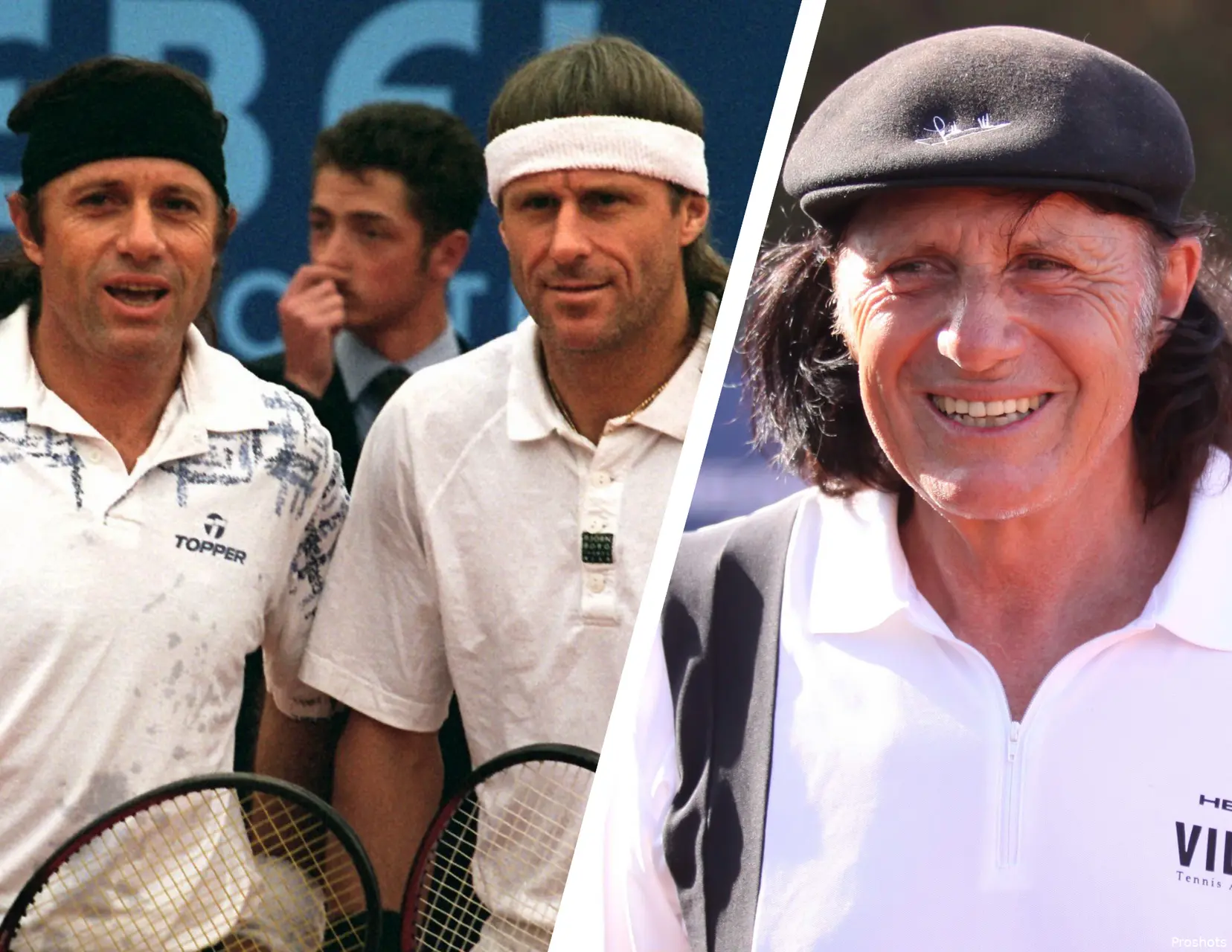
Argentina's Guillermo Vilas is the most successful male player South America has ever produced. No man from this continent can match Vilas's haul of four Grand Slam singles titles and 62 wins in singles tournaments.
Born in the Argentine capital Buenos Aires, Vilas was raised in the seaside resort of Mar del Plata. He turned professional in 1968 - the first year of Open Era tennis - and went on to establish himself as a leading player throughout much of the 1970s.
He made a main draw Grand Slam debut at the 1970 Wimbledon Championships. Vilas then waited until 1972 for his next appearance at a major.
First titles and entry into the top ten
Vilas reached his first career finals in 1972, losing to Jimmy Connors in Cincinnati and German Karl Meiler on home soil in Buenos Aires. The following year, playing Bjorn Borg, Vilas was crowned champion at the Buenos Aires tournament when the Swede retired hurt prior to a fourth set tiebreak. At that point, Vilas was trailing two sets to one.
Vilas's 1974 campaign witnessed further elevation in his standing. Titles won at Gstaad, Hilversum, Louisville, Toronto, Tehran, Buenos Aires and the prestigious Masters crown in Melbourne helped Vilas finish the year inside the top ten of the fledgling world rankings for the very first time. He'd now arrived as a major contender for the Grand Slams.
Maiden Grand Slam final and eleven titles across 1975-76
The 1975 season turned into another profitable one for Vilas. He picked up a quintet of titles. Among the titles captured was a third successive title in Buenos Aires.
1975 was also the year when Vilas progressed to a first Grand Slam final. A four set last four win over American Eddie Dibbs facilitated Vilas’s path into the French Open final. In the showpiece match, Vilas was brushed aside by defending champion Borg.
Vilas continued to be a serial title winner in 1976. He made it four in a row at Buenos Aires and claimed a first title at the prestigious Monte Carlo clay court event.
His best showing in the majors this year proved to be a semi-final run at the US Open. Vilas also reached a second consecutive Wimbledon quarter-final. These were his best runs at the British major.
1977: A year for the ages as Vilas wins 16 titles including two Grand Slams
In a year that ranks amongst the finest ever recorded in men's tennis, Vilas emerged triumphant on 16 occasions. He won 130 of his 145 singles matches.
1977 was the year when he transitioned from contender to a double major champion. He began the campaign by losing his second Grand Slam final to Roscoe Tanner on the grass courts of Melbourne at the Australian Open. Vilas wouldn't have to wait long for redemption.
At the 1977 French Open, with Borg absent, Vilas started as the favourite. In his last three matches, he lost just 16 games to secure glory in the French capital. The final was a clinic from the Argentine, winning 6-0, 6-3, 6-0 against Brian Gottfried.
Double Grand Slam glory materialised at the US Open, the final edition of the Stateside major to be played at Forest Hills. Going against type, Vilas produced a net rushing display that caught Connors by surprise. It was one of seven consecutive titles he accumulated after Wimbledon.
It was surprising after a season of perpetual success, Vilas failed to end as world number one. He produced a then record 53 match winning streak on clay. A record that stood until Rafael Nadal surpassed it in 2006. Number two had to suffice.
Borg puts Vilas in his place at Roland Garros, but rebounds to win a third major
Vilas warmed up for his French Open defence with trophy lifts in Hamburg and Munich. Borg returned to play in Paris, making it more important for Vilas to triumph when the best player on clay and in general was present. The two clashed in the final but Vilas managed to win only five games.
The 1978 season yielded a further four titles culminating in a third Grand Slam triumph Down Under. Vilas survived a five set thriller with Aussie Tony Roche in the quarters. In the final, playing another Australian, John Mark's, Vilas triumphed in four sets. The only caveat was Borg, who only featured in one Australian Open, was again absent.
Title success drops a fraction but fourth Grand Slam triumph cements Vilas as a great Four titles were accrued by Argentina's finest in the 1979 term. This included a seventh triumph in the city of his birth.
He rounded off the season with a successful retention of his Australian Open crown. A straight sets win over unheralded American John Sadri gave Vilas a fourth Grand Slam title.
Vilas's strike rate of success was now beginning to diminish. He managed to win a trio of events in 1980. The pick of these was winning Rome, one of the biggest clay court tournaments outside the French Open. Vilas pocketed three titles in the early months of the 1981 season before losing the other six finals he contested that year. He finished inside the top ten for the eighth season running.
1982 proved to be the last year Vilas would finish inside the top ten. It was his best campaign for a few seasons. He managed to win five titles including an eight success in Buenos Aires and a second Monte Carlo success.
Vilas reached the last of his eight Grand Slam finals in 1982, losing to Mats Wilander in the French Open final.

Last singles titles as decline sets in
Vilas won three titles in 1983. A fourth triumph in Kitzbuhel represented the last of his 62 singles titles (10th all-time in the Open Era). He appeared in 104 finals. Vilas received a ban, in June 1983, for his manager Ion Tiriac receiving appearance money for Vilas's appearing at events. These payments were outlawed.
Appearances from Vilas became sporadic for the remainder of the 1980s, with him officially retiring in 1992. His last significant major run came when he reached the 1986 French Open quarter-finals.
World Number One controversy
A long running sore for Vilas is his belief that he should have been ranked as world number one in his annus mirabilis of 1977.
It was evident with 16 titles, including two Grand Slams, Vilas was the clear standard bearer this season. However, at the time, rankings were based on the average of a player's results. This led to Connors, despite only winning eight titles that year, being ranked at the summit.
When inducted to the International Tennis Hall of Fame, in 1991, the inscription read “it was generally considered Vilas was the real No. 1 for 1977.”
An investigation conducted by Argentine journalist Eduardo Puppo and Romanian mathematician Marian Ciulpan found that Vilas should have been ranked number one for five weeks in 1975 and the first two weeks of 1976. The data was handed over to the ATP in 2014 and not disputed by them. However, the ATP have never rectified the perceived injustice.
In October 2020, a documentary on Netflix, called Guillermo Vilas: Settling the Score documented the controversy. Four years later and the ATP vice-president remained steadfast Vilas will never be classified as world number one.

Guillermo Vilas with Bjorn Borg.
Davis Cup and doubles record
Vilas spearheaded Argentina's run to the 1981 Davis Cup final, where America proved too strong.
He finished with a 45-10 Davis Cup singles record. This remains an Argentine record for most singles wins. His tally of 57 rubbers won is another Davis Cup record for his country.
In doubles competition, Vilas garnered 15 titles from 26 finals. He rarely played doubles in Grand Slams. Vilas's highest doubles ranking was 13.
Personal life and legacy
Vilas was known as a lothario figure away from the tennis court. He became famed for a playboy lifestyle more akin to.a rock star.
Eventually, at the age of 47, became married. He met Phiangphathu Khumueang when she was just 17. Despite the 30-year age gap, the pair married five years after their initial connection. Vilas's reputation is founded largely on his clay court exploits. 49 of his 62 singles titles were won on clay. He surpassed 650 match victories on the surface. His Grand Slam triumphs in Paris and New York were on clay. In 2016, the Daily Telegraph ranked him as the third greatest claycourter of all-time after Borg and Nadal.
However, winning two majors on grass at the Australian Open, gave his CV a more rounded flavour. Nine consecutive seasons finishing inside the top ten reflect his consistency in the upper echelons of men's tennis. In the Open Era, Vilas became the second man to win over 900 career matches.
Vilas was inducted to the International Tennis Hall of Fame in 1991. Along with Borg, Connors and John McEnroe, the hedonistic Vilas brought a sexier and edgier image to the sport. They helped the sport move away from its genteel image. Vilas also put Argentine tennis on the map. He was the first from his nation, male or female, to win a Grand Slam singles title.

Jay Brannon is a sports journalist from Sutton Coldfield, England, with a lifelong passion for athletic competition and storytelling. For the past 1.5 years, he has been a prominent voice at TennisUpToDate.com, where he has authored more than 3,000 articles, specializing in deep-dive columns, tactical analyses, liveblogs, and comprehensive match reports for the ATP and WTA tours.
Jay’s tennis reporting blends rigorous, real-time statistical analysis with on-the-ground coverage. He frequently travels to tournaments to cover the action firsthand from the press box and player press conferences. This direct access allows him to deliver sharp insight into player form and tour developments—a dedication sparked by his earliest sporting memory of the iconic 1991 Wimbledon final between Michael Stich and Boris Becker.
Beyond the court, Jay brings a versatile background in live broadcasting and media. His professional experience includes serving as a sports reporter for BHBN Hospital Radio—where he delivered live updates and analysis for West Bromwich Albion and Wolverhampton Wanderers matches—as well as working as a match reporter for Sutton Coldfield Town.
Jay holds a degree in Music Journalism and Broadcasting from Staffordshire University, a foundational training that shaped his voice as a thoughtful, authentic storyteller. Grounded in core journalistic ethics, he places a strict emphasis on careful sourcing, editorial accuracy, and swift, verified updates.
claps 0visitors 0
Just In


Popular News
Latest Comments
- A healthy Qinwen may be hard to stop next season. She was already scaring her opponents before her medical leave(s). Unfortunately, Zheng insisted on singing again. On the positive side -- Mirra did not sing!! ;~}
 mandoist11-10-2026
 - Where is it written that athletes, entertainers... People in general... are mandated to keep looking at -- or even using [anti]Social Media? Public & private figures consistently complain and reveal their concerns about negativity and violence thrown at them -- yet they insist on participating. Avoid it, don't use it, don't read it. It's okay to occasionally look up at the World instead beating your eyes & thumbs to death on The Inventions out there.mandoist11-10-2026
- great articlestennisseserver07-10-2026
- Medvedev was leading Djokovic 7-5, 3-5 when an attempted return..' NO you ignorants, Djokovic was leading .weiss05-10-2026
- No more bullshit "Wildcards" to these two. Qualify like everyone else -- there will be cameras there, too. Time to scream... WTF ????!!!!mandoist29-09-2026
- Let's not BS the general public -- Sabalenka started showing cracks in her game last season. Her losses and near-losses started at about the same time she began being distracted by Fame (constant Selfies, making TV commercials, magazine shoots, endless Social Media nonsense, etc., etc.) One would think even Saba could recognize the parallels with others who failed before her -- Raducanu, Giorgi, Bouchard to name a few.mandoist25-09-2026
- Gross!! Hey Raducanu, Giorgi, and Bouchard -- reserve a seat at your Social Media Selfie table for Saba + Naomi. They're heading in your direction soon enough.mandoist24-09-2026
- And then these same players will complain about how lengthy their season’s were and need more time-off. I’m all for more tennis but the amount of tennis we get now is actually kind of crazy! We all need a break, especially the players.DaveyWavey23-09-2026
- You should do a comparison article for "different kinds of justice" the courts decide for tennis players. I can think of at least three players who received very small bans of a few months, however Tara Moore has been fighting for her literal survival the past few years. It seems odd considering she is not a "name" player, unlike the other cases.DaveyWavey22-09-2026
- PRIZE MONEY & POINTS Winner - $185,500 Finalist - $114,500 Semi-Finalist - $66,003 Quarter-Finalist - $35,000 Round of 16 - $18,045 Round of 32 - $13,005 Winner - 500 Finalist - 325 Semi-Finalist - 195 Quarter-Finalist - 108 Round of 16 - 60 Round of 32 - 1DaveyWavey20-09-2026

Loading