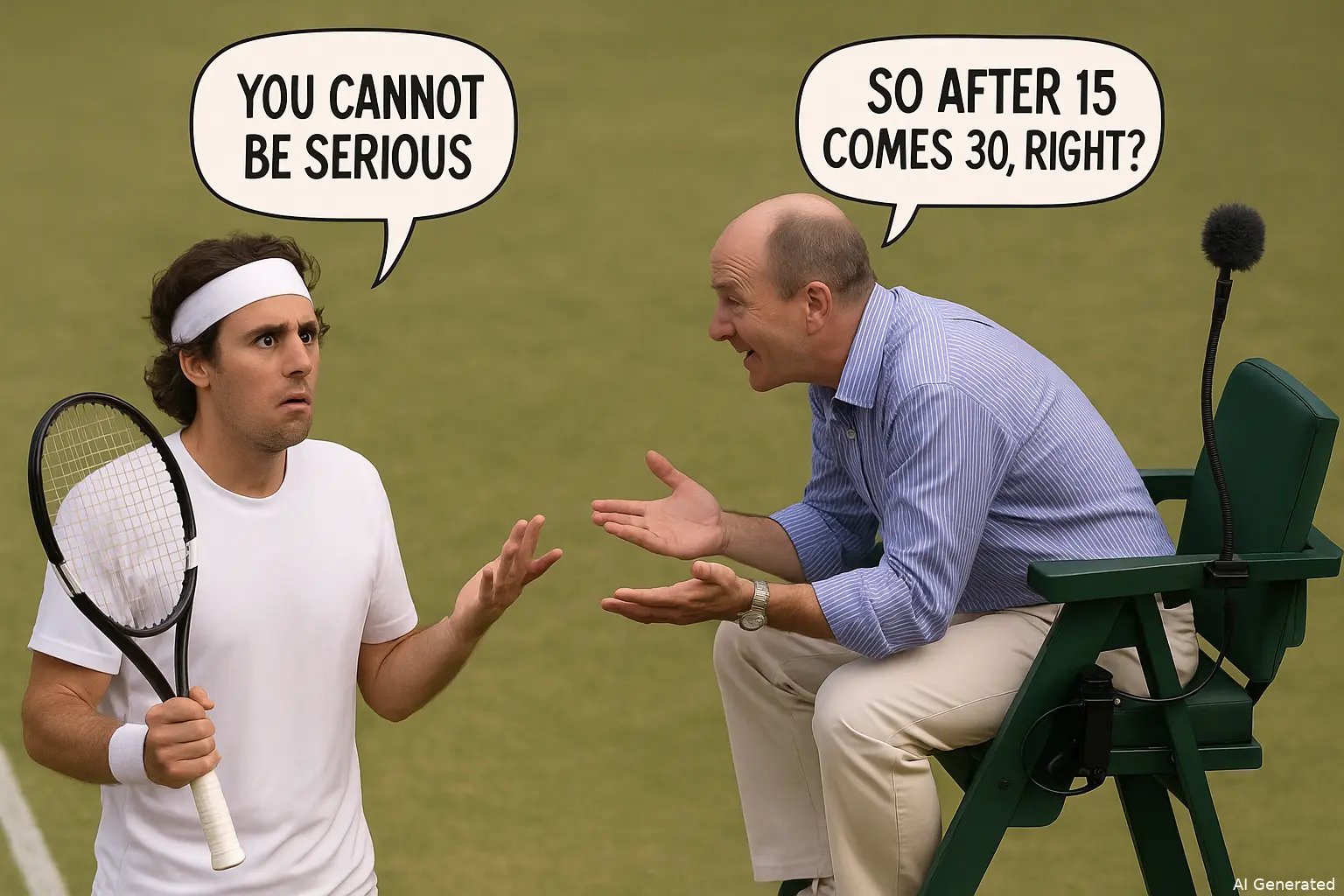
The scoring system on the ATP and WTA Tours can be a little confusing. Why does tennis count points as '15, 30, 40' and not numerically like most other sports?
Points give you games, games give you sets, and sets give you matches. The scoring in tennis even allows you to win a match by earning fewer total points than your opponent. This was the case for Jannik Sinner and Carlos Alcaraz in the French Open final, where the Spaniard won a total of 192 points, compared to 193 for his opponent. It mattered little, as the score was 4-6, 6-7, 6-4, 7-6, 7-6 in favor of Carlitos, who took home the trophy.
A couple of hours before that, Sinner had three "match points." This means that Sinner was just one point away from victory three times before the match ended. But what does this entire scoring system mean? Here's a breakdown.
Here is what the article contains:
1. What do the scores mean? (15, 30, 40...)
2. How do you win a game, set and match?
3. What is a tiebreak and how does it work?
4. Scoring in doubles and singles
5. Common scoring terms every tennis fan should know
6. Tennis scoring in Grand Slams vs regular matches
2. How do you win a game, set and match?
3. What is a tiebreak and how does it work?
4. Scoring in doubles and singles
5. Common scoring terms every tennis fan should know
6. Tennis scoring in Grand Slams vs regular matches

1. What Do the Scores Mean? (15, 30, 40...)
In tennis, the scoring system can sometimes be confusing for beginners. Points within each "game" are counted as 15, 30, 40, and then "game." The first point is 15, the second is 30, the third is 40, and one more point wins the game, as long as the player has a two-point lead.
This means that when players are tied at 40-40, they are at "deuce." The player who wins the next point gets the "advantage," and if they win the following point, they win the "game." Otherwise, they return to deuce until one player can score two consecutive points.
Although there is debate on the matter, it's believed that the scoring is related to a clock divided into quarters (15, 30, 45, 60). Over time, early tennis players may have opted to say "40" instead of "45" to make the call shorter. In any case, a "game" can last an indefinite amount of time, as the number of points is less important than achieving a two-point lead over the opponent.
2. How Do You Win a Game, Set, and Match?
To win a game, a player must have at least four points and a two-point advantage over their opponent. If the game reaches deuce, they will have to play at least two extra points to determine the winner of the game.
For each game, one of the players will serve, alternating between games. The player who wins six games will win a set, provided they have a minimum difference of two games. For example, a player can win 6-4, but if the score reaches 5-5, two more games will be played, with the goal of one player getting ahead by two. If they tie again at 6-6, a tie-break will be played. Normally played to seven points with a two-point difference, the tie-break determines the winner of a set when players are tied at 6-6 in games.
In women's tournaments and most men's tournaments, matches are best-of-three sets, meaning the first player to win two sets wins the match. However, in men's Grand Slam tournaments (Australian Open, Roland Garros, Wimbledon, and US Open), men's matches are played best-of-five sets. This means a player could come back after losing the first two sets, a clear example being the recent Roland Garros final, where Carlos Alcaraz came back from two sets down and won the match in five sets. There is also the issue of super tie-break.

Carlos Alcaraz won Roland Garros despite winning less points
3. What is a Tiebreak and How Does It Work?
A tie-break is a deciding game used when the score reaches 6-6. It seeks to prevent sets from lasting indefinitely and has a numerical scoring system: 1, 2, 3... until a player reaches seven points with a minimum advantage of two.
In the tie-break, the first player starts serving for the first point, and then they take turns serving two points each. Sides are changed every six points played, maintaining the cycle until one of the players gets seven points—or manages to create a two-point difference after that.
Whoever wins the tie-break wins the set 7-6. In some tournaments or in doubles formats, a 10-point tie-break is used. This was precisely the case in the French Open final, where Alcaraz secured the victory in the fifth-set tie-break by a score of 10-2.
4. Scoring in Doubles vs. Singles
The scoring system for singles and doubles follows the same basic line, though doubles has a few key variations. Each team has two players who take turns serving throughout the set. The first player on a team will serve in the first game, and then, when it's the team's turn to serve again in the third game, it will be the second player who serves.
Depending on the tournament, many doubles draws have "no-ad scoring." This means the 15, 30, 40, and game scoring is maintained, but if it gets to deuce, there is no advantage point. In this case, to win the game, it is enough to make 4 points before the rival team, without needing the two-point difference required in singles. After 40-40, the team that wins the next point wins the game.
Additionally, a 10-point tie-break is often implemented to replace the third set. This is a "match tie-break" where the first team to reach 10 points with a two-point difference wins the match, with the objective of shortening the duration of the match. Recently, in Venus Williams's return to the courts in doubles (along with Hailey Baptiste), they ended up falling in the match tie-break against Taylor Townsend and Shuai Zhang, with a final score of 6-4, 3-6, [10-6].
5. Common Scoring Terms Every Tennis Fan Should Know
- Love: Means zero. If the score is 15-love, it indicates 15-0.
- Deuce: Used when the score is 40-40. From there, you need to win two consecutive points to take the game.
- Advantage (Ad): After deuce, if a player wins a point, they have the advantage. If they win the next point, they win the game. If they lose it, they return to deuce.
- Break: When a player wins the game in which their opponent was serving.
- Deuce: Used when the score is 40-40. From there, you need to win two consecutive points to take the game.
- Advantage (Ad): After deuce, if a player wins a point, they have the advantage. If they win the next point, they win the game. If they lose it, they return to deuce.
- Break: When a player wins the game in which their opponent was serving.
- Break point: When a player has a chance to break. For example, with player 1 serving at 30-40, player 2 has a break point—a chance to 'break' their opponent's serve on the next point.
- Set point / Match point: A point that, if won, grants the set or the match, respectively. The same point can be simultaneously a break, set, and match point depending on the circumstances.
- Tiebreak: A tie-breaker game played when a set score is 6-6. Unlike the rest of the scoring (15, 30, 40...), this is done numerically (1, 2, 3...).
- Set point / Match point: A point that, if won, grants the set or the match, respectively. The same point can be simultaneously a break, set, and match point depending on the circumstances.
- Tiebreak: A tie-breaker game played when a set score is 6-6. Unlike the rest of the scoring (15, 30, 40...), this is done numerically (1, 2, 3...).
6. Tennis Scoring in Grand Slams vs. Regular Matches
In regular tournaments, the scoring system is best-of-three sets, with tie-breaks in each set if necessary. This applies equally to men's and women's tournaments. The only exception is the four Grand Slam tournaments: Australian Open, Roland Garros, Wimbledon, and the US Open. In these, the men's singles draws are decided in best-of-five sets.
For some time now, all Grand Slams have adopted a super tie-break for the decisive set, to 10 points with a two-point difference. Previously, there were sets that had no limits, as games were played until one of the players got a two-game lead. This all changed with the famous match between John Isner and Nicolas Mahut at Wimbledon in 2010, which took 3 days and more than 11 hours to decide the winner with an impressive 70-68 in the fifth set.

Cristhián AvilaTennis Journalist
Cristhián Ávila is a tennis journalist based in Santiago, Chile, and has been part of the TennisUpToDate team since early 2023. He covers the ATP and WTA Tours as well as all four Grand Slams, producing breaking news, match reports, analysis, and regular liveblogs from major tournaments.
His reporting combines statistical analysis with clear explanation, helping readers understand tactical developments, player form, and broader storylines across the tour. Working fluently in both Spanish and English, Cristhián collaborates with an international editorial team and contributes to comprehensive global coverage. As part of his work, he has conducted interviews and media interactions with leading figures in the sport, including Caroline Wozniacki and John McEnroe.
In his journalism, Cristhián places strong emphasis on careful sourcing, editorial accuracy, and updating articles promptly when new, verified information becomes available. His coverage is grounded in research, context, and direct engagement with professional tennis.
claps 2visitors 1
Just In



Popular News



Latest Comments
- Does Sinner need that 4.5 mil? I doubt it. He can make that with three modelling gigs!😅🤣Rapunzel21-10-2026
- Did "People Magazine" purchase this website? This nonstop storyline is bullshit.
 mandoist21-10-2026
 - Listen... this is of no concern to anyone but these two. Deal with your own issues -- most of us have our own. Thanks, media, for these insignificant follow-ups which are meaningless.mandoist21-10-2026
- This is so very very sad, for all three of them. I truly thought they had an unbreakable bond, but life throws up so many differing challenges. Having your homeland suffering in such a terrible way, makes happiness lose out to guilt as well. Our thoughts are with them. X💔bjsexton20-10-2026
- I have lost all respect for Svitolina! Could she not have waited until he had played at the Paris Masters!!! She is selfish and don't give a damn about Gael. That is NOT how love is demonstrated Elina!!Rapunzel19-10-2026
- Perhaps convenient tennis tour sex is not a strong enough experience in which to base a marriage?mandoist19-10-2026
- Fight the Good Fight... Tennis (sports in general) need more Humans such as yourself.mandoist18-10-2026
- When is WTA going to mandate Genetic Testing (DNA) ???mandoist18-10-2026
- Hey, Dan... you just wake up from a coma? Regardless -- Thanks for the comedy this morning!mandoist18-10-2026
- Two Things: 1. Stop allowing these Spoiled Trust-Fund Elitists to behave badly. Your little hand-slaps do not deter them. 2. STOP the incessantly annoying "towel wiping" nonsense!!!!mandoist15-10-2026

Loading