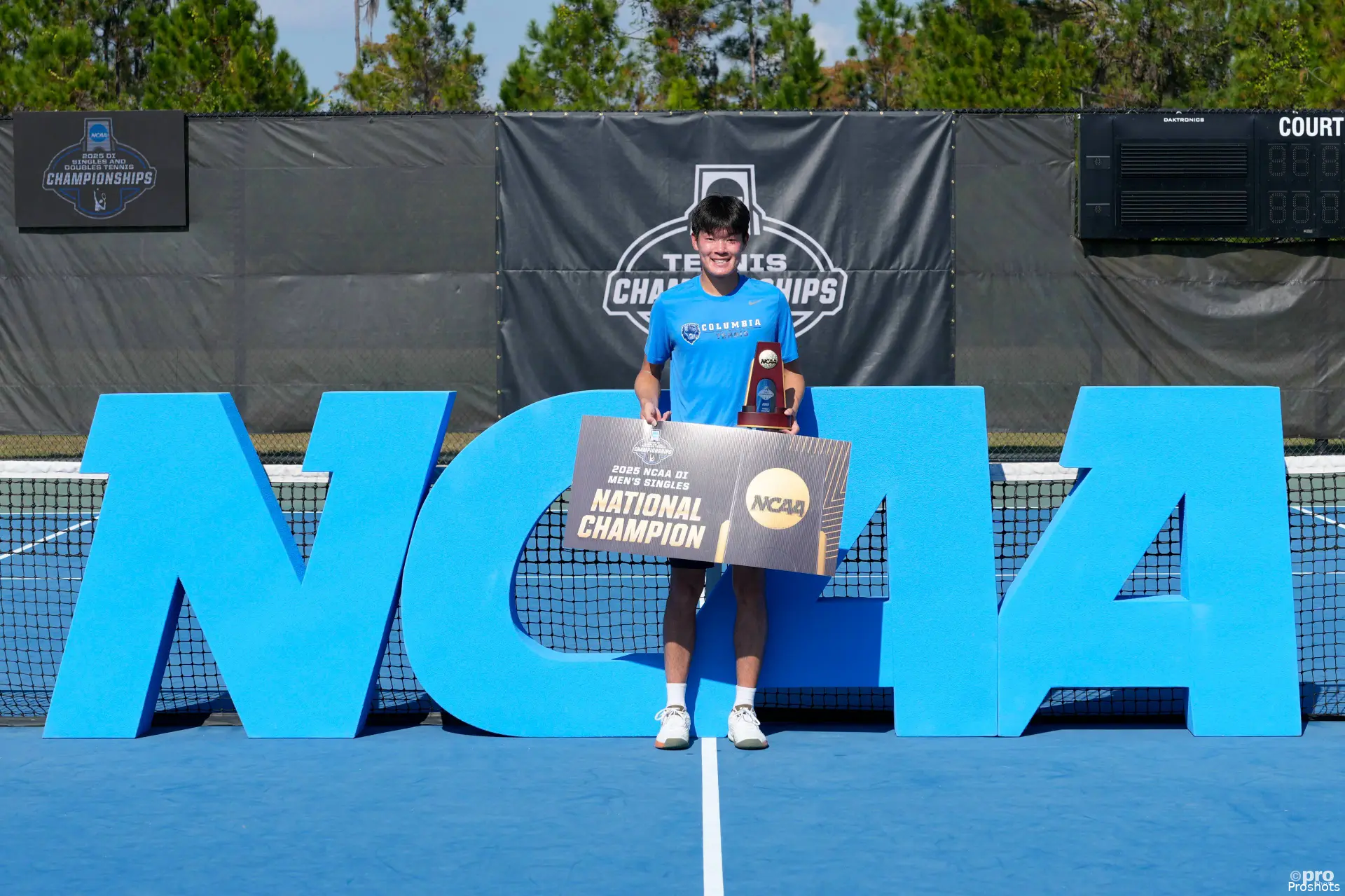
This weekend in Melbourne should have been a pure celebration of achievement. Twenty-one-year-old American Michael Zheng stunned the tennis world at the Australian Open, outlasting world No. 53 Sebastian Korda in a first-round, five-set battle. The win sent Zheng into the second round and guaranteed him roughly $225,000 in prize money. For a player ranked outside the top 170, that is not a bonus. It is transformative.
Except it may also be money he is not allowed to keep. Zheng is still enrolled at Columbia University, finishing a psychology degree. He delayed turning professional because he wanted an education. That decision has now placed him in a regulatory gray zone where winning at a Grand Slam may be treated as a violation rather than an accomplishment. At the exact same time, American college football tells a very different story.
On Monday night, Carson Beck took the field in the national championship game for the University of Miami. Over the weekend, Beck acknowledged to reporters that he actually graduated two years ago, making it superb obvious that he remains enrolled in college solely to continue playing football. According to On3, Beck’s NIL valuation currently sits at $3.1 million, making him one of the most valuable athletes in college sports. So let’s be very clear about what we are looking at.
A tennis player who earns money by winning matches on the sport’s biggest stage may be forced to give that money up. A football player who is no longer meaningfully a student can earn millions for his name, image, and likeness while playing for a national title on Monday night. If that sounds broken, it is because it is.
Amateur sport did not survive college athletics
The idea of amateurism at the college level is effectively dead. Football killed it. Basketball finished the job. NIL simply made the reality impossible to hide.
College sports are now professional enterprises in everything but name. There are agents, collectives, bidding wars, transfer portals, and open market valuations. No serious observer still believes that top college football is an amateur endeavor. And yet tennis players are still being governed as if it is 1995.
Tennis is different from football and basketball in one crucial way. Prize money is not optional. It is how the sport functions. It pays for travel, coaching, medical care, equipment, and survival. For players outside the elite tier, prize money is not income in the traditional sense. It is reimbursement for competing at all.
Telling a tennis player he cannot keep prize money earned through performance is not protecting amateur values. It is denying economic reality.
This is not just unfair. It is legally fragile.
With NIL now firmly established, restrictions like the one facing Zheng are increasingly difficult to justify under U.S. law.
Courts have already shown little patience for blanket rules that suppress athlete compensation while generating massive revenue for institutions and governing bodies. NIL cracked the foundation. What remains is selective enforcement dressed up as principle.
If an athlete can earn millions because his face appears on a billboard, it is very hard to argue that another athlete cannot keep money he earned by winning a match. One is hypothetical value. The other is earned compensation. One is branding. The other is labor. From an antitrust perspective, the distinction is thin at best.
Tennis is paying for football’s hypocrisy
College tennis did not create this problem. It inherited it.
The sport is now being asked to live under rules that football and basketball long ago outgrew. The result is a system where tennis players train like professionals, compete against professionals, and defeat professionals, yet are told they must remain financially amateur.
That is not tradition. That is exploitation.
It Is time for the courts to level the playing field
This will not be fixed internally. Institutions that benefit from ambiguity rarely rush to eliminate it.
What is needed is judicial clarity. If NIL is legal, then performance-based earnings must be as well. Once the door has been opened to seven-figure compensation, it cannot be selectively closed on athletes whose sports happen to rely on prize money instead of endorsements.
Michael Zheng did not exploit a loophole. He exposed one. And if college sports want to retain even a shred of credibility, the answer is obvious. Let him keep what he earned and fix why he probably has to give it back.

Aron SolomonGuest Author
A Pulitzer Prize-nominated journalist for his groundbreaking op-ed in The Independent exposing the NFL’s “race-norming” policies, Aron Solomon, JD, is a globally recognized thought leader in law, media, and strategy.
As Chief Strategy Officer for AMPLIFY, he leverages his deep expertise to shape the future of legal marketing. Aron has taught entrepreneurship at McGill University and the University of Pennsylvania and was honored as a Fastcase 50 recipient, recognizing him among the world’s top legal innovators. A prolific commentator on law, business, and culture, his insights regularly appear in Newsweek, The Hill, Crunchbase News, and Literary Hub.
He has also been featured in The New York Times, Fast Company, Fortune, Forbes, CBS News, CNBC, USA Today, ESPN, TechCrunch, BuzzFeed, Venture Beat and countless other leading global media outlets. We are proud to have Aron on board at TennisUpToDate, where his deep tennis expertise enriches the site with sharp, original columns that connect the sport to wider cultural debates.
claps 0visitors 0
Just In

Popular News
Latest Comments
- A healthy Qinwen may be hard to stop next season. She was already scaring her opponents before her medical leave(s). Unfortunately, Zheng insisted on singing again. On the positive side -- Mirra did not sing!! ;~}
 mandoist11-10-2026
 - Where is it written that athletes, entertainers... People in general... are mandated to keep looking at -- or even using [anti]Social Media? Public & private figures consistently complain and reveal their concerns about negativity and violence thrown at them -- yet they insist on participating. Avoid it, don't use it, don't read it. It's okay to occasionally look up at the World instead beating your eyes & thumbs to death on The Inventions out there.mandoist11-10-2026
- great articlestennisseserver07-10-2026
- Medvedev was leading Djokovic 7-5, 3-5 when an attempted return..' NO you ignorants, Djokovic was leading .weiss05-10-2026
- No more bullshit "Wildcards" to these two. Qualify like everyone else -- there will be cameras there, too. Time to scream... WTF ????!!!!mandoist29-09-2026
- Let's not BS the general public -- Sabalenka started showing cracks in her game last season. Her losses and near-losses started at about the same time she began being distracted by Fame (constant Selfies, making TV commercials, magazine shoots, endless Social Media nonsense, etc., etc.) One would think even Saba could recognize the parallels with others who failed before her -- Raducanu, Giorgi, Bouchard to name a few.mandoist25-09-2026
- Gross!! Hey Raducanu, Giorgi, and Bouchard -- reserve a seat at your Social Media Selfie table for Saba + Naomi. They're heading in your direction soon enough.mandoist24-09-2026
- And then these same players will complain about how lengthy their season’s were and need more time-off. I’m all for more tennis but the amount of tennis we get now is actually kind of crazy! We all need a break, especially the players.DaveyWavey23-09-2026
- You should do a comparison article for "different kinds of justice" the courts decide for tennis players. I can think of at least three players who received very small bans of a few months, however Tara Moore has been fighting for her literal survival the past few years. It seems odd considering she is not a "name" player, unlike the other cases.DaveyWavey22-09-2026
- PRIZE MONEY & POINTS Winner - $185,500 Finalist - $114,500 Semi-Finalist - $66,003 Quarter-Finalist - $35,000 Round of 16 - $18,045 Round of 32 - $13,005 Winner - 500 Finalist - 325 Semi-Finalist - 195 Quarter-Finalist - 108 Round of 16 - 60 Round of 32 - 1DaveyWavey20-09-2026

Loading