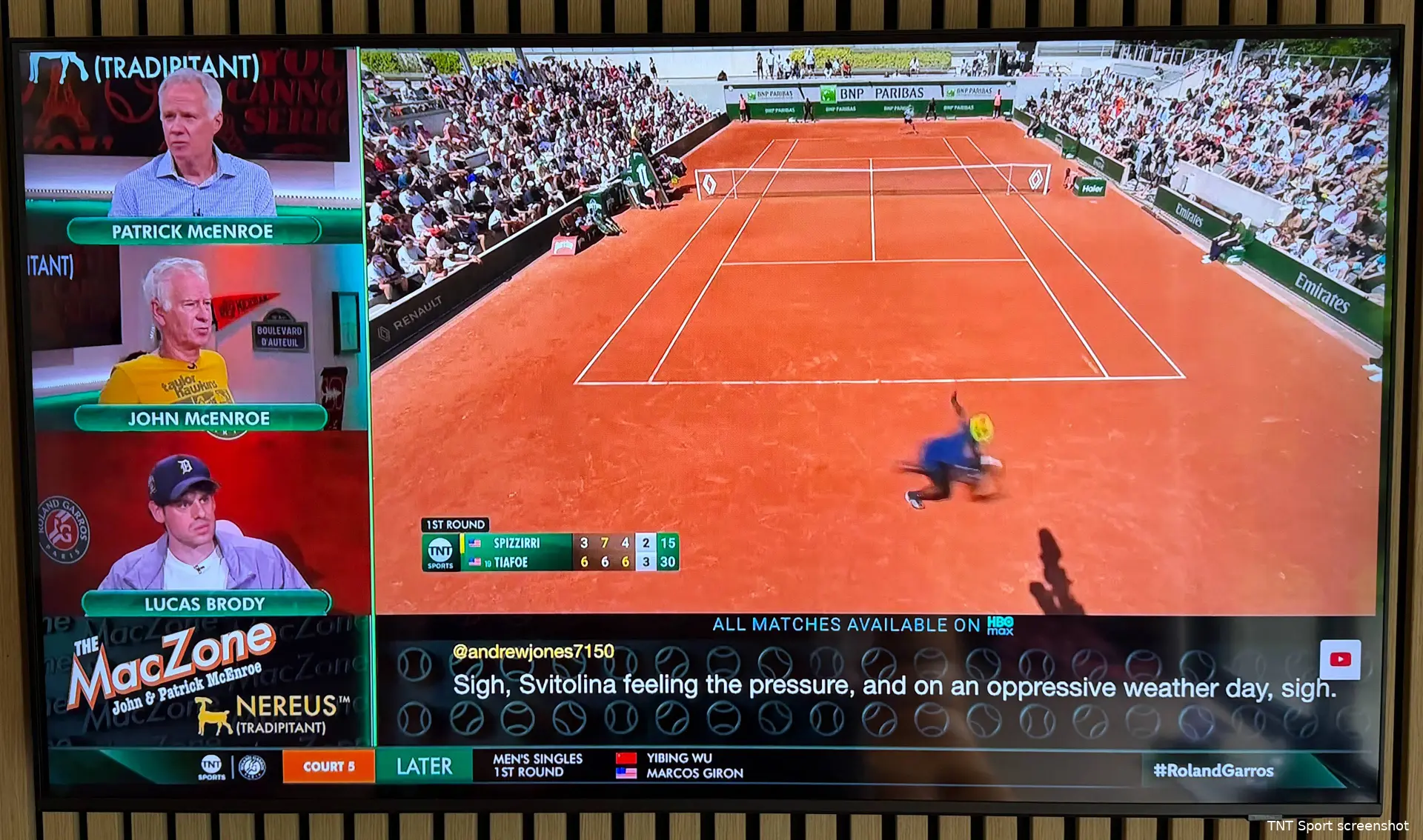
What fresh Hell is this? I turned on the Elina Svitolina vs. Anna Bondár match today right at the start of the third set, expecting, perhaps foolishly, to actually watch tennis. Instead, I got a television panel.
Not just any panel, either. John McEnroe, his somehow even more irritating brother Patrick, and a collection of other guys sitting around talking about whatever crossed their minds while the actual match — the thing allegedly being broadcast — was shoved into a tiny corner of the screen like an afterthought.
And beneath the already-miniaturized match feed? Scrolling social media comments.
Not analysis. Not tactics. Not insight. Troll commentary. Random noise about how Svitolina was “feeling the pressure.” This was during the French Open. A Grand Slam.
At one point, I genuinely wondered whether somebody in production had accidentally hit the wrong button and switched over to a sports-talk simulcast that was never supposed to air over live play. But no. This appeared to be intentional. Which honestly makes it worse.
Would this ever happen during a men’s match?
Because let’s ask the question everyone already knows the answer to.
Can anyone — honestly, sincerely, without laughing — imagine this happening during a men’s match?
Can you imagine a fifth set between Taylor Fritz and Arthur Rinderknech getting shrunk into a postage stamp while Martina Navratilova hangs out with Caroline Garcia and Jessica Pegula discussing unrelated storylines over the top of the action?
Can you picture producers deciding that the actual tennis mattered less than studio banter and social-media sludge? Of course you can’t. Nobody can.
Because somewhere deep in the decision-making hierarchy of professional tennis broadcasting, women’s matches are still treated as background content. Even now. Even after decades of growth. Even after women’s tennis routinely produces bigger personalities, more compelling stories, and often more entertaining matches than the men’s side.

Frances Tiafoe of United States serves during the match against Andrea Pellegrino
Women’s tennis still gets treated differently
That is the part that drives longtime fans insane.
The WTA has spent years trying to convince audiences that its product deserves equal respect, equal billing, equal visibility, equal investment. Then a broadcaster comes along during a Slam and essentially says: Actually, hold that thought while the McEnroes riff for a while. It is hard to imagine a more self-defeating presentation if you tried.
And the social-media comments underneath the match somehow made the whole thing feel even cheaper. Tennis already struggles with online abuse, particularly toward women players. Every tournament says it takes harassment seriously. Every governing body releases statements about protecting athletes from toxic online culture.
Then broadcasters literally put troll reactions on the screen during a live match. What are we doing here? Who exactly is this for? Because it certainly is not for people who love tennis.
Modern sports broadcasts are terrified of silence
One of the strangest things about modern sports broadcasting is how terrified executives seem to be of simply showing the sport. They constantly behave as though viewers will become bored if they are left alone with actual competition for more than thirty consecutive seconds.
Basketball gets split-screen debates during free throws. Baseball gets interviews during innings. Football broadcasts spend half the game promoting other programming.
But tennis should be the easiest sport in the world to present cleanly. The drama is already there. The tension is already there. Especially in a deciding set at Roland Garros. You do not need to decorate it with noise.
And yet the women’s game, in particular, keeps getting treated like content that needs help. Like audiences require famous male personalities talking over it in order to remain engaged.

Elina Svitolina - Anna Bondar Roland Garros 2026
The women’s game has carried tennis for years
Meanwhile, women’s tennis has quietly carried huge stretches of this sport for years.
The WTA produces emotional volatility, stylistic diversity, unpredictable draws, compelling rivalries, comeback stories, personality clashes, and global stars. The women often speak more candidly in press conferences. They show more vulnerability. They interact with fans more naturally. They routinely save tournaments from the monotony that sometimes creeps into the men’s side. And still this happens.
The image on my television today said more about professional tennis than any press release ever could.
A Grand Slam women’s match reduced to wallpaper while a group of men talked over it. Then the internet trolls got their own chyron.
Somewhere in a boardroom, somebody probably thought this was innovative programming. To tennis fans, it looked like disrespect.

Aron SolomonGuest Author
A Pulitzer Prize-nominated journalist for his groundbreaking op-ed in The Independent exposing the NFL’s “race-norming” policies, Aron Solomon, JD, is a globally recognized thought leader in law, media, and strategy.
As Chief Strategy Officer for AMPLIFY, he leverages his deep expertise to shape the future of legal marketing. Aron has taught entrepreneurship at McGill University and the University of Pennsylvania and was honored as a Fastcase 50 recipient, recognizing him among the world’s top legal innovators. A prolific commentator on law, business, and culture, his insights regularly appear in Newsweek, The Hill, Crunchbase News, and Literary Hub.
He has also been featured in The New York Times, Fast Company, Fortune, Forbes, CBS News, CNBC, USA Today, ESPN, TechCrunch, BuzzFeed, Venture Beat and countless other leading global media outlets. We are proud to have Aron on board at TennisUpToDate, where his deep tennis expertise enriches the site with sharp, original columns that connect the sport to wider cultural debates.
claps 5visitors 5
Just In

Popular News
Latest Comments
- A healthy Qinwen may be hard to stop next season. She was already scaring her opponents before her medical leave(s). Unfortunately, Zheng insisted on singing again. On the positive side -- Mirra did not sing!! ;~}
 mandoist11-10-2026
 - Where is it written that athletes, entertainers... People in general... are mandated to keep looking at -- or even using [anti]Social Media? Public & private figures consistently complain and reveal their concerns about negativity and violence thrown at them -- yet they insist on participating. Avoid it, don't use it, don't read it. It's okay to occasionally look up at the World instead beating your eyes & thumbs to death on The Inventions out there.mandoist11-10-2026
- great articlestennisseserver07-10-2026
- Medvedev was leading Djokovic 7-5, 3-5 when an attempted return..' NO you ignorants, Djokovic was leading .weiss05-10-2026
- No more bullshit "Wildcards" to these two. Qualify like everyone else -- there will be cameras there, too. Time to scream... WTF ????!!!!mandoist29-09-2026
- Let's not BS the general public -- Sabalenka started showing cracks in her game last season. Her losses and near-losses started at about the same time she began being distracted by Fame (constant Selfies, making TV commercials, magazine shoots, endless Social Media nonsense, etc., etc.) One would think even Saba could recognize the parallels with others who failed before her -- Raducanu, Giorgi, Bouchard to name a few.mandoist25-09-2026
- Gross!! Hey Raducanu, Giorgi, and Bouchard -- reserve a seat at your Social Media Selfie table for Saba + Naomi. They're heading in your direction soon enough.mandoist24-09-2026
- And then these same players will complain about how lengthy their season’s were and need more time-off. I’m all for more tennis but the amount of tennis we get now is actually kind of crazy! We all need a break, especially the players.DaveyWavey23-09-2026
- You should do a comparison article for "different kinds of justice" the courts decide for tennis players. I can think of at least three players who received very small bans of a few months, however Tara Moore has been fighting for her literal survival the past few years. It seems odd considering she is not a "name" player, unlike the other cases.DaveyWavey22-09-2026
- PRIZE MONEY & POINTS Winner - $185,500 Finalist - $114,500 Semi-Finalist - $66,003 Quarter-Finalist - $35,000 Round of 16 - $18,045 Round of 32 - $13,005 Winner - 500 Finalist - 325 Semi-Finalist - 195 Quarter-Finalist - 108 Round of 16 - 60 Round of 32 - 1DaveyWavey20-09-2026

Loading