
I’m watching a first-round match between Amanda Anisimova, currently ranked world No. 6, and former world No. 1 Karolina Pliskova.
Two elite players (okay, one currently and one formerly elite player) A night session. Prime time.
From multiple television angles, I counted 92 people in the stands. Maybe my math is off. Maybe it was 192. Maybe even 210. But it was 8:25 p.m. in Doha, this was a Women’s Tennis Association 1000-level event, and that’s precisely the point.
It shouldn’t even be a debate. WTA 1000 tournaments are supposed to represent the sport at its highest non-Grand Slam level. They are marketed as elite showcases, premium stops on the calendar, destinations for fans and sponsors alike. These are events that shape rankings, storylines, rivalries, and television narratives.
And yet here we were watching two world-class professionals hit in front of what looked like a private lesson gallery. This isn’t about shaming a host city. It’s about asking a necessary question the sport has danced around for too long.
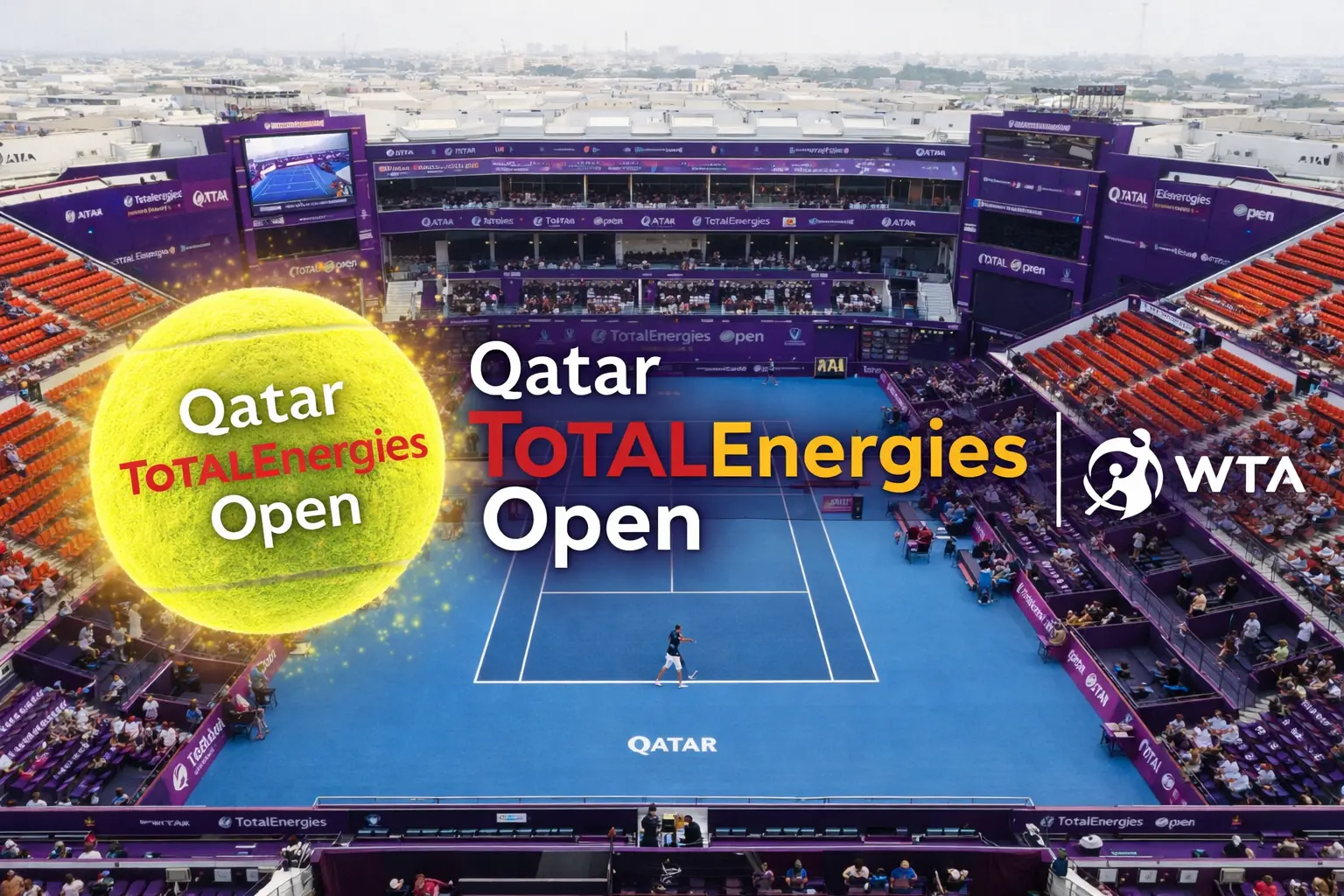
WTA 1000 label not justified
What does a tournament actually have to earn to be a 1000? Because lately, it feels like the label has been handed out far more easily than the experience justifies.
We’ve created too many “fake-1000” events—tournaments that carry the weight of the designation without consistently delivering the atmosphere, visibility, attendance, or cultural pull that the tier implies.

Karolina Pliskova benefited from a retirement from Anisimova.
I’ve written before that our own event in Montreal falls into that category as well. It is a proud tournament with history and loyal supporters, but prestige in modern tennis is no longer inherited. It has to be renewed every year through packed stands, buzz, and a sense that players are performing inside something bigger than the match itself.
A 1000-level badge should not be a courtesy title. It should be an earned credential. Right now, the pathway from 250 to 500 and from 500 to 1000 feels far too soft. There is no visible bar. No publicly articulated standard for attendance, ticket demand, broadcast reach, atmosphere, or local engagement. Imagine if tennis adopted the same rigor it applies to ranking points.
To be a 1000, a tournament should consistently prove it can draw crowds for weekday sessions, not just finals. It should demonstrate genuine local interest, not reliance on corporate seating blocks that remain empty on camera. It should move tickets without heavy discounting and create the sense that being there matters. It should be about more than just some sponsor throwing a little money behind getting an event to a city. Because optics matter.
Fans at home notice empty seats. Casual viewers notice. Sponsors notice. And players absolutely notice. Tennis is not a studio sport. It feeds off human presence. Energy. Noise. Tension between points. The murmur before a serve. The eruption after a break.
When those elements are missing, even the best tennis in the world flattens. WTA players in particular deserve better than to perform marquee-level matches inside what looks like a rehearsal hall. The tour has made real strides in recent years—larger prize pools, more visibility, better scheduling. But presentation is part of legitimacy, and legitimacy is part of growth.
Cannot sell a product showing rows of empty chairs
You cannot sell a product as premium while showing rows of empty chairs. There is also a scheduling issue buried in all of this. First rounds at major events are notoriously overloaded with matches, but if you insist on placing top players into night sessions, then the environment must justify the spotlight. Otherwise, you are diluting the very currency that the night match is supposed to carry.
Not every city needs to host a 1000. That’s not an insult. It’s just reality. Different markets excel at different scales. Some are perfect for intimate 500-level events. Others thrive as developmental stops. And a very select few Indian Wells, Rome, and sometimes Madrid, have built something that unmistakably feels massive.
Doha not there yet
Those tournaments didn’t become iconic because the tour told us they were. They did it because the crowds, the grounds, and the energy made it obvious. Doha, on this evidence, is not there yet. And that’s okay—if the tour is willing to be honest about what that means.
What isn’t okay is continuing to inflate categories without holding tournaments accountable to them. Tennis has spent decades trying to expand its footprint, attract new fans, and compete in an increasingly crowded sports-entertainment market. The fastest way to undermine that effort is to broadcast emptiness under the banner of prestige.
If the WTA wants its top tier to mean something, it needs to define what that something is. Attendance thresholds. Marketing commitments. Local outreach. Broadcast presentation standards.
Make the criteria public. Make promotion between tiers conditional. Make hosting a 1000 an achievement rather than an entitlement. Because when the world No. 6 and a former No. 1 walk onto court in prime time, the question should never be how many people bothered to show up. It should be how loud the building is going to get. Right now, too often, the silence is doing the talking.

Aron SolomonGuest Author
A Pulitzer Prize-nominated journalist for his groundbreaking op-ed in The Independent exposing the NFL’s “race-norming” policies, Aron Solomon, JD, is a globally recognized thought leader in law, media, and strategy.
As Chief Strategy Officer for AMPLIFY, he leverages his deep expertise to shape the future of legal marketing. Aron has taught entrepreneurship at McGill University and the University of Pennsylvania and was honored as a Fastcase 50 recipient, recognizing him among the world’s top legal innovators. A prolific commentator on law, business, and culture, his insights regularly appear in Newsweek, The Hill, Crunchbase News, and Literary Hub.
He has also been featured in The New York Times, Fast Company, Fortune, Forbes, CBS News, CNBC, USA Today, ESPN, TechCrunch, BuzzFeed, Venture Beat and countless other leading global media outlets. We are proud to have Aron on board at TennisUpToDate, where his deep tennis expertise enriches the site with sharp, original columns that connect the sport to wider cultural debates.
claps 2visitors 2
Just In

Popular News
Latest Comments
- A healthy Qinwen may be hard to stop next season. She was already scaring her opponents before her medical leave(s). Unfortunately, Zheng insisted on singing again. On the positive side -- Mirra did not sing!! ;~}
 mandoist11-10-2026
 - Where is it written that athletes, entertainers... People in general... are mandated to keep looking at -- or even using [anti]Social Media? Public & private figures consistently complain and reveal their concerns about negativity and violence thrown at them -- yet they insist on participating. Avoid it, don't use it, don't read it. It's okay to occasionally look up at the World instead beating your eyes & thumbs to death on The Inventions out there.mandoist11-10-2026
- great articlestennisseserver07-10-2026
- Medvedev was leading Djokovic 7-5, 3-5 when an attempted return..' NO you ignorants, Djokovic was leading .weiss05-10-2026
- No more bullshit "Wildcards" to these two. Qualify like everyone else -- there will be cameras there, too. Time to scream... WTF ????!!!!mandoist29-09-2026
- Let's not BS the general public -- Sabalenka started showing cracks in her game last season. Her losses and near-losses started at about the same time she began being distracted by Fame (constant Selfies, making TV commercials, magazine shoots, endless Social Media nonsense, etc., etc.) One would think even Saba could recognize the parallels with others who failed before her -- Raducanu, Giorgi, Bouchard to name a few.mandoist25-09-2026
- Gross!! Hey Raducanu, Giorgi, and Bouchard -- reserve a seat at your Social Media Selfie table for Saba + Naomi. They're heading in your direction soon enough.mandoist24-09-2026
- And then these same players will complain about how lengthy their season’s were and need more time-off. I’m all for more tennis but the amount of tennis we get now is actually kind of crazy! We all need a break, especially the players.DaveyWavey23-09-2026
- You should do a comparison article for "different kinds of justice" the courts decide for tennis players. I can think of at least three players who received very small bans of a few months, however Tara Moore has been fighting for her literal survival the past few years. It seems odd considering she is not a "name" player, unlike the other cases.DaveyWavey22-09-2026
- PRIZE MONEY & POINTS Winner - $185,500 Finalist - $114,500 Semi-Finalist - $66,003 Quarter-Finalist - $35,000 Round of 16 - $18,045 Round of 32 - $13,005 Winner - 500 Finalist - 325 Semi-Finalist - 195 Quarter-Finalist - 108 Round of 16 - 60 Round of 32 - 1DaveyWavey20-09-2026

Loading
