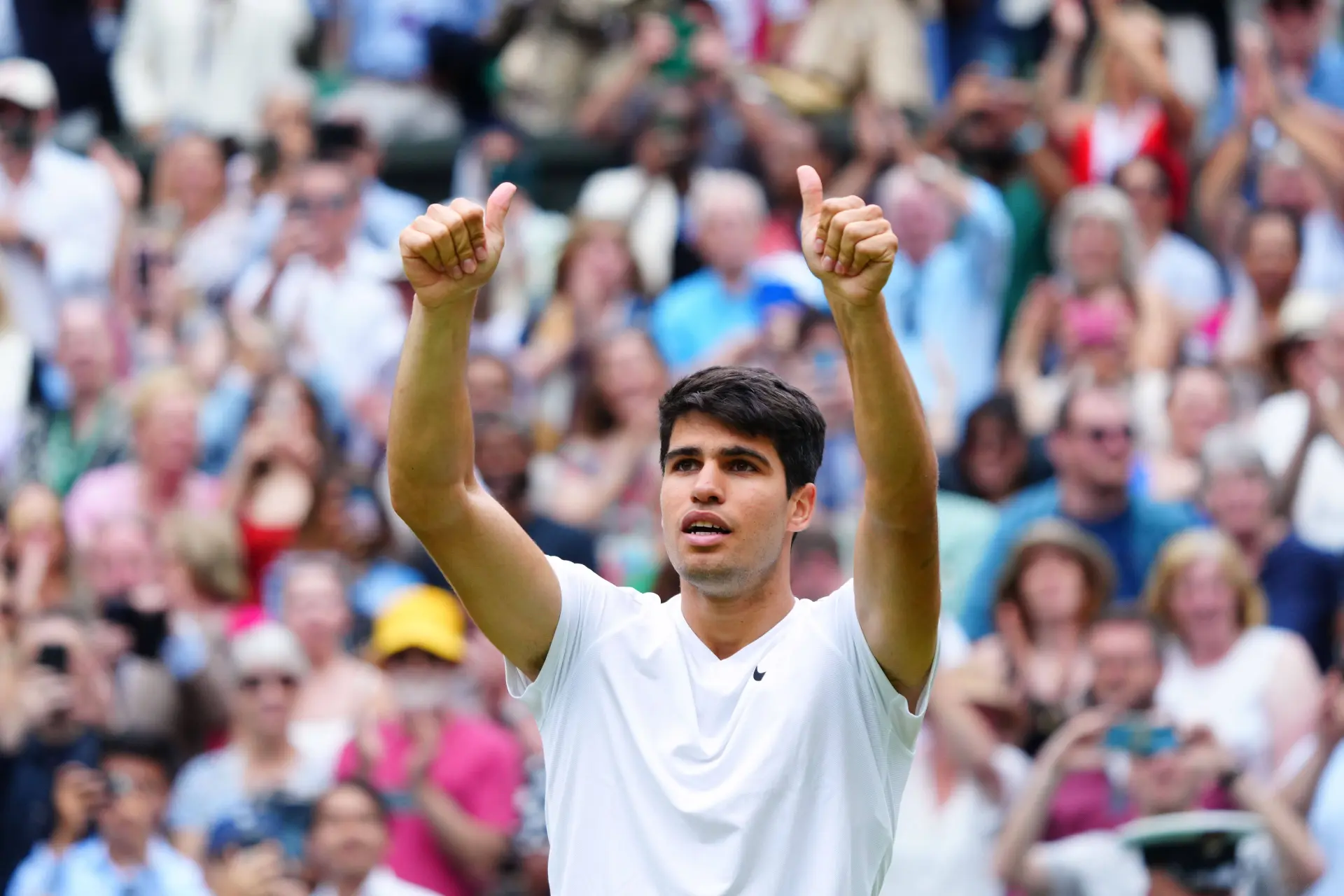
Wimbledon is preparing to take a different approach to influencers after content creators became one of the most discussed stories surrounding this year's US Open. New York's decision to welcome almost 100 influencers has generated plenty of attention, but several incidents have also raised questions about whether some newcomers understand the etiquette expected at a tennis tournament.
The debate has become impossible to ignore at Flushing Meadows. Players have been distracted by bright lights, excessive noise and spectators moving around during points, while Naomi Osaka and Coco Gauff have both reminded fans that attending a tennis match comes with certain responsibilities.
The most notable incident came during Osaka's first-round match, when a group in a box performed a lip-synching routine for TikTok. Ring lights have also caused problems during the tournament, with spectators asked to turn them off because they could distract players.
Wimbledon does not intend to replicate the US Open's approach according to ESPN. The All England Club will have no dedicated accreditation category for influencers or content creators, while its existing entry rules prohibit spectators from bringing items that could reasonably be used to disrupt matches.
The US Open controversy goes beyond influencers
The problems at Flushing Meadows have not been limited to social-media personalities. Aryna Sabalenka stopped her third-round match to complain about a spectator smoking cannabis, while Jakub Mensik called for a drunk fan to be removed after being heckled during a night session.
French veteran Adrian Mannarino was particularly blunt when describing the atmosphere. “People are allowed to move around in the crowd during points. The tournament puts up with it, and I don't know if it's the best thing for tennis in general. There's a smell of marijuana on the court, noise everywhere. The truth is it's turning into a bit of a zoo.”
That combination of incidents has turned spectator behaviour into a recurring topic throughout the tournament. The New York Times even captured the debate with the headline: “Influencers, noise and weed: has the US Open become a zoo?”
British content creator Eliza Wastcoat, a former Wimbledon ball-girl, believes the influx of new faces comes with an obvious learning curve.
“It's definitely interesting to see the United States Tennis Association inviting new people in, but then with that comes a double-edged sword," she said. "These are folks that aren't familiar with the tennis environment, or how the etiquette works. They will probably learn from this experience.”
@katticuspfinch Tennis etiquette is that you don’t even GET UP IN THE MIDDLE OF A POINT but now at @US Open apparently it’s ring lights and photo shoots everywhere in the MIDDLE OF A POINT. Listen, I love bringing new people to the open and I’m all for getting more people into tennis because it’s such a fun sport to watch but if you’re going to disrespect the players, you shouldn’t come to the match. And I LOVE content creators bringing tennis to everyone on social media but if you’re not going to be respectful of the game being played thats NOT OKAY. Yyou can see ring lights from all over the stadium and the umpire and players made it very clear that it’s a HUGE DISTRACTION and it’s now impacting the players ability to play the game we are all here to see. And apparently the us open and USTA are just fine with it because their staff is helping it happen. @influencersinthewild @Tennis Channel #nyccontentcreator #naomiosaka #usopen #tennistiktok #usopentennis ♬ original sound - There I Ruined It
Wimbledon knows the value of social media
There is some irony in Wimbledon's decision. The All England Club has been one of tennis's biggest social-media pioneers, embracing platforms such as Twitter and Instagram more than 15 years ago.
That strategy has paid off, with Wimbledon's Instagram account now boasting more than eight million followers, roughly twice as many as the US Open. The American tournament's influencer programme was partly inspired by Wimbledon's success in reaching new audiences.
@nypostsports These influencers weren’t influencing this guy. 🤦♂️🎾 The theme of influencers taking over and ruining the US Open experience for others has been a hot topic of conversation.
♬ original sound - New York Post Sports
Brendan McIntyre, the USTA's head of content and communication, previously explained the reasoning behind the initiative.
“The USTA's mission is to grow the game. We want to get more people involved with the sport. We want to introduce them to tennis and we want to find every possible way of doing it. And working with content creators is a way of reaching people where they are now.”
The experiment has shown the potential of bringing new audiences to tennis, but also the complications that can follow. Wastcoat pointed out another irony from the Osaka incident: the person filming the TikTok routine was reportedly a US Open employee.
For now, Wimbledon appears happy to grow its digital audience without adopting the same accreditation model. The All England Club reviews its social-media policies annually, but after the scenes in New York, it has little reason to rush into changing its approach.

Cristhián AvilaTennis Journalist
Cristhián Ávila is a tennis journalist based in Santiago, Chile, and has been part of the TennisUpToDate team since early 2023. He covers the ATP and WTA Tours as well as all four Grand Slams, producing breaking news, match reports, analysis, and regular liveblogs from major tournaments.
His reporting combines statistical analysis with clear explanation, helping readers understand tactical developments, player form, and broader storylines across the tour. Working fluently in both Spanish and English, Cristhián collaborates with an international editorial team and contributes to comprehensive global coverage. As part of his work, he has conducted interviews and media interactions with leading figures in the sport, including Caroline Wozniacki and John McEnroe.
In his journalism, Cristhián places strong emphasis on careful sourcing, editorial accuracy, and updating articles promptly when new, verified information becomes available. His coverage is grounded in research, context, and direct engagement with professional tennis.
claps 0visitors 0
Just In

Popular News

Latest Comments
- Perhaps convenient tennis tour sex is not a strong enough experience in which to base a marriage?
 mandoist19-10-2026
 - Fight the Good Fight... Tennis (sports in general) need more Humans such as yourself.mandoist18-10-2026
- When is WTA going to mandate Genetic Testing (DNA) ???mandoist18-10-2026
- Hey, Dan... you just wake up from a coma? Regardless -- Thanks for the comedy this morning!mandoist18-10-2026
- Two Things: 1. Stop allowing these Spoiled Trust-Fund Elitists to behave badly. Your little hand-slaps do not deter them. 2. STOP the incessantly annoying "towel wiping" nonsense!!!!mandoist15-10-2026
- A healthy Qinwen may be hard to stop next season. She was already scaring her opponents before her medical leave(s). Unfortunately, Zheng insisted on singing again. On the positive side -- Mirra did not sing!! ;~}mandoist11-10-2026
- Where is it written that athletes, entertainers... People in general... are mandated to keep looking at -- or even using [anti]Social Media? Public & private figures consistently complain and reveal their concerns about negativity and violence thrown at them -- yet they insist on participating. Avoid it, don't use it, don't read it. It's okay to occasionally look up at the World instead beating your eyes & thumbs to death on The Inventions out there.mandoist11-10-2026
- great articlestennisseserver07-10-2026
- Medvedev was leading Djokovic 7-5, 3-5 when an attempted return..' NO you ignorants, Djokovic was leading .weiss05-10-2026
- No more bullshit "Wildcards" to these two. Qualify like everyone else -- there will be cameras there, too. Time to scream... WTF ????!!!!mandoist29-09-2026

Loading