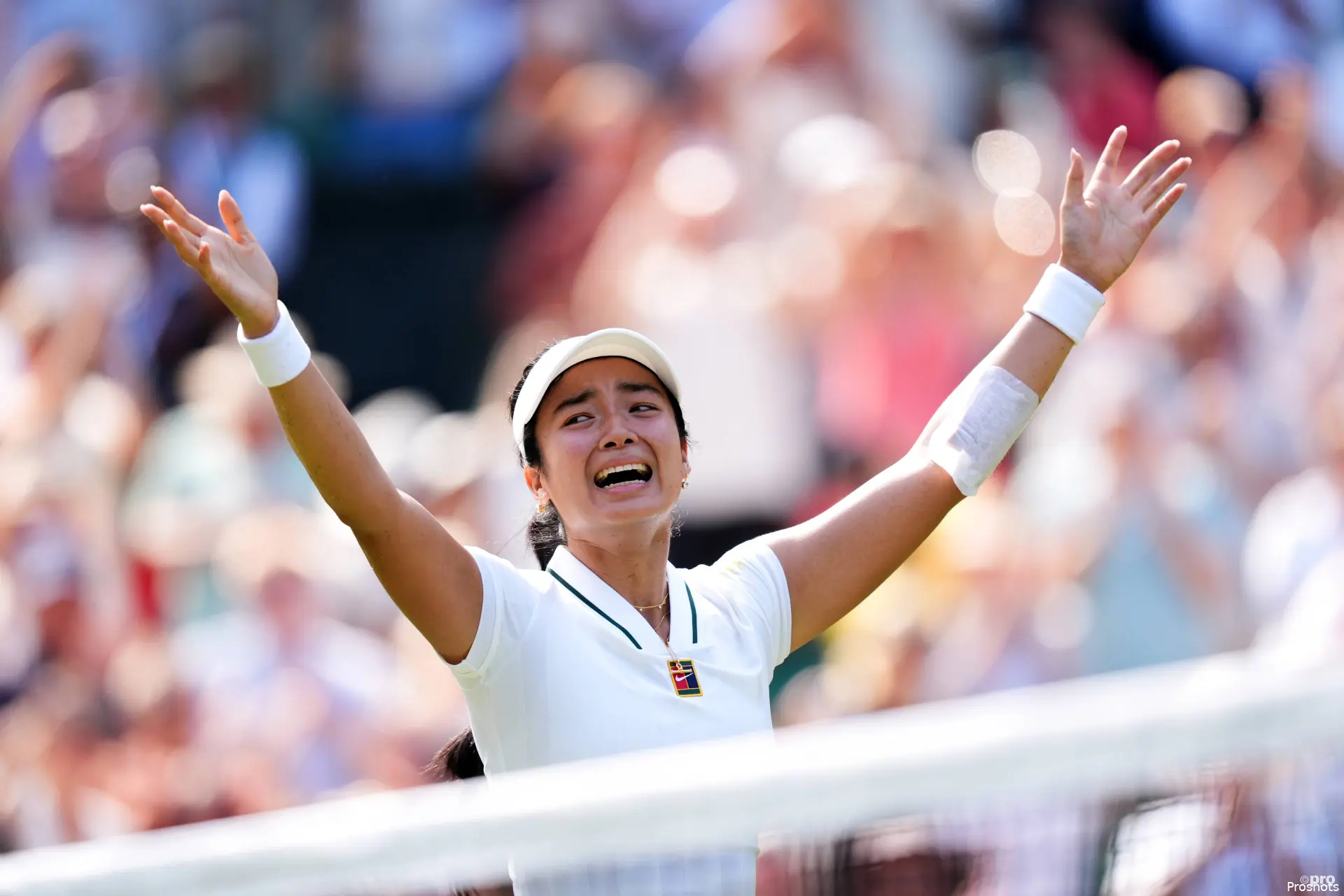
When 21-year-old Alexandra Eala walked off Center Court at Wimbledon this afternoon after defeating Iga Świątek, the reaction was predictable.
Another upset. Another breakthrough. Another reminder that women's tennis is deeper than ever. Those descriptions weren't entirely wrong. Beating one of the greatest players of this generation is always significant. But they also missed something that has become increasingly difficult to ignore.
Wasn't an isolated result
This wasn't an isolated result. It was another chapter in a story unfolding since she was 17. I've been saying for a long time that Alex Eala wasn't simply a talented young player or an intriguing prospect. To me, she looked like someone whose game would eventually carry her into the sport's highest tier. I never pretended to know exactly when it would happen. Tennis has a habit of making fools of predictions. But I never understood why so many people viewed her ceiling as lower than it actually was.
The rankings told one story. Her tennis told another. Sometimes those things don't line up immediately. The public often evaluates young players by the names they've beaten. Coaches tend to notice something else. They watch how a player constructs points. They notice balance, decision-making, anticipation and whether a player remains composed when rallies become uncomfortable.
Those qualities usually travel. Raw power can disappear when confidence fades. A huge serve can desert you. Timing comes and often goes. But players who consistently solve problems tend to keep solving them as the level rises. That's what first stood out to me about Eala.
Even as a teenager, she rarely looked rushed. She wasn't trying to overpower opponents who could hit bigger than she could. She absorbed pace naturally, redirected the ball with purpose and seemed unusually comfortable making adjustments in the middle of points. There was a patience to her game that felt older than her years, but there was also an unmistakable willingness to attack when the opportunity presented itself. And she dealt with the omnipresent pressure of her destiny to be the greatest player ever from the Philippines.
Ranking a label not the truth
Over the past few months, the résumé has finally begun catching up with the eye test. In Berlin, she defeated Elena Rybakina in straight sets on grass. That result alone deserved far more attention than it received. Rybakina is one of the cleanest ball strikers on the WTA Tour and a former Wimbledon champion whose game is built for fast courts. Eala didn't simply survive that match. She controlled long stretches of it.
Now she's beaten Świątek again. Different opponent. Different challenge. Same composure. At some point, we have to stop treating these victories as lightning strikes.
One of the easiest mistakes in sports is assuming that a player's future will look exactly like their present. Rankings become labels. Once someone is described as a prospect, people continue thinking of them that way long after their tennis has outgrown the description.
The same thing happened with players like Coco Gauff. Before she became a Grand Slam champion and a fixture at the top of the rankings, every big win was framed as an upset. Eventually there were simply too many of them for that label to make sense anymore.

Alexandra Eala has won again.
I think Alex Eala is approaching that same point. That doesn't mean the road ahead will be smooth. Every future Top 10 player experiences setbacks. There will be disappointing losses, injuries, confidence dips and tournaments where nothing seems to click. That's professional tennis. Development almost never follows a straight line.
But those inevitable bumps shouldn't obscure the larger picture. When a player repeatedly proves she can compete with—and beat—the very best in the world, the conversation has to evolve.
We're no longer wondering whether she belongs on the biggest stages. She's answering that question herself. The next question is how high she can climb.I've believed for several years that the answer is the Top 10. Nothing I've seen recently has made me reconsider. If anything, victories over players like Rybakina and Świątek reinforce why I felt that way in the first place.
The rankings will eventually reflect it. They usually do.Sometimes they just arrive a little later than the tennis itself.

Aron SolomonGuest Author
A Pulitzer Prize-nominated journalist for his groundbreaking op-ed in The Independent exposing the NFL’s “race-norming” policies, Aron Solomon, JD, is a globally recognized thought leader in law, media, and strategy.
As Chief Strategy Officer for AMPLIFY, he leverages his deep expertise to shape the future of legal marketing. Aron has taught entrepreneurship at McGill University and the University of Pennsylvania and was honored as a Fastcase 50 recipient, recognizing him among the world’s top legal innovators. A prolific commentator on law, business, and culture, his insights regularly appear in Newsweek, The Hill, Crunchbase News, and Literary Hub.
He has also been featured in The New York Times, Fast Company, Fortune, Forbes, CBS News, CNBC, USA Today, ESPN, TechCrunch, BuzzFeed, Venture Beat and countless other leading global media outlets. We are proud to have Aron on board at TennisUpToDate, where his deep tennis expertise enriches the site with sharp, original columns that connect the sport to wider cultural debates.
claps 1visitors 1
Just In


Popular News
Latest Comments
- A healthy Qinwen may be hard to stop next season. She was already scaring her opponents before her medical leave(s). Unfortunately, Zheng insisted on singing again. On the positive side -- Mirra did not sing!! ;~}
 mandoist11-10-2026
 - Where is it written that athletes, entertainers... People in general... are mandated to keep looking at -- or even using [anti]Social Media? Public & private figures consistently complain and reveal their concerns about negativity and violence thrown at them -- yet they insist on participating. Avoid it, don't use it, don't read it. It's okay to occasionally look up at the World instead beating your eyes & thumbs to death on The Inventions out there.mandoist11-10-2026
- great articlestennisseserver07-10-2026
- Medvedev was leading Djokovic 7-5, 3-5 when an attempted return..' NO you ignorants, Djokovic was leading .weiss05-10-2026
- No more bullshit "Wildcards" to these two. Qualify like everyone else -- there will be cameras there, too. Time to scream... WTF ????!!!!mandoist29-09-2026
- Let's not BS the general public -- Sabalenka started showing cracks in her game last season. Her losses and near-losses started at about the same time she began being distracted by Fame (constant Selfies, making TV commercials, magazine shoots, endless Social Media nonsense, etc., etc.) One would think even Saba could recognize the parallels with others who failed before her -- Raducanu, Giorgi, Bouchard to name a few.mandoist25-09-2026
- Gross!! Hey Raducanu, Giorgi, and Bouchard -- reserve a seat at your Social Media Selfie table for Saba + Naomi. They're heading in your direction soon enough.mandoist24-09-2026
- And then these same players will complain about how lengthy their season’s were and need more time-off. I’m all for more tennis but the amount of tennis we get now is actually kind of crazy! We all need a break, especially the players.DaveyWavey23-09-2026
- You should do a comparison article for "different kinds of justice" the courts decide for tennis players. I can think of at least three players who received very small bans of a few months, however Tara Moore has been fighting for her literal survival the past few years. It seems odd considering she is not a "name" player, unlike the other cases.DaveyWavey22-09-2026
- PRIZE MONEY & POINTS Winner - $185,500 Finalist - $114,500 Semi-Finalist - $66,003 Quarter-Finalist - $35,000 Round of 16 - $18,045 Round of 32 - $13,005 Winner - 500 Finalist - 325 Semi-Finalist - 195 Quarter-Finalist - 108 Round of 16 - 60 Round of 32 - 1DaveyWavey20-09-2026

Loading