“She’s back to being dangerous”: Kim Clijsters on Swiatek’s clay-court revival before Roland Garros
WTA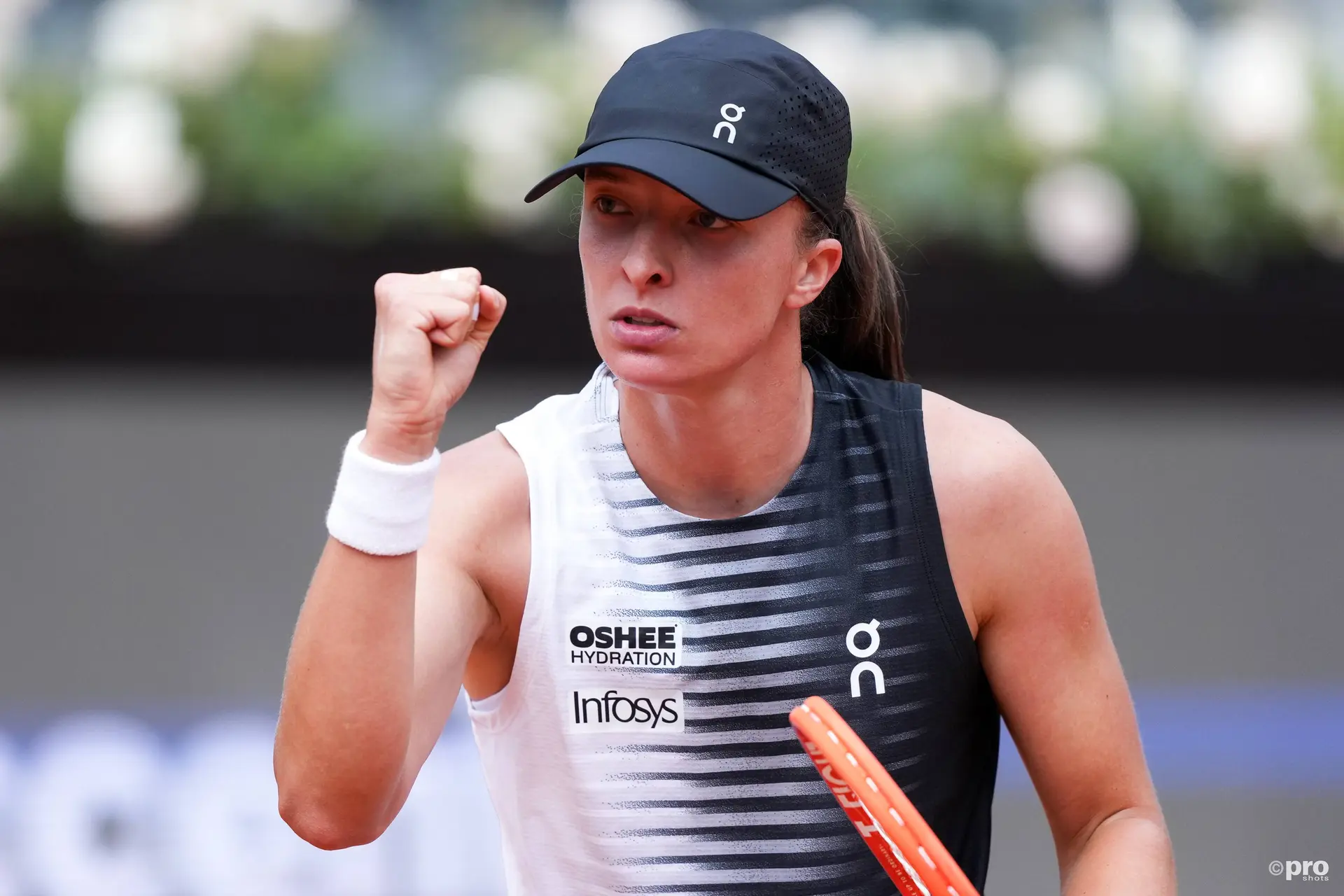
Iga Swiatek’s run in Rome has triggered strong reactions from within the tennis community, with former world No. 1 Kim Clijsters at Love All Podcast describing herself as “excited” by the level the Polish player has shown following her recent coaching adjustment with Francisco Roig.
Clijsters framed the timing of the improvement as particularly relevant with Roland Garros approaching, where Swiatek remains a central reference point in the women’s clay-court field. “Excited” by what she has seen in Rome, Clijsters suggested Swiatek is re-entering the group of primary contenders for Paris.
In Rome, Swiatek compiled a strong run to the semifinals, registering four victories and reasserting control in baseline exchanges and key pressure moments. She defeated Naomi Osaka and Jessica Pegula along the way before falling to eventual champion Elina Svitolina, ending her bid for a fourth title at the event.
The broader assessment, however, pointed toward stabilisation. A three-time Rome champion with a historically dominant record at the tournament, Swiatek appeared closer to her established clay-court baseline level at a key point in the season.
“Really nice to hear”: Clijsters on Swiatek’s visible reset under Roig
Kim Clijsters placed significant emphasis on Swiatek’s visible and emotional presence on court, identifying a clear contrast with earlier tournaments in the season. She linked the change to both coaching influence and a gradual rebuilding of internal confidence.
“Really nice to hear that,” Clijsters said, reacting to Swiatek’s own assessment of her improved comfort in training and competition. She added that during Indian Wells and Miami, “you could see the fear, the stress in her body, in the way she was looking over at times at her player’s box.”

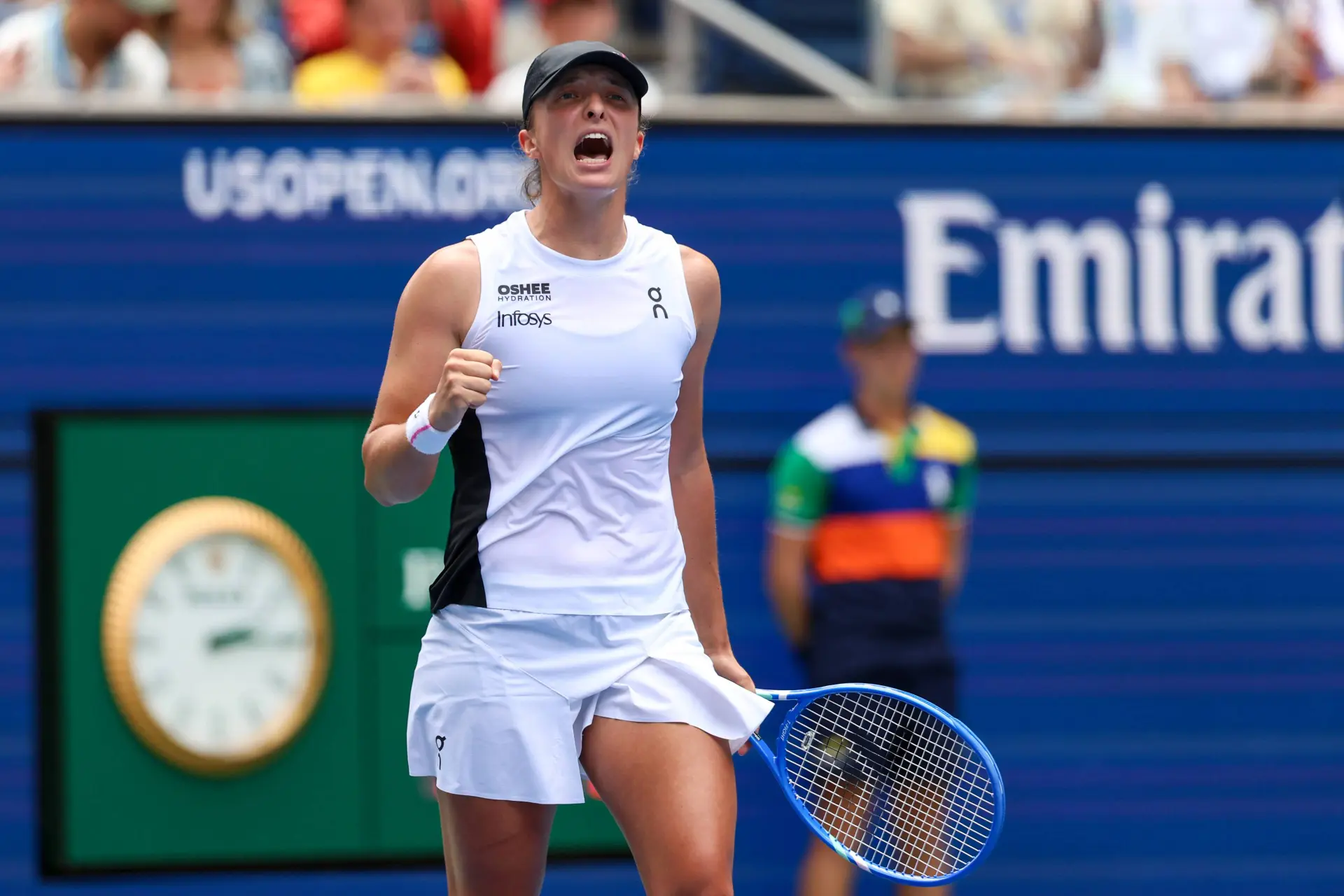
Iga Swiatek celebrates point during the match against Day
Clijsters highlighted the shift in competitive expression as one of the most important developments, particularly in how Swiatek now manages momentum and emotional output during matches. “Now to see her with a different kind of energy out there, and she’s still showing the fist pumps, but there’s more of a natural flow to it,” she said.
She contrasted that with earlier patterns where emotional activation appeared less organic. “Whereas before it almost looked like she had to do it to try to pump herself up, but it wasn’t a natural way,” Clijsters added, referencing the difference in on-court behaviour.
Clijsters also underlined the stabilising influence of Francisco Roig, describing him as “an intense coach but at the same time super laid back,” capable of reinforcing confidence through repetition and clarity.
“Sometimes you need somebody to keep repeating that so you still believe it after all the wins that she’s had. But it’s really nice to see her happy and explaining that, and playing great tennis,” she said.
Shot disguise and variation driving clay-court efficiency
Beyond the psychological aspect, Clijsters pointed to clear tactical refinements in Swiatek’s game, particularly in how she constructs points on the backhand wing. She emphasised increased variation in depth, spin, and angle as a defining feature of her current clay-court level.
“The backswing is a little bit harder to read as well,” Clijsters explained, highlighting improved disguise in preparation phases. According to her assessment, this reduces opponent reaction time and limits early court positioning advantages in baseline exchanges.

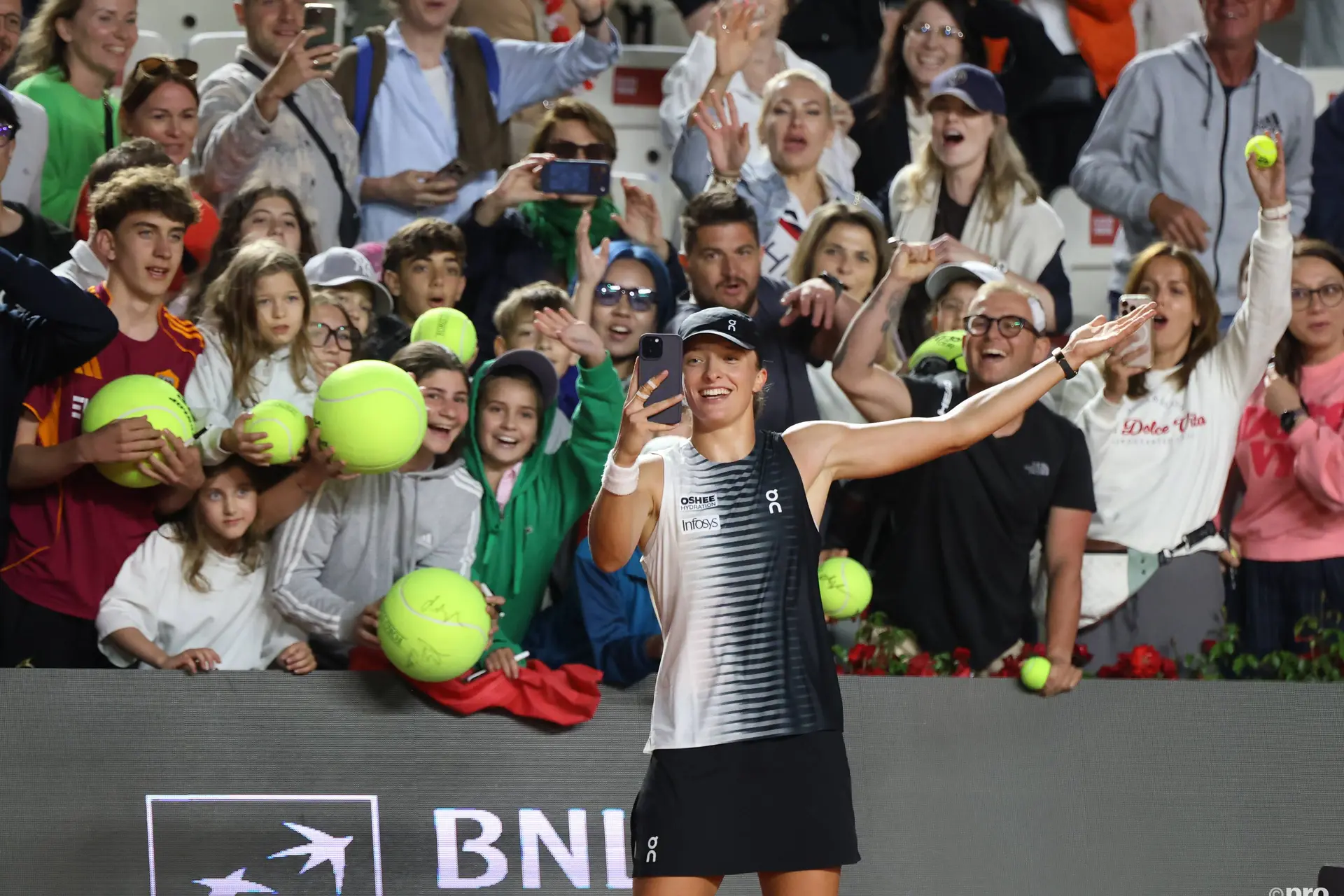
Iga Swiatek takes selfie with fans after Rome Open win 2026
Clijsters also noted Swiatek’s ability to alternate between deep cross-court control patterns and shorter, more angled shots designed to stretch opponents laterally. That variation, she suggested, is central to her effectiveness on clay and increasingly difficult to neutralise.
“She can hit it deep crosscourt, she can hit the backhand deep through the middle of the court, but then out of nowhere she changes it up,” Clijsters said, underlining the unpredictability now embedded in Swiatek’s tactical profile.
Swiatek’s Roland Garros results
| Year | Round Reached | Opponent | Score |
| 2019 | Round of 16 | Simona Halep | 1-6, 0-6 |
| 2020 | Champion | Sofia Kenin | 6–4, 6–1 |
| 2021 | Quarterfinals | Maria Sakkari | 4–6, 2–6 |
| 2022 | Champion | Coco Gauff | 6–1, 6–3 |
| 2023 | Champion | Karolina Muchova | 6–2, 5–7, 6–4 |
| 2024 | Champion | Jasmine Paolini | 6–2, 6–1 |
| 2025 | Semifinals | Aryna Sabalenka | 6-7, 6-4, 0-6 |

Cristhián AvilaTennis Journalist
Cristhián Ávila is a tennis journalist based in Santiago, Chile, and has been part of the TennisUpToDate team since early 2023. He covers the ATP and WTA Tours as well as all four Grand Slams, producing breaking news, match reports, analysis, and regular liveblogs from major tournaments.
His reporting combines statistical analysis with clear explanation, helping readers understand tactical developments, player form, and broader storylines across the tour. Working fluently in both Spanish and English, Cristhián collaborates with an international editorial team and contributes to comprehensive global coverage. As part of his work, he has conducted interviews and media interactions with leading figures in the sport, including Caroline Wozniacki and John McEnroe.
In his journalism, Cristhián places strong emphasis on careful sourcing, editorial accuracy, and updating articles promptly when new, verified information becomes available. His coverage is grounded in research, context, and direct engagement with professional tennis.
claps 0visitors 0
Just In


Popular News

Latest Comments
- A healthy Qinwen may be hard to stop next season. She was already scaring her opponents before her medical leave(s). Unfortunately, Zheng insisted on singing again. On the positive side -- Mirra did not sing!! ;~}
 mandoist11-10-2026
 - Where is it written that athletes, entertainers... People in general... are mandated to keep looking at -- or even using [anti]Social Media? Public & private figures consistently complain and reveal their concerns about negativity and violence thrown at them -- yet they insist on participating. Avoid it, don't use it, don't read it. It's okay to occasionally look up at the World instead beating your eyes & thumbs to death on The Inventions out there.mandoist11-10-2026
- great articlestennisseserver07-10-2026
- Medvedev was leading Djokovic 7-5, 3-5 when an attempted return..' NO you ignorants, Djokovic was leading .weiss05-10-2026
- No more bullshit "Wildcards" to these two. Qualify like everyone else -- there will be cameras there, too. Time to scream... WTF ????!!!!mandoist29-09-2026
- Let's not BS the general public -- Sabalenka started showing cracks in her game last season. Her losses and near-losses started at about the same time she began being distracted by Fame (constant Selfies, making TV commercials, magazine shoots, endless Social Media nonsense, etc., etc.) One would think even Saba could recognize the parallels with others who failed before her -- Raducanu, Giorgi, Bouchard to name a few.mandoist25-09-2026
- Gross!! Hey Raducanu, Giorgi, and Bouchard -- reserve a seat at your Social Media Selfie table for Saba + Naomi. They're heading in your direction soon enough.mandoist24-09-2026
- And then these same players will complain about how lengthy their season’s were and need more time-off. I’m all for more tennis but the amount of tennis we get now is actually kind of crazy! We all need a break, especially the players.DaveyWavey23-09-2026
- You should do a comparison article for "different kinds of justice" the courts decide for tennis players. I can think of at least three players who received very small bans of a few months, however Tara Moore has been fighting for her literal survival the past few years. It seems odd considering she is not a "name" player, unlike the other cases.DaveyWavey22-09-2026
- PRIZE MONEY & POINTS Winner - $185,500 Finalist - $114,500 Semi-Finalist - $66,003 Quarter-Finalist - $35,000 Round of 16 - $18,045 Round of 32 - $13,005 Winner - 500 Finalist - 325 Semi-Finalist - 195 Quarter-Finalist - 108 Round of 16 - 60 Round of 32 - 1DaveyWavey20-09-2026

Loading