“It’s miserable on a slow court”: Taylor Fritz raises concerns over Dunlop balls before Indian Wells 2026
ATPSunday, 01 March 2026 at 01:00
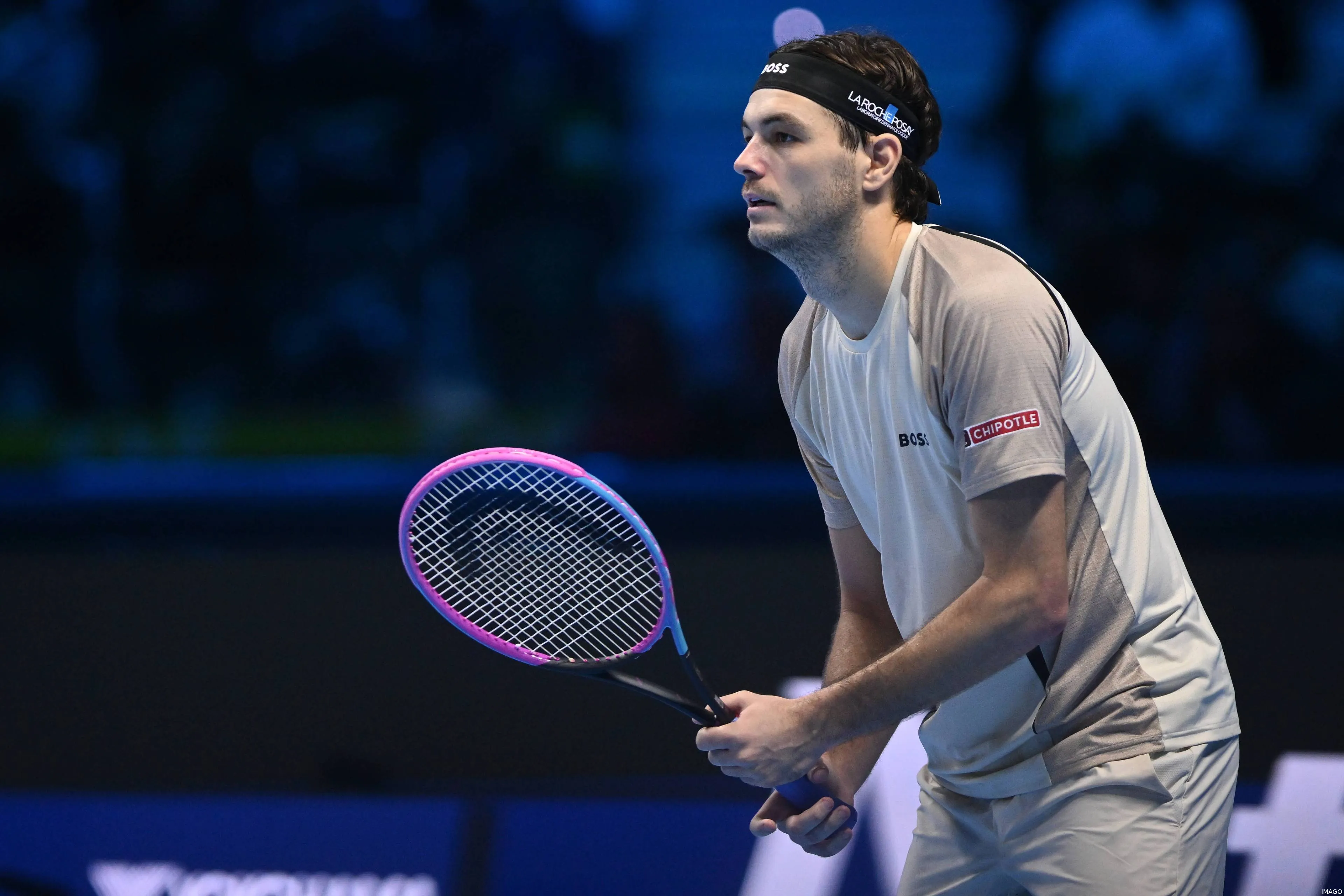
Taylor Fritz will return to Indian Wells in 2026 not only as a former champion, but as one of the tournament’s most analytically engaged contenders. The world No. 7, who lifted the title in 2021 by defeating Rafael Nadal in the final, is again among the top seeds heading into the season’s first ATP Masters 1000 event.
The American arrives in steady form. He reached the latter rounds in Dallas earlier this year and has maintained consistency on North American hard courts, an environment that historically suits his serve-dominated, first-strike game. His ranking stability over the past 18 months reflects that reliability.
Yet his focus ahead of Indian Wells has not been solely on opponents. Speaking candidly during a live stream while playing video games, Fritz offered an extended and detailed assessment of the tournament’s decision to switch from the long-standing Penn Tour ball to the Dunlop ball for 2026.
For a player whose title in the California desert remains the biggest of his career, the technical shift is more than cosmetic. In Fritz’s view, the change could alter rally length, error rates and even strategic preferences depending on session timing.

Ball change could reshape match dynamics
Fritz explained during the stream that the Dunlop ball, now widely used across the ATP Tour, behaves differently when conditions are slow and when the balls become worn.
“It’s going to be very interesting, because they’re changing the ball at Indian Wells this year to the Dunlop ball. The Dunlop ball is what we play with the most on tour, but I also think it plays slow. The Dunlop ball plays slow when it’s worn out, and they’ve been wearing it out really fast. I think the quality of the ball has dropped exponentially.”
He contrasted the Dunlop with both the Penn Tour balls historically used in Indian Wells and the Wilson US Open balls. According to Fritz, Dunlop balls produce fewer unforced errors because players “feel the ball well,” which in slower conditions may neutralize attacking advantages.
“With the Dunlop balls, people feel the ball well. Once it gets slow, it’s a massive advantage to the person who moves better, because you can’t hit a winner and no one is really going to miss.”
Fritz also questioned durability and current manufacturing standards, linking recent frustrations to broader changes in production.
“We need to switch to ball changes sooner. Seven and nine games is too long. I was looking at the ball the other night at 3-all in the first set and thinking, how are we playing with this right now? How are we playing professional tennis with this ball? It’s ridiculous.”
He added that he injured himself last season using a batch of balls he described as inferior to standard tour issue, reinforcing his view that overall ball quality “has gone down.”

Desert physics and tactical scheduling
Beyond the ball itself, Fritz addressed what he considers a persistent misconception about Indian Wells: that it is uniformly slow. Drawing on years of experience at the event, he explained that desert conditions produce sharp contrasts between daytime and nighttime sessions.
“In the past, if you play during the day, it’s not slow. At night, it’s slow because it’s the desert. Deserts get super cold and the air gets very heavy at night. During the day, the air is very dry and thin, so the ball goes through the air very fast.”
For a player whose strengths lie in serve velocity and aggressive baseline play, those environmental differences matter. He indicated that scheduling preferences will form part of his competitive planning this year. “Personally, I’ll be requesting a day match every single time. Otherwise, I’m going to play during the day, where I get rewarded for my serve and my aggressive groundstrokes.”
As the 2021 champion, Fritz has already proven he can adapt to Indian Wells conditions. The question for 2026 is whether the Dunlop ball will reinforce longer rallies and defensive patterns, or simply introduce a temporary adjustment phase for the field.
For Fritz, the uncertainty is tactical rather than emotional. He has succeeded with multiple ball types throughout his career. But in a Masters 1000 event where marginal differences often determine semifinalists and finalists, even a change in felt compression or wear rate can influence match outcomes.
claps 0visitors 0
Just In



Popular News
Latest Comments
- This person has arguably always been a 'problem personality'. Rarely, if ever, has he been The Solution to any matter in sports. More often combative and accusatory via media blurbs and texts. As for his "great success" as a coach -- the planets were aligned in his favor the day The Williams Family signed on to him. The William sisters were going to succeed regardless of his, or anyone else's, input. If you want to know how other players' have been affected by his "coaching" simply study the graphics on a chart. Average results, with a degree of combativeness and animosity in every camp. His "success" is entirely attributed to the natural Williams talent(s). Not unlike Raducanu's claim to fame of winning one title.
- Quinwen learned it's better to have friends in tennis. Happy to see she has changed her attitude on the circuit.
- Remind her the racquet is in HER hand, not any coach.
- My advice to Coco is take a few months off from the tour and focus on the serve. If MacMillan is not producing the expected results, relieve him of his duties and hire someone else. To hell with the rankings and what people will say. Just take a break. Mental health is far more important than money.
- Eventually (as other sports have done) WTA will be forced to make DNA / Gender Testing mandatory in order to protect and promote fairness in competitions. End of so-called 'controversy'.
- It's sad... but Rybakina is not going to be able to endure her groomer's interference in Life and still excel to her best level. BTW: No media has reported her last sentence to the physio. They kept asking questions and she abruptly told them: "I know what it is; I'm ready to go now".
- You seem to have 'lost the plot' ??
- This needs to be done, and I think Jessica Pegula is an excellent choice for chair to look into the situation. However, a very brief look at the other members of the panel would suggest a very USA heavy contingent. The group needs to represent all interests, not just turn it into a way the US can screw more money out of an already biased calendar.
- The tennis world should be kissing her feet for taking-on this long needed position in a much needed council. The WTA and ATP need a good shaking-up. Pegula's business heritage is a proven one. Let's hope she and her colleagues can stop WTA & ATP from shutting their work down and out. GO GET 'EM !!
- So the Sportswasher's largest market is... the Filipino community? That's all well and good but the hundreds and hundreds of empty seats throughout is embarrassing. Talk about bad optics!


Loading