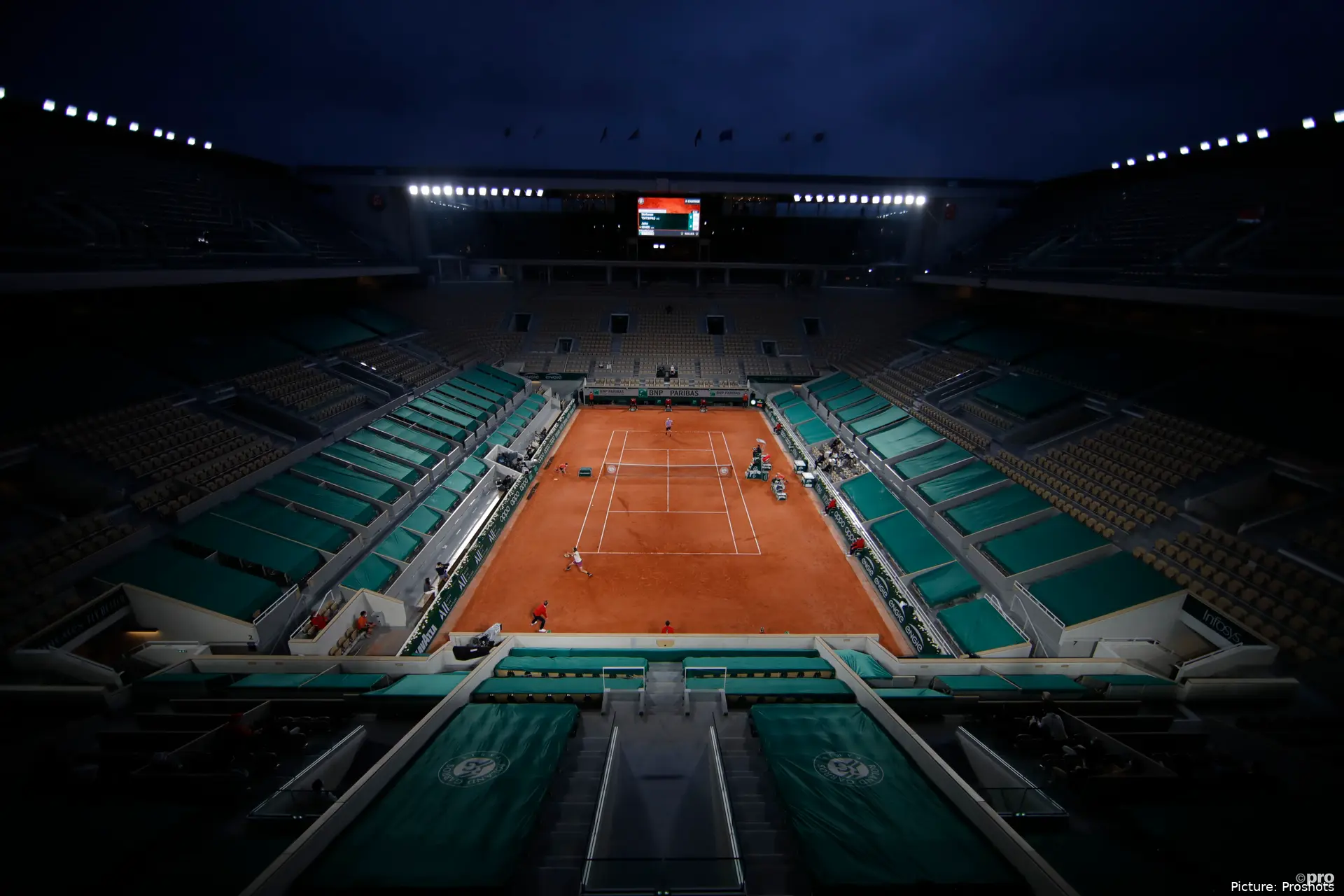
Teenage wildcard Ksenia Efremova has said she has experienced difficulties finding practice partners in the build-up to her Roland Garros debut, claiming that “sometimes it’s difficult to train with the girls because they don’t want to play points”. The 17-year-old, one of the youngest players in the women’s main draw, made the comments during her first press conference in Paris ahead of her Grand Slam debut.
Efremova is currently ranked world No. 623 and is still at the early stages of her professional career. Despite her ranking, she arrives at Roland Garros with junior pedigree, having won the Australian Open girls’ singles title earlier in 2026, alongside a series of ITF-level results during her transition into professional tennis.
She has yet to play a WTA main draw match at Tour level (WTA 250 or above) and has not competed in a senior Grand Slam main draw before. Her only previous appearance at Roland Garros came in qualifying last year, where she exited in the opening round. In recent weeks, she has also competed in qualifying draws in Madrid and Strasbourg, recording a notable win in Madrid over world No. 106 Lulu Sun.
However, her preparations in Paris have been complicated by what she described as reluctance from some players to engage in full practice sets.
Practice difficulties in Paris
Efremova said she had repeatedly encountered situations where potential practice partners were unwilling to play structured points or full sets, particularly when she was involved as a wildcard entrant.
“Sometimes it’s difficult to train with the girls because they don’t want to play points, they don’t want to play sets, because I am a wildcard,” she said in a press conference. “That has already happened to me. I don’t want to say no, but it has already happened that some girls didn’t want to because I was a wildcard.”
She also referenced an instance in which a practice session eventually took place after initial hesitation, describing the competitive nature of the exchange that followed. “Afterwards there was even a situation where a girl came and said, ‘okay, it’s fine.’ And after that I beat her 6-2. It was good.”
Junior success and expectations
Efremova earned her Roland Garros wildcard following her Australian Open junior title in January, joining a list of past junior champions in Melbourne that includes Marta Kostyuk, Clara Tauson, Karolína Plíšková and Victoria Azarenka.
Despite that success, she insisted that junior achievements do not necessarily translate into recognition on the professional circuit or with practice partners. “It’s good to win a junior Grand Slam, but I’m aiming a bit higher than that. Winning a junior Grand Slam doesn’t make you a ‘wow’ player to your practice partners,” she said.
Her Roland Garros debut will come against 18th seed Sorana Cîrstea, a significantly more experienced opponent. Efremova has cited inspiration from compatriot Loïs Boisson, who reached the semi-finals in 2025 as a surprise entrant ranked No. 361. Efremova enters this year’s event as world No. 625, the youngest and lowest-ranked player in the main draw.
First-round test against Cîrstea
“Honestly, I really want to go far, show everyone I’m really capable of it, and tell myself I’m sure of myself. I’m full of confidence, I can do it. Plus, playing Roland-Garros, it’s home, it’s France,” she said in press conference. “I’m going to try to do what Loïs Boisson did last year – it wasn’t bad, honestly. But my aim is to play good matches, just play well.”
Her opponent, Cîrstea, is almost 20 years older. When Efremova was born in 2009, Cîrstea was already making her breakthrough, reaching the Roland Garros quarter-finals that same year in her first appearance at that stage, aged 19.
Now 36, Cîrstea arrives at Roland Garros ranked world No. 18, the highest position of her career. The contrast in experience frames an opening-round match scheduled for Court Suzanne-Lenglen on Sunday afternoon, in one of the early standout fixtures of the French Open first round.


Cristhián AvilaTennis Journalist
Cristhián Ávila is a tennis journalist based in Santiago, Chile, and has been part of the TennisUpToDate team since early 2023. He covers the ATP and WTA Tours as well as all four Grand Slams, producing breaking news, match reports, analysis, and regular liveblogs from major tournaments.
His reporting combines statistical analysis with clear explanation, helping readers understand tactical developments, player form, and broader storylines across the tour. Working fluently in both Spanish and English, Cristhián collaborates with an international editorial team and contributes to comprehensive global coverage. As part of his work, he has conducted interviews and media interactions with leading figures in the sport, including Caroline Wozniacki and John McEnroe.
In his journalism, Cristhián places strong emphasis on careful sourcing, editorial accuracy, and updating articles promptly when new, verified information becomes available. His coverage is grounded in research, context, and direct engagement with professional tennis.
claps 0visitors 0
Just In

Popular News
Latest Comments
- A healthy Qinwen may be hard to stop next season. She was already scaring her opponents before her medical leave(s). Unfortunately, Zheng insisted on singing again. On the positive side -- Mirra did not sing!! ;~}
 mandoist11-10-2026
 - Where is it written that athletes, entertainers... People in general... are mandated to keep looking at -- or even using [anti]Social Media? Public & private figures consistently complain and reveal their concerns about negativity and violence thrown at them -- yet they insist on participating. Avoid it, don't use it, don't read it. It's okay to occasionally look up at the World instead beating your eyes & thumbs to death on The Inventions out there.mandoist11-10-2026
- great articlestennisseserver07-10-2026
- Medvedev was leading Djokovic 7-5, 3-5 when an attempted return..' NO you ignorants, Djokovic was leading .weiss05-10-2026
- No more bullshit "Wildcards" to these two. Qualify like everyone else -- there will be cameras there, too. Time to scream... WTF ????!!!!mandoist29-09-2026
- Let's not BS the general public -- Sabalenka started showing cracks in her game last season. Her losses and near-losses started at about the same time she began being distracted by Fame (constant Selfies, making TV commercials, magazine shoots, endless Social Media nonsense, etc., etc.) One would think even Saba could recognize the parallels with others who failed before her -- Raducanu, Giorgi, Bouchard to name a few.mandoist25-09-2026
- Gross!! Hey Raducanu, Giorgi, and Bouchard -- reserve a seat at your Social Media Selfie table for Saba + Naomi. They're heading in your direction soon enough.mandoist24-09-2026
- And then these same players will complain about how lengthy their season’s were and need more time-off. I’m all for more tennis but the amount of tennis we get now is actually kind of crazy! We all need a break, especially the players.DaveyWavey23-09-2026
- You should do a comparison article for "different kinds of justice" the courts decide for tennis players. I can think of at least three players who received very small bans of a few months, however Tara Moore has been fighting for her literal survival the past few years. It seems odd considering she is not a "name" player, unlike the other cases.DaveyWavey22-09-2026
- PRIZE MONEY & POINTS Winner - $185,500 Finalist - $114,500 Semi-Finalist - $66,003 Quarter-Finalist - $35,000 Round of 16 - $18,045 Round of 32 - $13,005 Winner - 500 Finalist - 325 Semi-Finalist - 195 Quarter-Finalist - 108 Round of 16 - 60 Round of 32 - 1DaveyWavey20-09-2026

Loading