"Last week I had him in the top eight, now I’m moving him into the top five": Daniil Medvedev returns to elite group in view of Querrey and Johnson
ATP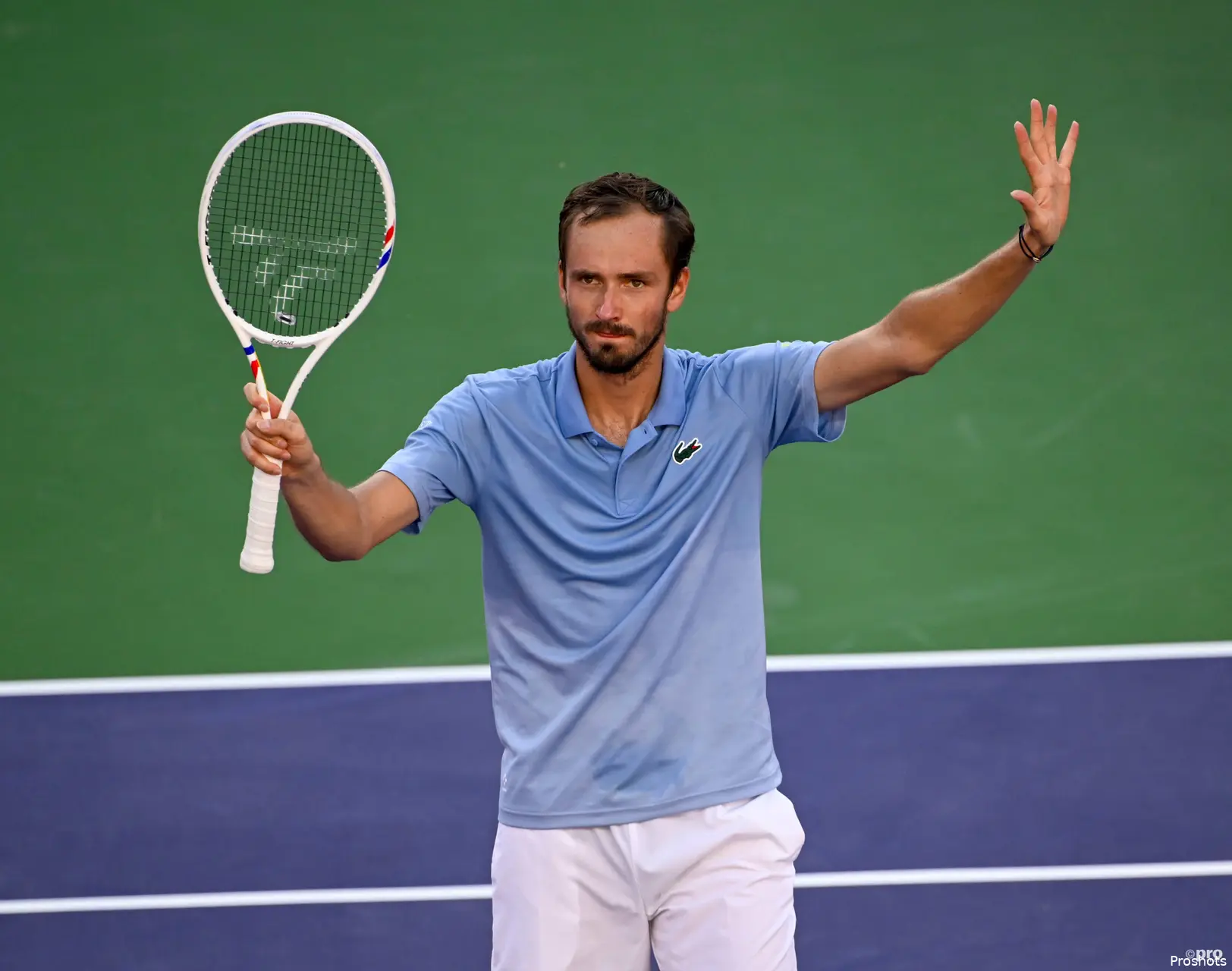
On the latest episode of Nothing Major, Sam Querrey steered the conversation as he and Steve Johnson analysed the men’s Indian Wells semifinals and final, offering detailed insight into tactics, momentum shifts, and what the results mean for the top of the game.
Sinner too strong for Zverev in the first semi-final
Querrey began the Nothing Major Podcast by revisiting Jannik Sinner’s 6–2, 6–4 win over Alexander Zverev, a match he watched from courtside and one that slightly surprised him.
“I was a little surprised,” Querrey admitted, pointing out that Zverev had been playing outstanding tennis coming into the match. With the hot conditions in mind, he expected a more conservative approach.

“I thought Sasha was going to retreat behind the baseline and just stay back there, not passive, but make a lot of balls over and over,” he said. Instead, Zverev played aggressively from the start.
That decision led to an early break for Sinner, who then “kind of steamrolled him from there.” Johnson acknowledged the surprise but supported the intent behind Zverev’s tactics. “I’m not going to get mad or second guess him being more aggressive,” Johnson said. “That’s what we’ve been asking him to do in these situations.”
He explained that while Zverev might have been able to outlast Sinner in long rallies, especially in the heat, that approach is unlikely to succeed consistently against the very best. “You can’t just outrally Sinner or Carlos Alcaraz,” Johnson said. “You’ve got to find a way to be aggressive while still playing within yourself.”
Although the execution was not there on this occasion, Johnson viewed the attempt positively. "He made a step, maybe the wrong one today, but maybe the right one in the long term.”
Querrey agreed, noting he had gone back and forth on the issue himself, wondering whether this might have been a match where Zverev should have extended rallies and tested Sinner physically, but ultimately acknowledging the long-term importance of developing a more aggressive style.

Jannik Sinner won Indian Wells.
Medvedev ends Alcaraz’s perfect run
The second semifinal saw Daniil Medvedev defeat Carlos Alcaraz, who had entered the match with a 16–0 record.
Querrey pointed out that while it might appear to be an upset, it was not entirely unexpected given Medvedev’s form.
“Medvedev is so awkward,” he said, highlighting the Russian’s low backhand that forces opponents to strike the ball at uncomfortable heights around their knees and ankles.
He also emphasised how aggressive Medvedev was during the match, while noting that Alcaraz did not perform at his best, despite holding a break lead in the second set.
“It was one of the first times I’ve seen Carlos look a little uneasy,” Querrey added.
Johnson agreed, saying an off day for Alcaraz was inevitable, and praising Medvedev’s consistency across the week. “He’s got two titles this year, he’s playing great tennis,” Johnson said.
He also pointed to moments that could have disrupted Medvedev’s run, including a video review incident and the travel demands from Dubai to the United States, but noted that Medvedev “stayed the course,” which he believes is essential to his success.
“For me, this proves he’s back in that top group,” Johnson said. “Last week I had him in the top eight, now I’m moving him into the top five.”
Variety at the top benefits the sport
The discussion then turned to the broader picture of the men’s game. While acknowledging the drawing power of Sinner and Alcaraz, Johnson stressed the importance of variety.
“As much as we want to see Sinner versus Alcaraz in every final, it’s good for the sport that there’s some change,” he said.
He added that while blockbuster matchups remain important, it is healthy to see different players competing for titles, even if ideally one of the top two is still involved.
Querrey reinforced that point by noting the strong viewership numbers generated by matches involving Sinner and Alcaraz, even in less favourable time slots, underlining their growing influence on the sport.
Sinner triumphs in a high-level final
Attention then shifted to the final, where Sinner defeated Medvedev 7–6, 7–6 in one of the highest-quality matches of the tournament.
“There were no breaks, the level was just so high,” Querrey said, describing the opening set as exceptional.
The second-set tiebreak proved decisive. Medvedev raced to a 4–0 lead, and at 3–0, Sinner double-faulted and briefly shook out his arm, raising concerns about a possible physical issue.
“From courtside, it looked like one of those moments where we might see something happen with Sinner,” Querrey explained.
However, Sinner responded emphatically, winning seven consecutive points to close out the match. The closing stages featured outstanding rallies, including a 25-shot exchange at 5–5 that brought the crowd to its feet.
“If you can’t get Sinner out, he’s going to step up,” Querrey said.
Would a third set have favoured Medvedev?
Querrey raised the question of whether Medvedev would have been the favourite had the match gone to a third set, especially given the extreme heat.
Before the match, he believed that if it extended beyond one hour and 45 minutes, Medvedev would have had the advantage.
However, his courtside perspective told a different story.
“Sinner actually looked fine,” he said. “Outside of that little arm moment, he was playing long rallies and looked totally okay.”
As a result, Querrey felt Sinner would likely have held up physically in a deciding set.
Johnson emphasised the mental significance of Sinner’s performance in the conditions.
“It’s important for those guys to prove to themselves that they can get through tough matches in the heat,” he said. “That’s what makes them great, they’re always looking for ways to improve.”
He was particularly impressed with how Sinner handled the pressure of trailing 4–0 in the tiebreak.
“That’s when you’re reminded, this is still Jannik Sinner,” Johnson said. “He just buckled down and showed why he’s one of the best in the world.”
A place among the greats
The victory also carried historic significance. With the win, Sinner became just the third player to capture all six Masters 1000 hardcourt titles, joining Roger Federer and Novak Djokovic.
Neither Querrey nor Johnson had initially realised the milestone, but both were struck by its importance once noted.
“At his age, that’s incredible,” Johnson said. “When guys are putting their names alongside those legends this early, it just shows how strong the sport is right now.”

Samuel GillEditor-in-Chief
Samuel Gill is the Chief Content Officer (CCO) of TennisUpToDate.com, a role he has held since 2020. He is responsible for editorial governance across the platform, including setting content standards, overseeing accuracy and consistency, and guiding long-term editorial strategy. Since joining, he has contributed more than 10,000 articles and editorial pieces across the TennisUpToDate network, playing a central role in the daily operation and development of the site.
Based in Leicester, Samuel has a broad background in tennis media. In his current role, he works closely with editors and writers to ensure coverage meets clear journalistic standards, with particular attention to verification, consistency, and timely updates when new information becomes available.
claps 0visitors 0
Just In




Popular News
Latest Comments
- Lena... Takin' care of business
 mandoist25-10-2026
 - Can you please stop publishing this nonsense? Stick to Tennis.mandoist25-10-2026
- Does Sinner need that 4.5 mil? I doubt it. He can make that with three modelling gigs!😅🤣Rapunzel21-10-2026
- Did "People Magazine" purchase this website? This nonstop storyline is bullshit.mandoist21-10-2026
- Listen... this is of no concern to anyone but these two. Deal with your own issues -- most of us have our own. Thanks, media, for these insignificant follow-ups which are meaningless.mandoist21-10-2026
- This is so very very sad, for all three of them. I truly thought they had an unbreakable bond, but life throws up so many differing challenges. Having your homeland suffering in such a terrible way, makes happiness lose out to guilt as well. Our thoughts are with them. X💔bjsexton20-10-2026
- I have lost all respect for Svitolina! Could she not have waited until he had played at the Paris Masters!!! She is selfish and don't give a damn about Gael. That is NOT how love is demonstrated Elina!!Rapunzel19-10-2026
- Perhaps convenient tennis tour sex is not a strong enough experience in which to base a marriage?mandoist19-10-2026
- Fight the Good Fight... Tennis (sports in general) need more Humans such as yourself.mandoist18-10-2026
- When is WTA going to mandate Genetic Testing (DNA) ???mandoist18-10-2026

Loading