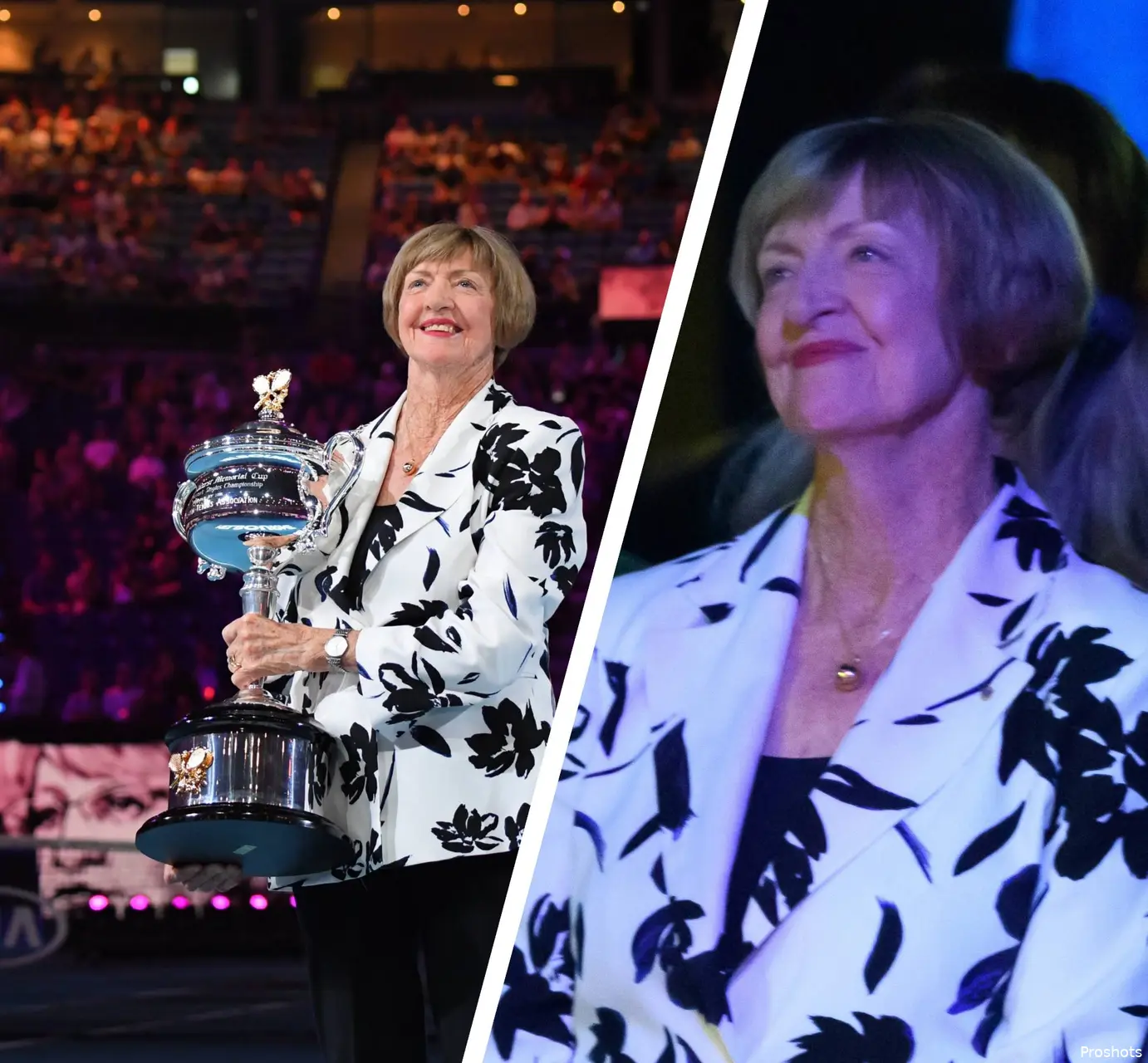
In Grand Slam competition, Margaret Court is the most successful player, man or woman, in tennis history. A total of 24 singles Grand Slams remains unsurpassed. Likewise, Court's combined tally of singles and doubles Grand Slams stands at a record 64.
Margaret Court: Early life and first tennis steps
Born on July 16, 1942, in Albury, Perth, Australia, to parents Maude and Lawrence. She was their fourth and last child. Her mother almost died giving birth to Margaret.
Court was raised in a Catholic household and went to St Bridgets, a local Catholic parochial school. In her youth, Court played many different sports. Taking up tennis at the age of eight. Court used to sneak into the Albury and Border Tennis Club and was then spotted by the resident professional, Wally Rutter. She was then invited to the club's coaching clinics.
When aged 16, Court relocated to Melbourne to work with a past Grand Slam champion, Frank Sedgman. His training regime accelerated Court's fitness. Court became a dominant figure on the Australian junior circuit. Her first recognised career titles came at this point, winning two events in 1958.
At 17, Court stunned the tennis world with a Grand Slam breakthrough at only her second attempt. Then being played in Brisbane, Court emerged triumphant at the Australian Championships (now the Australian Open) after a straight sets victory over compatriot, Jan Lehane. Bizarrely, Court was beaten in the junior final by Lesley Turner. She consolidated this major triumph with three additional titles in her homeland in the latter part of 1960.
From elevation in standing to mammoth title haul
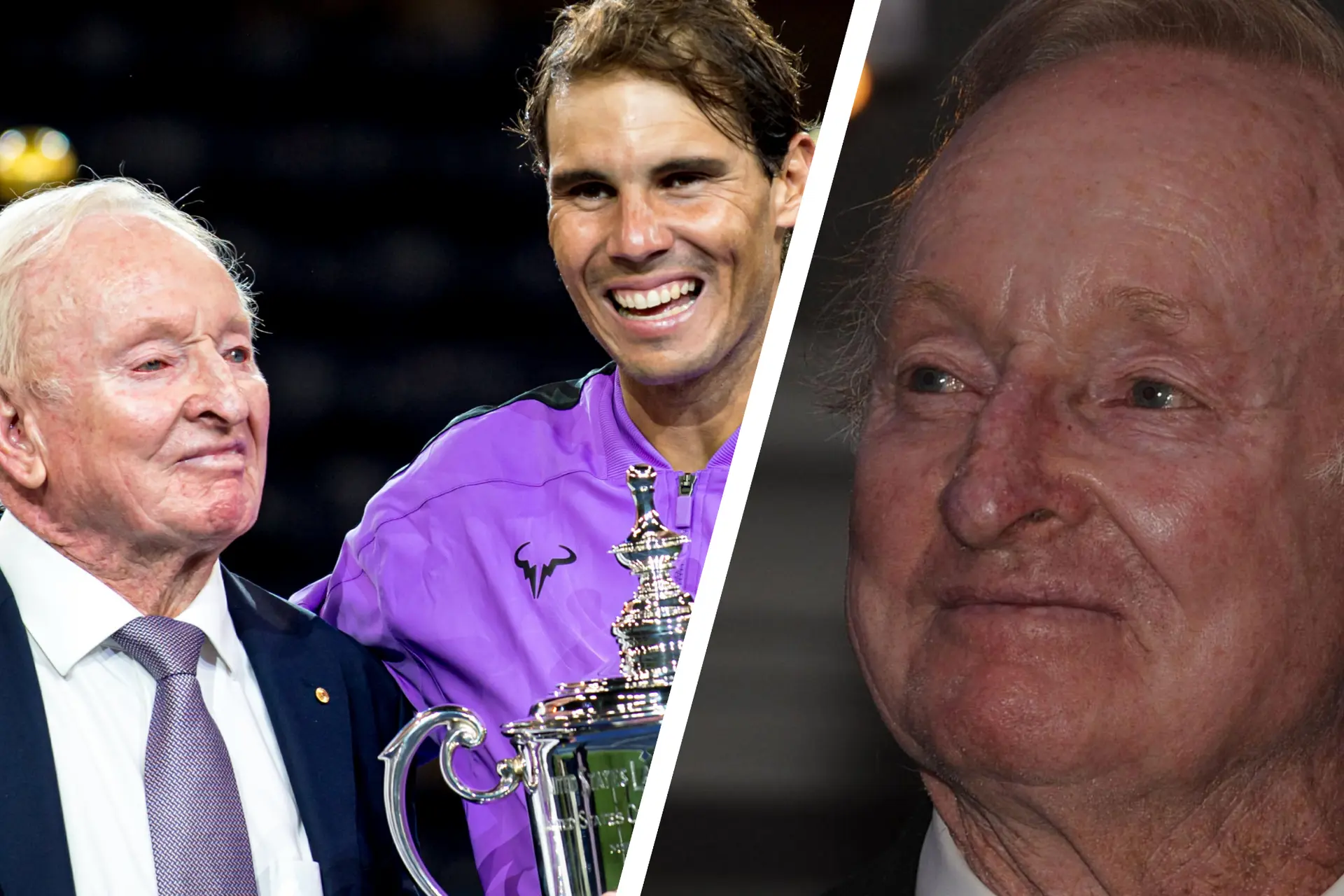
Fourteen tournament successes represented a significant elevation in Court's standing. This run of trophies included a supreme defence of her Australian Championships title. There was also her first run of clay court tournament wins, including the Paris International Championships.
The 1962 season witnessed Court winning three of the four majors. A third consecutive title in Melbourne was supplemented by maiden Grand Slam ecstasy at the French Championships (now French Open) and US Championships (now US Open). Court once again clinched 14 titles throughout the calendar year.
Court became the first Australian woman to win a Wimbledon singles title when beating a young Billie Jean Moffitt (later King) in a final that was the first Grand Slam final clash of a rivalry that was the biggest of Court's career. This victory proved the zenith of a 1963 season which yielded 15 titles, including making it four in a row at the Australian Championships.
Court's volume of success increased further in 1964 as the Perth native claimed twenty titles. A fifth successive Australian Championships and second French Championships trophy were amongst the mammoth haul.
Another 20 titles were accumulated in 1965. Three Grand Slam triumphs materialised at the Australian Championships, Wimbledon, and the US National Championships. Two of the final wins came against Brazil’s Maria Bueno, although the final Down Under witnessed Bueno retire hurt in the deciding set. Billie Jean Moffit was the beaten opponent in the US Final.
The 1966 campaign was truncated after Court opted to retire after a defeat in Munich. She had still won six titles that term, including an unprecedented seventh Australian Championships title in a row.
Court reversed her retirement decision in November 1967 and returned to competition in New South Wales. Her success in the 1968 season continued where she'd left off in 1966. A total of fifteen titles across the year reasserted Court's position as one of the sport’s premier operators, although no Grand Slam triumph would come in what was now the Open Era until 1969.
Over the next two years, Court triumphed in seven of the eight Grand Slams. Wimbledon was the only major to elude her in a 1969 season that saw Court win her first three Grand Slams of the Open Era. She needed three sets to win the French Open final against Britain’s Ann Jones. Her triumvirate of Slams formed part of another campaign in which Court won 20 titles.
Calendar Grand Slam and the end of career
In 1970, Court achieved the ultimate prize in tennis by winning all four majors to complete a Calendar Year Grand Slam. This made her the first woman to do it in the Open Era and only the second female, after Maureen Connolly, to achieve the feat in any era. The first two Slams were claimed in straight-set finals in Australia and France. The Wimbledon final was a different story, however. In perhaps Court's most iconic major final, she outlasted Billie Jean King 14-12 and 11-9 in the Wimbledon showpiece. The Grand Slam was then completed in New York when Court defeated Rosie Casals, an American, on her home patch at the US Open.
After winning 21 titles in her annus mirabilis of 1970, Court's success dropped sharply in 1971. A ‘mere’ nine titles were accrued in a season where Court's only Slam triumph came at the Australian Open. Court had her first child in 1972 and began to play less, but still pocketed ten titles in 1972, including the Australian Open, now in a Christmas slot.

Margaret Court receives ceremony at Australian Open.
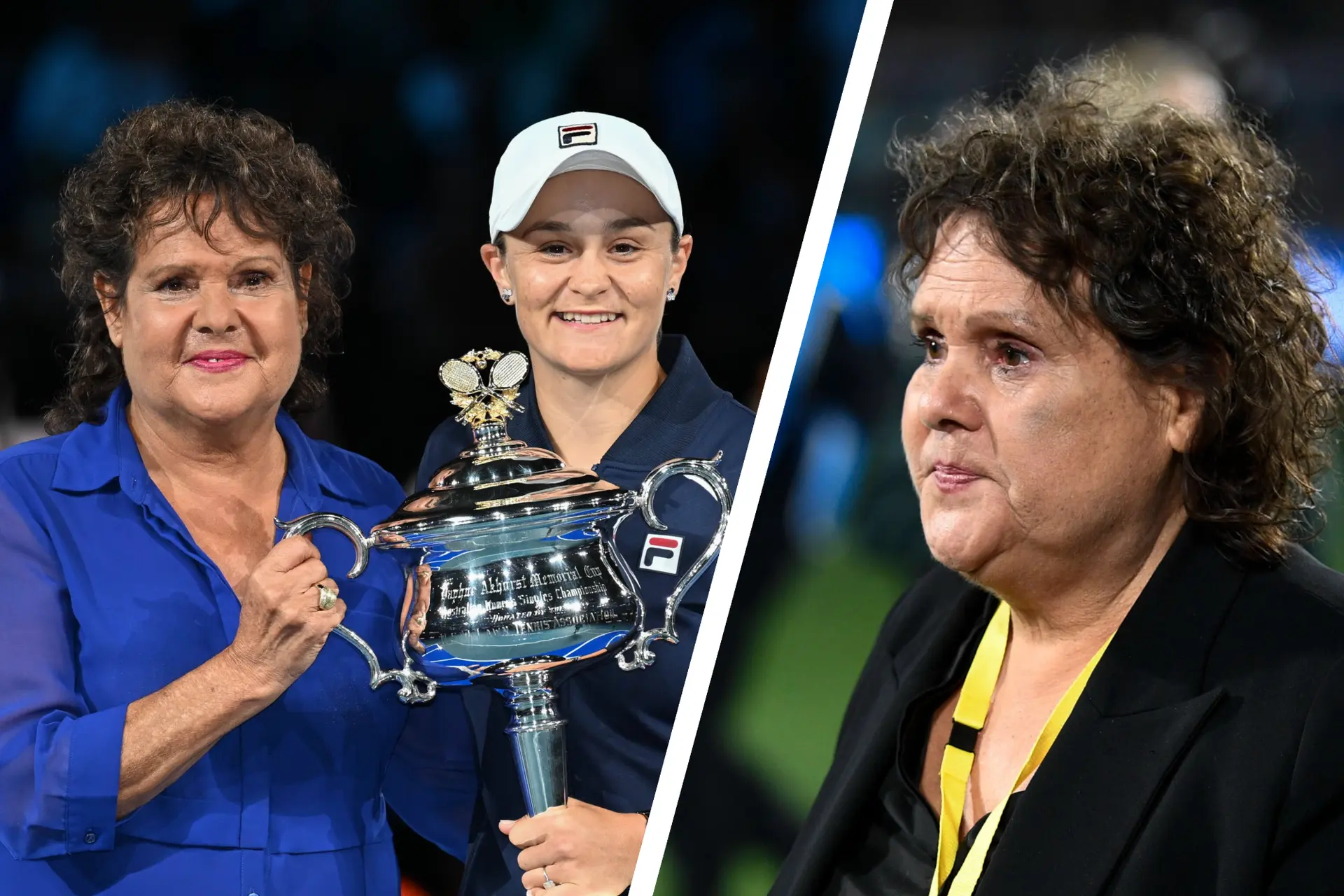
The year 1973 was the last great year of Court's illustrious career, winning three Grand Slams. Her success at the Australian Open was her eleventh victory at her home major, a record that remains to this day. No woman has ever won more editions of a singles Grand Slam than Court's 11 in Australia. She then beat a young Chris Evert to win a fifth and last French Open title. Meanwhile, the victory over Evonne Goolagong in the US Open final was the 24th and last singles major title. This total is a record in the women's game and matched by Novak Djokovic in the men's game.
Her 24 wins came from 29 finals, and Court won just over half the Grand Slam singles events she entered. Court reached at least the quarter-finals in 43 of her 47 Grand Slam appearances.
The last few years of Court's career saw her attendance become a little more sporadic. She won just a further quartet of singles titles until playing her last match in 1977. The pick of these was the 1975 Virginia Slims Championships, now referred to as the WTA Finals.
Court finished with a gargantuan total of 192 singles titles from 234 finals. It's a total unsurpassed in the women's game. She also became the first official world number one when the Women's Tennis Association (WTA) was founded in 1973.
Margaret Court's doubles career was stacked with a litany of success. She managed to win 19 Grand Slam women's doubles titles from 33 finals. Like in singles play, Court was victorious in all the Grand Slams in her career. She won 8 Australian Opens, 5 US Opens, 4 French Opens, and 2 Wimbledon crowns. Much of her doubles glory came in tandem with fellow Australian players, including Evonne Goolagong and Lesley Bowrey. The latter part of her doubles success included the final four majors being won alongside the Brit, Virginia Wade. The two of them won three of the four majors in 1973.
Court enjoyed a smidge of greater success in mixed doubles than the women's discipline. She clinched 21 Grand Slam titles from 25 finals to swell her overall total to a record 62 across the three disciplines. Ten of the mixed doubles titles were won in alliance with compatriot Ken Fletcher, including a calendar year Grand Slam in 1963, followed by the first two of the 1964 season. Court is the only player to win a Grand Slam in both singles and mixed doubles competition.
The Australian is part of a unique club of three to have won what is termed the “boxed set”. This is where a player has won every Grand Slam across singles, doubles and mixed. American greats Darlene Hard and Martina Navratilova are the others in this exclusive trio. Court is also one of six players to achieve a double Career Slam in two separate disciplines. The other five being Serena Williams, Hart, Navratilova, Frank Sedgman, and Roy Emerson. Where Court stands alone is being the only tennis player to own a “double boxed set”, winning all of the four Grand Slams in every discipline at least twice. In honour of her nation, Court was a winning member of four Fed Cup squads. These successes occurred in 1964, 1965, 1968, and 1971.
Accolades, personal life and controversy
On two occasions, Court was awarded ABC Sportsman of the Year in 1963 and 1970. Court has featured in several sporting Hall of Fames. She was inducted into the International Tennis Hall of Fame in 1979. Her induction to the Australian Sports Hall of Fame came in 1985, and thirteen years later, she was upgraded to Legend status.
In 2001, Court was inducted onto the Victorian Honour Roll of Women. The Philippe Chatrier Award was bestowed upon her in 2006.
Having already been given the Officer of the Order of Australia, Court was advanced to the Companion of the Order of Australia. Court grew up in an extremely religious family. Her Catholic upbringing was ingrained in her from an early age, but in the 1970s, she became ensconced in Pentecostalism. She eventually undertook a role as a pastor, establishing Margaret Court Ministries in 1991. The charity has carried out considerable Humanitarian work. She married Barry Court in 1967, and they had four children, all born in the 1970s.
The controversial views of Court have become a greater talking point in the 21st century, particularly in light of the Australian Open organisers naming their second show court after her. A number of people, including fellow greats such as John McEnroe and Martina Navratilova, have called for the court to be renamed. Court has been a long-held opponent of same-sex marriage. She was once on record for repugnant comments endorsing Apartheid South Africa in 1970, “South Africans have this thing better organised than any other country, especially America”. Court has often called for a distinction to be made between her tennis achievements and her societal viewpoints.
One thing is for sure: Court's achievements on the court place her in a pantheon of legends where a case could only be made for three or four other women being ahead of her in any GOAT debate. She straddled eras with her success, almost played out evenly across the amateur period and the Open Era. The usual caveats apply about the amateur era being less competitive; her finest hour, a calendar year Grand Slam, materialised in the Open Era. Factually, though, Court had won more than any woman to wield a racket.
Read also

Margaret Court: Career Titles and Major Achievements
| Category | Achievement | Details |
| Singles Grand Slams | 24 | All-time Record: Australian (11), French (5), US (5), Wimbledon (3) |
| Total Grand Slams | 64 | All-time Record: 24 Singles, 19 Doubles, 21 Mixed Doubles |
| Calendar Grand Slam | 1970 | One of only three women to win all 4 Majors in one year |
| Boxed Set | Achieved | Won all 4 Slams in Singles, Doubles, and Mixed (only player to do it twice) |
| Total Career Titles | 192 | 92 of these achieved during the Open Era |
| Career Win % | 91.69% | Best win-loss record in the history of women's tennis |
| World No. 1 | 7 Years | Ranked No. 1 in 1962-65, 1969-70, and 1973 |
| Fed Cup Titles | 4 | Lead Australia to victory in 1964, 1965, 1968, and 1971 |
Margaret Court: Major Finals and Milestones
| Year | Competition / Tournament | Result | Category |
| 1960 | Australian Chp. | Winner | 1st Grand Slam Singles Title (at age 17) |
| 1962 | French & US Chp. | Winner | 1st woman to win Majors on multiple surfaces in one year |
| 1963 | Wimbledon | Winner | 1st Australian woman to win Wimbledon Singles |
| 1963 | Grand Slam Mixed | Winner | Completed Calendar Year Grand Slam (Mixed Doubles) |
| 1964 | French Chp. | Winner | Completed Career Grand Slam (Singles) |
| 1965 | Grand Slam Mixed | Winner | Completed 2nd Calendar Year Grand Slam (Mixed Doubles) |
| 1969 | US Open | Winner | 1st Open Era Grand Slam Singles Title |
| 1970 | The Grand Slam | Winner | Completed Calendar Year Grand Slam (Singles) |
| 1973 | US Open | Winner | 24th and Final Grand Slam Singles Title |
| 1975 | Wimbledon | Winner | Final Grand Slam title (Mixed Doubles w/ Marty Riessen) |

Jay Brannon is a sports journalist from Sutton Coldfield, England, with a lifelong passion for athletic competition and storytelling. For the past 1.5 years, he has been a prominent voice at TennisUpToDate.com, where he has authored more than 3,000 articles, specializing in deep-dive columns, tactical analyses, liveblogs, and comprehensive match reports for the ATP and WTA tours.
Jay’s tennis reporting blends rigorous, real-time statistical analysis with on-the-ground coverage. He frequently travels to tournaments to cover the action firsthand from the press box and player press conferences. This direct access allows him to deliver sharp insight into player form and tour developments—a dedication sparked by his earliest sporting memory of the iconic 1991 Wimbledon final between Michael Stich and Boris Becker.
Beyond the court, Jay brings a versatile background in live broadcasting and media. His professional experience includes serving as a sports reporter for BHBN Hospital Radio—where he delivered live updates and analysis for West Bromwich Albion and Wolverhampton Wanderers matches—as well as working as a match reporter for Sutton Coldfield Town.
Jay holds a degree in Music Journalism and Broadcasting from Staffordshire University, a foundational training that shaped his voice as a thoughtful, authentic storyteller. Grounded in core journalistic ethics, he places a strict emphasis on careful sourcing, editorial accuracy, and swift, verified updates.
claps 0visitors 0
Just In

Popular News
Latest Comments
- A healthy Qinwen may be hard to stop next season. She was already scaring her opponents before her medical leave(s). Unfortunately, Zheng insisted on singing again. On the positive side -- Mirra did not sing!! ;~}
 mandoist11-10-2026
 - Where is it written that athletes, entertainers... People in general... are mandated to keep looking at -- or even using [anti]Social Media? Public & private figures consistently complain and reveal their concerns about negativity and violence thrown at them -- yet they insist on participating. Avoid it, don't use it, don't read it. It's okay to occasionally look up at the World instead beating your eyes & thumbs to death on The Inventions out there.mandoist11-10-2026
- great articlestennisseserver07-10-2026
- Medvedev was leading Djokovic 7-5, 3-5 when an attempted return..' NO you ignorants, Djokovic was leading .weiss05-10-2026
- No more bullshit "Wildcards" to these two. Qualify like everyone else -- there will be cameras there, too. Time to scream... WTF ????!!!!mandoist29-09-2026
- Let's not BS the general public -- Sabalenka started showing cracks in her game last season. Her losses and near-losses started at about the same time she began being distracted by Fame (constant Selfies, making TV commercials, magazine shoots, endless Social Media nonsense, etc., etc.) One would think even Saba could recognize the parallels with others who failed before her -- Raducanu, Giorgi, Bouchard to name a few.mandoist25-09-2026
- Gross!! Hey Raducanu, Giorgi, and Bouchard -- reserve a seat at your Social Media Selfie table for Saba + Naomi. They're heading in your direction soon enough.mandoist24-09-2026
- And then these same players will complain about how lengthy their season’s were and need more time-off. I’m all for more tennis but the amount of tennis we get now is actually kind of crazy! We all need a break, especially the players.DaveyWavey23-09-2026
- You should do a comparison article for "different kinds of justice" the courts decide for tennis players. I can think of at least three players who received very small bans of a few months, however Tara Moore has been fighting for her literal survival the past few years. It seems odd considering she is not a "name" player, unlike the other cases.DaveyWavey22-09-2026
- PRIZE MONEY & POINTS Winner - $185,500 Finalist - $114,500 Semi-Finalist - $66,003 Quarter-Finalist - $35,000 Round of 16 - $18,045 Round of 32 - $13,005 Winner - 500 Finalist - 325 Semi-Finalist - 195 Quarter-Finalist - 108 Round of 16 - 60 Round of 32 - 1DaveyWavey20-09-2026

Loading